
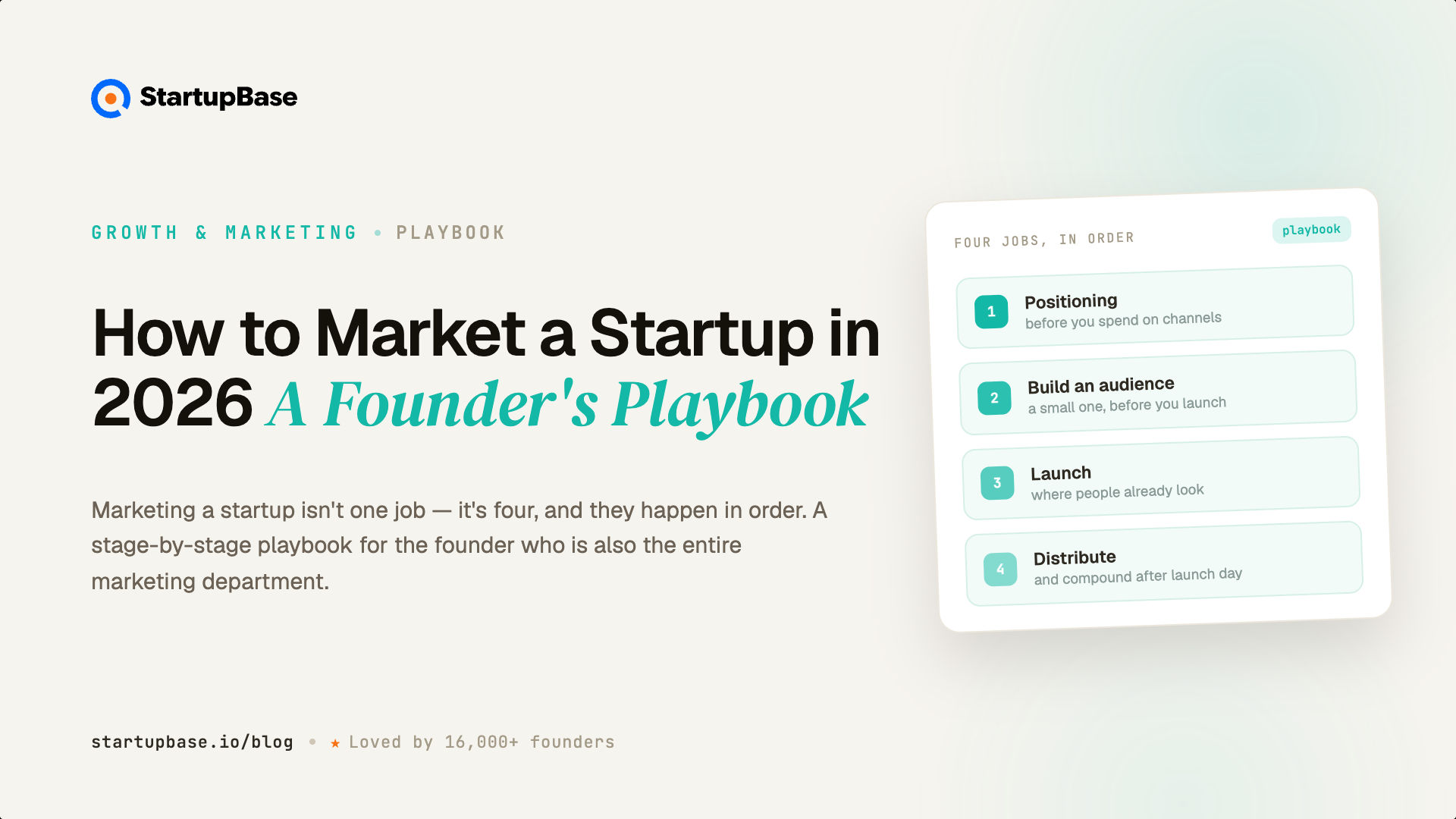
Marketing a startup is four jobs done in order: get the positioning right, build a small audience before launch, launch where people are looking, then distribute and compound after. Most advice skips the sequence and hands you a list of channels. This playbook walks each stage with the one thing that matters, and links to the deep dive for each. Written for the founder who is also the whole marketing team.
Quick Answer
Search how to market a startup and every result hands you the same handful of things: AI personalization, short form video, community, an ICP, a positioning statement, and a few more you have read a dozen times. None of it is wrong, but it was written for a company with a marketing budget and a team to spend it, and it hands you a pile of channels with no order to run them in.
You do not have a team. You are the founder, the product, the support desk, and the entire marketing department, and you have maybe five hours a week for all of it. What you need is not a longer list of tactics. It is a sequence.
Here is the useful version. Marketing a startup is not one job. It is four, and they happen in order: get the positioning right, build a small audience before you launch, launch where people are already looking, then distribute and compound after launch day. Do them out of order and each one fails. This is the startup marketing plan in the order that actually works, and it links to the deep dive at each step so you can go as far as you need.
Why startup marketing has to happen in order
Most marketing advice is a menu. It lists content, ads, SEO, social, email, and community as if they were interchangeable, and lets you pick whichever appeals. That works for a company that can run several at once. It fails a solo founder, because the channels depend on each other and only work in sequence.
Content marketing assumes you know who you are writing for, which is the positioning job. Launching assumes you have a few people who will show up, which is the pre-launch job. SEO assumes a domain with some history, which comes after launch. Run them in the wrong order and you write blog posts for an audience you have not defined, launch to an empty room, and wait months for search traffic that a new domain cannot produce yet.
So before any channel, the question is not "which one." It is "which one now." That answer changes as the startup moves through four stages.
Stage 1: Positioning, before you spend a minute on channels
Everything downstream breaks if this is vague. The single most expensive marketing mistake a founder makes is running channels before knowing who the product is for and what it replaces.
Positioning is two sentences you can say without hedging. Who exactly has this problem, and what are they using instead of you right now. Not "small businesses." A specific person: the solo founder launching an AI tool who needs their first users without paying for ads. When you can name them and name what they use today, you know where to find them, what to say, and which pain to lead with. Everything after this borrows those words.
The test is simple. Show your homepage to someone for five seconds, take it away, and ask what the product does and who it is for. If they cannot say it back, no amount of marketing spend will fix it, because you would be pouring traffic onto a page that does not convert.
This stage costs nothing but honesty, and it is the one founders skip because it does not feel like marketing. It is the only part that makes the rest work.
Stage 2: Build a small audience before you launch
The mistake here is thinking pre-launch marketing means collecting a big waitlist. A waitlist is not traction. Signing up costs a person nothing, so the number tells you almost nothing about demand, and most of that list will never open your launch email.
The real job before launch is smaller and harder: talk to twenty people who actually have the problem, in their own words, and collect a short list of people who genuinely want the thing rather than a long list of people who clicked a button once. Twenty real conversations beat two thousand anonymous signups, because the twenty tell you whether the product is right and become your first users when you ship.
The other pre-launch move is to show up where your buyers already are, so launch day is not you shouting into an empty room. You do not need to build an audience of your own from scratch. You need access to one that exists, which means being useful in the communities your users already live in for a month or two before you need anything from them.
This is the full argument, including what to measure instead of signups and a realistic four to eight week timeline: pre launch marketing: how to build an audience before you launch.
Stage 3: Launch where people are already looking
Launch day is not one announcement. It is a sequence of moments across the places where people go specifically to find new products, plus the audience you spent stage two building.
The reason launch platforms work when a cold social post does not is intent. Someone scrolling a feed is not looking for a new tool. Someone browsing a launch platform is. That is the rarest and most valuable kind of attention a new product can get, and it is why a launch belongs at the center of stage three rather than a tweet that gets buried in an hour.
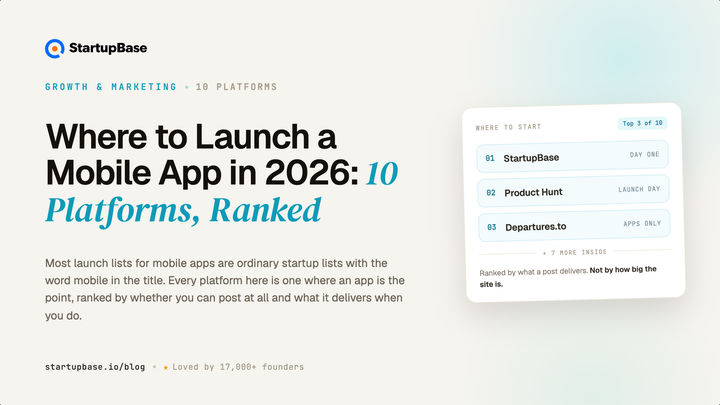
The move most founders get wrong is treating launch as a single day on a single platform. A better launch is a stack: your email list and the one platform with the biggest audience on day one, then a handful more over the following weeks, each done properly. The options are ranked by what each one actually gives you, a spike, early users, a backlink, or lasting discovery, in best places to launch your product, with the biggest names compared in best Product Hunt alternatives and the iOS and Android channels covered separately in where to launch a mobile app.
This is also where StartupBase fits into the sequence, and the reason it fits is that it does not end at stage three. Every approved product gets a real launch spot, and the listing keeps working into stage four through rankings, collections, topic pages, and search, which is the part a one day spike cannot give you. It is the difference between launching once and disappearing, and launching once and staying discoverable.
👉 Submit your product to StartupBase
Stage 4: Distribute and compound after launch day
This is the stage nobody plans for, and it is where startups are actually built. Launch day ends, the traffic spike fades, and now you need real users on an ordinary Tuesday with no event to rally around.
The work splits into two tracks that run at the same time. The fast track is direct: talk to people who have the problem, one message at a time, and turn launch attention into your first hundred users through manual effort that does not scale. The slow track is compounding: content aimed at what your buyers actually search, a few good directory listings, an email list you own, and a reputation in the communities you joined in stage two. The fast track keeps you alive while the slow track warms up.
Three deep dives cover this stage, because it is the largest one:
- Getting the first users out of a launch, by hand: how to get your first 100 users after launch.
- Doing all of it on no budget, and which free channels actually compound: how to market a startup with no money.
- Getting search and referral traffic to the site once you are past launch: how to get traffic to your startup website.
The founders who win this stage are the ones who treat distribution as a habit, not an event. They relaunch when they ship something real, they keep showing up in the same two communities, and they let the slow channels compound instead of quitting them at week three when nothing has happened yet.
The channel question, answered by stage
Now the menu makes sense, because each channel has a stage where it belongs.
| Channel | When it works | Why |
|---|---|---|
| Customer conversations | Stage 1 to 2 | The only way to get positioning and first users right |
| Communities | Stage 2 onward | Presence built early pays off at launch and after |
| Launch platforms (StartupBase, Product Hunt) | Stage 3 | Intent based attention, the rarest kind for a new product |
| Direct outreach | Stage 3 to 4 | Unscalable and the single most reliable source of early users |
| Content and SEO | Stage 4 | Needs a domain with some history to work at all |
| Directories | Stage 4 | Small permanent surfaces, best once you know your category |
| Email list | Stage 2 onward | The only audience you own, start collecting early |
| Paid ads | After stage 4 | Amplify a funnel that already converts, never create one |
The lesson in the table is the last row. Ads come last, not first, because they multiply whatever your page already does. If the page does not convert, ads buy you expensive proof of that. Get the first four stages working for free, then consider paying to go faster.
Which communities, and how to use them
One channel runs through every stage after the first, so it deserves its own note: communities. They are where you validate in stage two, where launch attention comes from in stage three, and where reputation compounds in stage four.
The catch is that most communities remove product posts on sight, and the ones that allow promotion each have their own rule. Dropping a link in the wrong room gets you removed and teaches you nothing. The reliable approach is to be useful first and mention your product second, and to know before you post which rooms allow what. We mapped sixteen of them, with the honest self promotion rule for each, in best communities for founders.
A note for SaaS specifically
If you sell software to businesses, stage four looks a little different, because SaaS gets bought differently than it gets launched. The launch crowd is makers and early adopters, but your paying buyer usually shows up months later, comparing tools with intent, reading reviews before they ever contact you.
That means the compounding track for SaaS leans harder on review presence and comparison pages, the places buyers go when they are close to a decision. The full version, including why reviews are the one asset a competitor cannot copy, is in best places to promote and launch your SaaS.
FAQ
What is the best way to market a startup with no budget?
Run the four stages in order using only free channels: get positioning right, talk to twenty real people before launch, launch where people are already looking, then distribute through content, communities, and direct outreach. Free is not free, you pay in time, so pick two channels you can sustain rather than ten you cannot. The full plan is in how to market a startup with no money.
How do startups get their first customers?
Almost always through manual, unscalable work: direct conversations with people who have the problem, a launch on platforms where people look for new products, and being useful in the communities those people already use. Viral moments are not a strategy because you cannot repeat them on purpose.
How long does startup marketing take to work?
Direct outreach and launches produce results in days. Content, SEO, and community reputation take three to six months to compound. That gap is why you run the fast channels and the slow channels at the same time, rather than waiting for one before starting the other.
Do I need to be on every social platform?
No. Pick the one platform where your buyers already are and be genuinely present there. Five accounts updated occasionally do less than one where you actually show up. The platform choice comes out of your stage one positioning: you go where the specific person you defined already spends time.
When should a startup start paying for ads?
After the first four stages are working and the page converts organic traffic. Ads amplify a funnel that already works, they do not create one. Paying to send traffic to a page that does not convert buys you an expensive lesson you could have learned for free.
Final thoughts
Marketing a startup feels overwhelming because the advice treats it as one enormous job with a hundred tactics. It is not. It is four jobs, done in order, and at any given moment only one of them is your job.
Get the positioning right so everything downstream has something true to say. Build a small real audience before you launch so launch day is not silent. Launch where people are already looking. Then distribute and compound, patiently, until the market starts to notice.
You do not need a bigger budget or a marketing team. You need to know which stage you are in, and do that one thing well.
Ready to launch?
Startup Marketing
Startup Growth
Distribution
Founder Marketing







 Continue with Google