
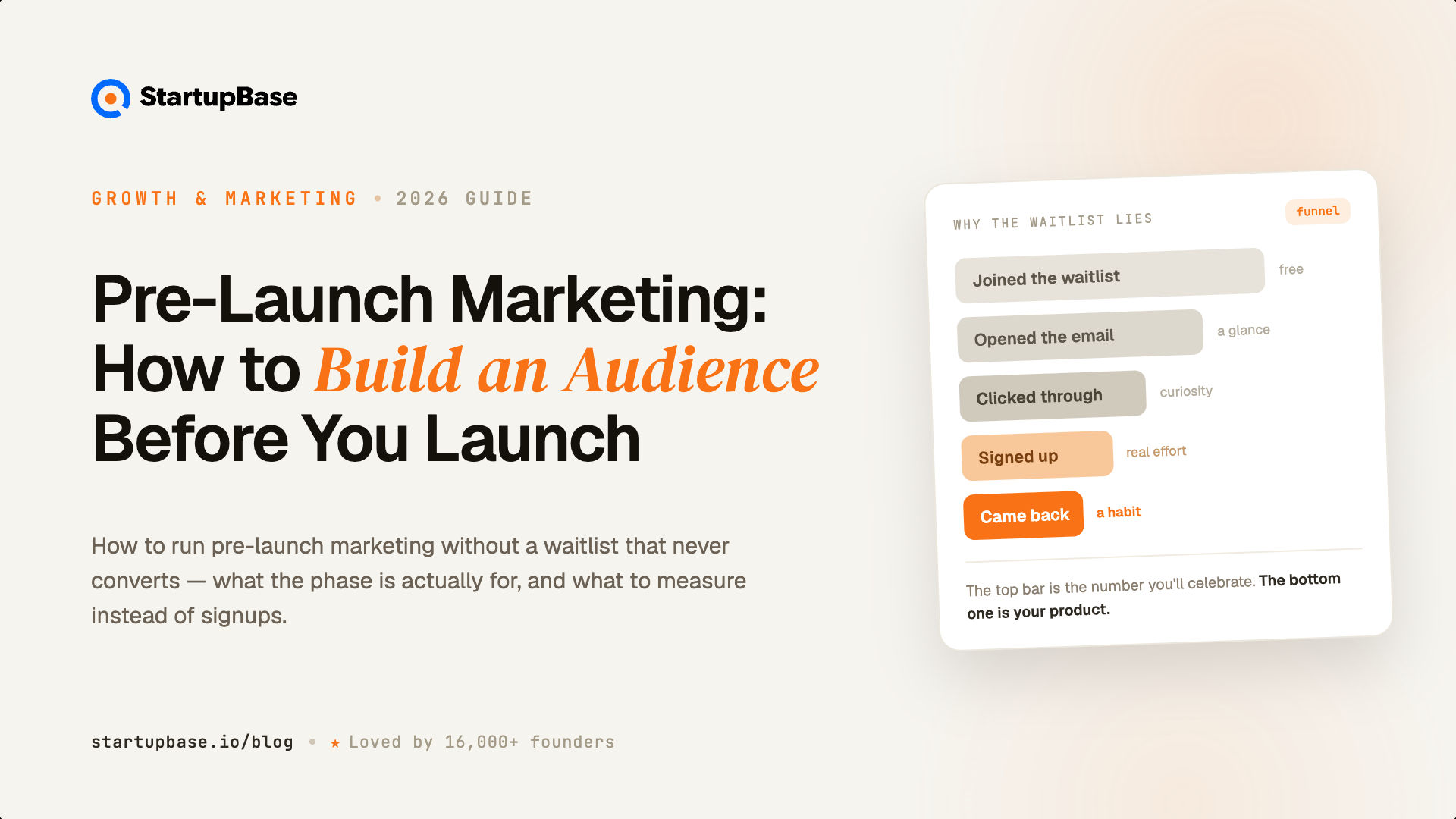
Pre launch marketing is not about hype. It has three jobs: find out whether anyone wants this, collect a small number of people who genuinely do, and make launch day something other than shouting into an empty room. A big waitlist is not traction, because signing up costs nothing and most of that list will never open your launch email. Measure conversations and replies instead of signups, spend four to eight weeks on it, then launch.
Quick Answer
Read enough pre launch marketing advice and you will notice something.
The company telling you to build a waitlist sells waitlist software. The company telling you to run a referral campaign sells referral software. The one recommending an interactive demo sells interactive demos. Everyone recommends the tactic they happen to charge for, and every list is titled something like "30 strategies to build hype."
So here is ours, up front: StartupBase is a launch platform, and our advice bends toward launching sooner. What we are not selling you is a waitlist, a referral loop, or three months of hype before you have spoken to a single user.
Which brings us to the thing most of those posts skip.
A waitlist is not traction
Two thousand people on a waitlist feels like proof. It is not.
Signing up for a waitlist costs a person nothing. No money, no time, no commitment, no risk. They were curious for eleven seconds. That is all a signup proves.
Then launch day arrives, you email the list, and most of it does not open. Of the ones who open, a fraction click. Of the ones who click, a fraction sign up. Of those, a fraction ever come back. Founders describe this moment as a betrayal, but nothing was betrayed. The number was always soft.
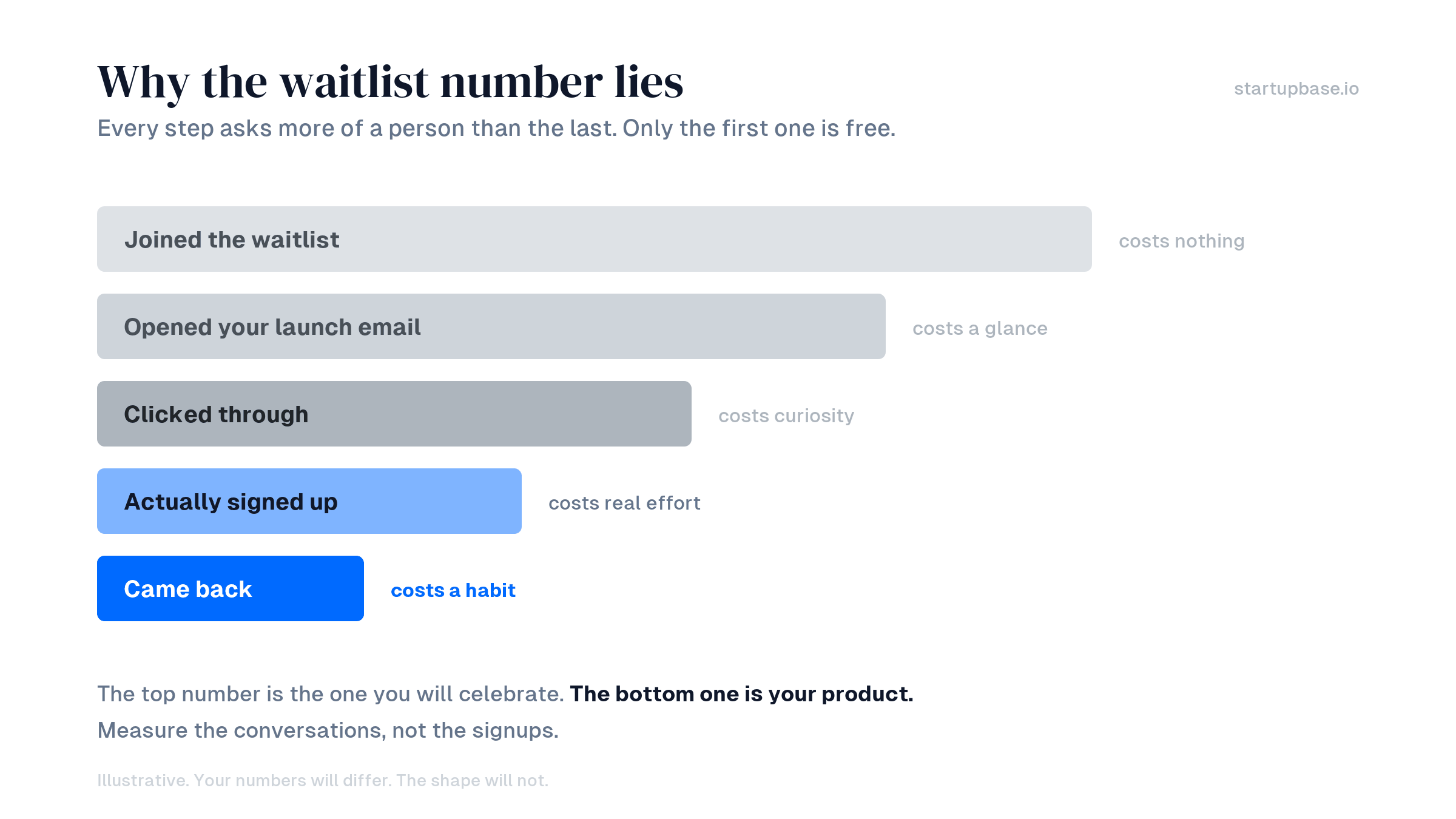
This is why the waitlist advice is so popular and so useless. It produces a metric that goes up, feels like progress, and predicts almost nothing.
The list is not worthless. It is just not proof, and treating it as proof is how founders spend three months building hype for something nobody asked for.
What pre launch marketing is actually for
Three jobs. That is the whole thing.
1. Find out whether anyone wants this. Before you finish building. This is the only one that can save you from months of wasted work, and it is the one the hype advice ignores completely.
2. Collect a small number of people who genuinely want it. Not the biggest list. The realest one. Twenty people who described the problem to you in their own words are worth more than two thousand who clicked a button.
3. Make launch day something other than shouting into an empty room. So that when you do launch, somebody is already listening.
Notice what is not on that list: buzz, hype, virality, or a countdown timer. Those are outcomes that occasionally happen to products people already wanted. They are not a strategy.
What actually works before you launch
1. Talk to people who have the problem
The highest signal activity available to you, and the one founders avoid because it is uncomfortable and does not scale.
Find twenty people who have the problem. Not twenty people in your target market: twenty people who have actually complained about it in the last month. They are in subreddits, in Slack groups, in replies to competitors, in support forums. Ask them what they do about it now. Ask what they tried and why it failed.
You are not pitching. You are checking whether the problem you imagined is the problem they have. It usually is not, quite, and finding that out before launch is worth more than every other tactic on this page combined.
What you get: the words your buyers actually use, which becomes your landing page copy. And your first users, because people who described the problem to you tend to try the fix.
2. Build in public
Share the process while you build. The bug that took two days, the pricing you got wrong, the feature nobody used, real numbers including bad ones.
This works pre launch because an audience built during the build persists to launch day. By the time you ship, people have been watching for weeks and feel some investment in whether it works.
The honest caveat: it takes months, not days, and it does not work for everyone. If you find it exhausting or performative, it will read that way, and a small honest presence in one community will do more than forced daily posting on a platform you hate.
3. A landing page that says one clear thing
Not a countdown. Not a hype video. One sentence that says what it does and who it is for, then a way to hear more.
The test: show it to someone for five seconds, take it away, and ask what the product does. If they cannot say it back, the page is not ready, and no amount of pre launch promotion will fix that.
Collect emails, but expect little from them. The list is a way to reach people on launch day, not a scoreboard.
4. Show up where your users already are
You do not need an audience of your own. You need access to one that exists.
This is the part the "build 2,000 followers before launching" advice gets wrong. Most founders will not build 2,000 followers, and they do not need to. There is already a subreddit, a Discord, a Slack group, or a newsletter where your users are. Being useful there for two months is faster than building a following from zero, and it is available to everyone.
Answer questions. Do not link anything. Become a person people recognize. When you launch, that is a recommendation instead of an ad.
5. Get in front of early adopters who actually try things
This is where most pre launch advice has it backwards. You do not need a crowd of strangers on a waitlist. You need a small number of people who will open the thing, use it, and tell you what is broken.
If you have something people can try, even a rough version, you do not need to sit in pre launch at all. Launching is free. Every approved product gets a real launch spot, so there is no editorial lottery and no queue to wait out. And you get back the thing a waitlist can never give you: reviews, comments, and real reactions from people who came looking for new products. That is a far more honest read on demand than a signup count, and the listing keeps working afterwards instead of expiring at midnight.
BetaList is another option for getting an early product in front of early adopters, and Product Hunt runs upcoming pages if you want something up before you are live. Worth knowing what BetaList costs you: it is curated, so you may not get in and they will not tell you why, and even once accepted it typically takes about two months to be featured, once. Submit early rather than the week before you launch. We compared it with everything else in the best BetaList alternatives.
The trap is treating that wait as the work. If there is something people can try and you are still building a waitlist, that is not pre launch marketing. That is procrastinating.
6. Email the list like a person
If you are collecting emails, send something occasionally. Not a newsletter. A short note about what you built this month, what broke, what you learned.
This is the difference between a list that opens your launch email and a list that forgot who you are. Most founders collect emails for four months, say nothing, then send one launch blast to strangers and wonder why it flopped.
What to measure instead of signups
Signups are the easiest number to grow and the least informative. Watch these instead.
- Conversations. How many people described the problem to you, unprompted, in their own words? That is the number that predicts whether this works.
- Replies. When you email your list, does anyone answer? A list of two hundred with ten repliers beats a list of two thousand with none.
- Unprompted interest. Did anyone ask when it launches without you bringing it up? Did anyone offer to pay before it exists?
- Specificity. Are people describing your exact use case back to you, or are they being polite? "Sounds cool, good luck" is a no with extra steps.
If those numbers are near zero after a month, more pre launch promotion will not help you. The problem is upstream.
A realistic pre launch timeline
Four to eight weeks. Not six months. The pre launch phase has a way of expanding to fill whatever time you give it, mostly because it is more comfortable than launching.
Weeks one and two. Talk to twenty people who have the problem. Nothing else. No landing page, no logo, no waitlist.
Weeks three and four. Put up a landing page using the words those people used. Start collecting emails. Start showing up in the one community where they live. Begin building in public if that suits you.
Weeks five and six. Submit to BetaList and Product Hunt upcoming, since those queues are slow. Keep the conversations going. Email your list once and see who answers.
Weeks seven and eight. Prepare your launch assets: the one line description, screenshots, a demo, and your first comment. Email the list to tell them the date. Then launch.
If you have shipped something usable and talked to twenty people, you are ready. The rest is you avoiding launch day.
When to stop and just launch
Most pre launch phases end because the founder finally runs out of excuses, not because the product got ready.
You are allowed to launch before it is perfect. The first launch gives you data you cannot get any other way, and you can relaunch. That is not a consolation prize: relaunching when you ship something real is how products keep earning attention. What you cannot get back is the three months you spent polishing a page for an audience that was never coming.
Launch when the thing works for one real use case and twenty people told you they want it. That is the bar.
Then launch properly
Pre launch gets you a warm room. Launch is what you do with it.
That means a launch day people can show up to, and a listing that keeps working afterwards, because the pre launch list will not carry you past week one. If you want the full sequence, see how to launch on StartupBase and our map of 100+ places to launch, relaunch, and list your product.
And when launch day is done and you need actual users, that is a different job: how to get your first 100 users after launching. For keeping it going on no budget, see how to market a startup with no money. And if you want to see where pre launch sits in the wider sequence, it is stage two of four in how to market a startup.
FAQ
What is pre launch marketing?
Everything you do to find users and validate demand before your product is publicly available. Done well it has three jobs: check whether anyone wants this, collect a small number of people who genuinely do, and make sure launch day is not silent. Done badly it is a waitlist nobody opens.
How long should the pre launch phase last?
Four to eight weeks for most software products. Longer than that and you are usually avoiding launch rather than preparing for it. The queue at curated platforms like BetaList is the main reason to start on the earlier side.
Do I need a waitlist before launching?
It helps, but it proves nothing. Signing up costs a person nothing, so the number tells you very little about demand. Collect emails so you can reach people on launch day, then judge the list by who replies, not by how big it is.
How many people do I need before launching?
There is no threshold. Twenty people who described the problem in their own words is a better position than two thousand anonymous signups. If you are waiting for a follower count before you launch, you are waiting for the wrong thing.
Where can I promote a product before it launches?
Product Hunt runs upcoming pages, and BetaList takes early stage products, though it is curated and typically takes about two months. If you have something people can actually use, skip the waiting: launching free on StartupBase gets you early adopters, reviews, and comments now, and the listing keeps working afterwards. Beyond that, the communities where your users already are will do more than any pre launch platform.
Should I build in public before launching?
If it suits you, yes, because the audience persists to launch day. But it takes months and it does not work for everyone. If it feels performative, being genuinely useful in one community is a better use of the same hours.
Final thoughts
Most pre launch advice is written by companies selling the tactic, and it optimizes for a number that feels good and predicts nothing.
The honest version is smaller and harder. Talk to people who have the problem. Write down the words they use. Collect a short list of people who actually want it and keep them warm. Show up where your users already are instead of trying to summon an audience from nothing.
Then launch, before you feel ready, because the launch is where you find out.
Launching something new?
Startup Launch
Startup Growth
Pre Launch Marketing
Audience Building







 Continue with Google