
The best places to launch your product in 2026 are not the longest list, they are the few that give you something real: a launch spike, early users, a backlink, or ongoing discovery. Start with a tight stack of Product Hunt, StartupBase, and the one or two channels that fit your product, then add a handful more over the following weeks. Submitting to a hundred low quality directories dilutes your time and your backlink profile. Pick platforms by what you get back, not by how many you can list.
Quick Answer
Launching a product once is rarely enough.
Most founders imagine launch day as one big moment: you publish the site, post on Product Hunt, share the link on X, email your list, watch the traffic spike, and hope something sticks.
Sometimes that works. More often, the spike fades.
The usual fix is volume: submit to a hundred directories and hope one of them lands. But most of those hundred places send no traffic, have no audience, and pass no link value. Submitting to all of them is not a launch strategy, it is busywork that dilutes your time and your backlink profile.
So this guide ranks launch places by the only thing that matters: what you actually get back. A launch day spike, early users, a backlink, or ongoing discovery. A few channels give you several. Most give you nothing. Start with the few, add a handful more over time, and skip the rest.
It starts with the stack that works.
What you actually get from a launch
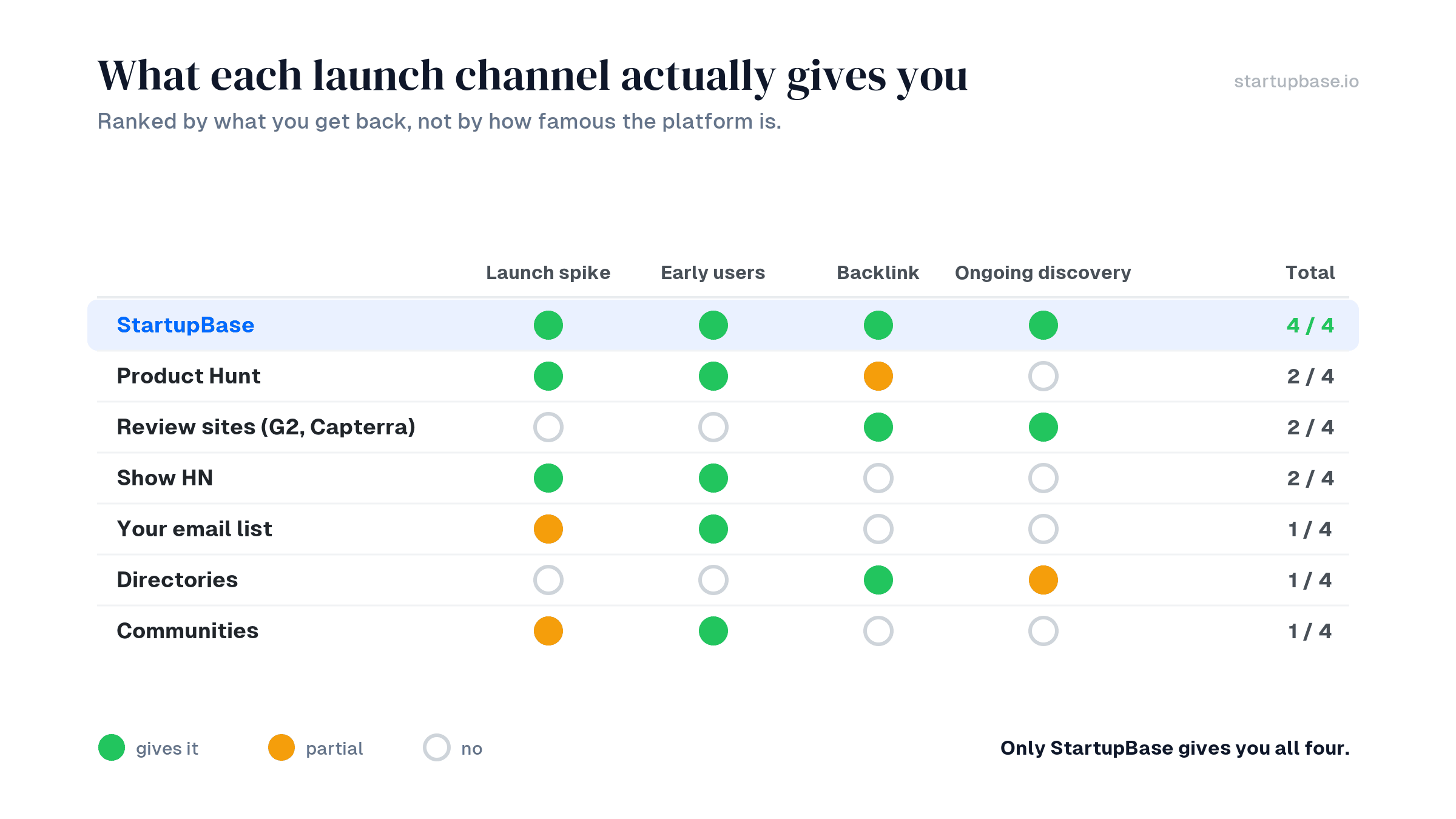
Before any list, get the frame right. Every launch channel gives you some mix of four things, and most give you far fewer than their pitch suggests.
- A launch day spike. A burst of traffic and attention on one day. Real, but it fades fast.
- Early users and feedback. Signups, comments, and the first people who tell you what is broken.
- A backlink. A link from the platform to your site, which helps SEO if the platform has authority and the link is dofollow.
- Ongoing discovery. The listing keeps sending traffic weeks and months later, through search, rankings, and category pages. This is the rarest and most valuable one.
Judge every platform below by which of these it actually delivers, not by how well known it is. A famous platform that only gives you a one day spike is worth less to a bootstrapped founder than an unglamorous one whose listing keeps working for a year.
The launch stack: pick a few, not a hundred
Here is the shape of a real launch. A tight first tier you start with, a second tier you add over the following weeks, and a long tail that is mostly optional.
The mistake almost every founder makes is inverting this: they spend launch week submitting to sixty directories and never build momentum anywhere. Do the opposite. Go deep on three or four places, then expand only as you have the time to do each one properly.
Tier 1: start here
These are the highest leverage places for almost any product. If you only do four things, do these.
Product Hunt
What you get: the biggest launch day spike anywhere, plus early users and social proof.
Product Hunt still has the largest single day tech audience. If you can rally a network, nothing beats it for a concentrated burst of attention. But it is a 24 hour sprint that rewards founders who already have an audience, and the spike fades by the next morning. Treat it as the moment, not the strategy. See Product Hunt vs StartupBase.
StartupBase
We put StartupBase here because it is the rare channel that gives you all four outcomes, not just the spike.
What you get: a launch spike, early users, a DR 72 dofollow backlink on the $39 plan, and ongoing discovery that keeps working after launch day.
Product Hunt gives you the day. StartupBase gives you the day plus the tail. Every approved product gets a real launch spot, and the listing keeps surfacing through daily launches, weekly and monthly rankings, collections, topic pages, reviews, and the newsletter. That ongoing discovery is the outcome most launch platforms simply do not have. Here is how to launch on StartupBase.
👉 Submit your product to StartupBase
Your own email list
What you get: the highest converting early users you will ever have.
The people who already asked to hear from you convert better than any external platform. If you have been collecting emails before launch, this is where you start on launch day. If you have not, start now, even a bare landing page. More on this in pre launch marketing.
The one channel that fits your product
What you get: depends on the product, but this is where product market fit of the channel matters most.
For technical products and developer tools, that is Show HN on Hacker News: a huge, sharp audience that is allergic to marketing copy but rewards genuinely useful tools. For AI tools, it is the big AI directories. For B2B SaaS, it is your G2 and Capterra profiles. Pick the one that matches what you built.
Tier 2: add over the following weeks
Once your Tier 1 launch is done, expand into these one at a time. None of them will carry a launch alone, but together they widen your surface area and add ongoing discovery.
Launch platforms
- Uneed: a clean maker launch with a newsletter and rolling leaderboards. Compare it in the best Uneed alternatives.
- Fazier: a simple, credible discovery listing for SaaS, AI, and indie tools.
- Peerlist: a builder network with an active launch section, strong for developer and design led products.
- BetaList: for products still collecting early users pre launch. Curated and slow, so submit early. See the best BetaList alternatives.
- MicroLaunch, TinyLaunch, Launching Next: smaller launch surfaces worth an extra listing once the big ones are done.
AI directories, if you built an AI tool
If your product is AI, dedicated AI directories send higher intent traffic than general launch platforms. There is a real ecosystem here, and a lot of noise. We sorted it in the best AI directories to submit your AI tool.
Developer channels, if you built a dev tool
Show HN, DevHunt, Dev.to, and StackShare reach engineers deciding what to adopt. For the full breakdown, see the best DevHunt alternatives.
Communities
Communities are where you get honest feedback and your first real users, but only if you show up like a builder, not a billboard.
- Indie Hackers: share a lesson, a number, or a milestone, not a link drop.
- Reddit: r/SaaS, r/startups, r/SideProject, and niche subreddits for your category. Read the rules first.
- Hacker News: beyond Show HN, useful build stories can land.
The best community posts sound like a person: "I built this because I kept hitting this problem," or "I launched and here are the numbers," or "here is the mistake I made." A polished announcement gets ignored.
Tier 3: the long tail (mostly optional)
Here is where most lists pad their numbers. These directories can help with SEO, branded search, and long tail discovery, and a user may find you here six months later while searching for alternatives. But the returns drop off fast, and submitting to all of them is exactly the busywork this guide warns against. Pick the few that fit your product type and skip the rest.
Software directories and review sites (strongest for SaaS and B2B):
- G2 and Capterra: the biggest B2B review sites, now under one company. Reviews are the moat here, and buyers research them before they ever contact you. More in best places to promote and launch your SaaS.
- GetApp, SaaSWorthy, SoftwareSuggest: additional software comparison listings.
- SaaSHub: a software directory and alternatives site. See the best SaaSHub alternatives.
- AlternativeTo: captures "alternative to" search traffic if you compete with a known tool.
- StackShare: for developer tools and infrastructure.
- SourceForge: a high authority directory for open source and developer software.
Startup directories (broader reach, lower intent):
- Crunchbase and Wellfound: company profiles that help credibility and branded search.
- F6S: accelerators, grants, and startup programs.
- Startup Stash, Startup Ranking, Postmake, Awesome Indie: curated resource directories worth the few minutes.
For the honest take on whether these help your rankings at all, read do startup directories help SEO. The short version: a focused listing on a few trusted directories helps, and bulk submitting to a hundred does almost nothing.
App marketplaces (if you live inside another ecosystem)
If your product belongs inside another platform, the marketplace listing is often worth more than any startup directory, because the users arrive with real intent to solve a specific problem.
- Chrome extension: Chrome Web Store
- Shopify app: Shopify App Store
- Slack app: Slack App Directory
- WordPress plugin: WordPress Plugin Directory
- Figma resource: Figma Community
- Developer tool: GitHub Marketplace
- Workspace add on: Google Workspace Marketplace
- Mobile app: Apple App Store and Google Play, plus the ten discovery channels in where to launch a mobile app
Treat these as real acquisition channels: proper screenshots, the right keywords, and reviews, not a one line entry.
Press, only when you have a story
Press is powerful, but "new SaaS tool launches" is not a story. Editors want an angle: a solo founder reaching a real revenue milestone, a tool that saves a specific audience real hours, an open source answer to overpriced enterprise software.
If you have that angle, segment your list rather than blasting the same email. Developer publications want technical depth. Startup publications want traction or a founder story. Business publications want market impact. Targets worth researching include TechCrunch, VentureBeat, The Verge, Fast Company, Inc., and the regional startup press that fits your market.
Without a real angle, your launch time is better spent on the tiers above.
Which places for your kind of product
The right stack depends on what you built.
| Product type | Start with (Tier 1 to 2) | Long tail that fits |
|---|---|---|
| SaaS | Product Hunt, StartupBase, your list, Uneed, Fazier | G2, Capterra, SaaSHub, AlternativeTo |
| AI tool | Product Hunt, StartupBase, AI directories, Fazier | There's An AI For That, Futurepedia, Toolify |
| Developer tool | StartupBase, Show HN, DevHunt, Dev.to | StackShare, AlternativeTo, GitHub Marketplace |
| Mobile app | Product Hunt, StartupBase, App Store, Google Play | AppAdvice, MakeUseOf, TechRadar |
| Ecommerce app | Product Hunt, StartupBase, Shopify App Store | G2, Capterra, GetApp |
| Open source | Show HN, GitHub, Hacker News, StartupBase | Dev.to, Reddit, SourceForge |
Pick your row. Do the first column well. Add the second only as you have capacity.
Why relaunching beats finding new places
Once you have worked your stack, the highest leverage move is not finding a hundred more directories. It is relaunching.
Your first launch is always imperfect. The positioning is too broad, the page sells features instead of outcomes, you do not yet know which audience cares most. The first launch gives you the data. The relaunch lets you use it.
Relaunch when you have a real reason for people to look again: a major update, a new AI feature, a free plan, a pricing change, a strong case study, or a meaningful milestone. A relaunch should not say "we still exist." It should say "here is what changed, and why it matters." Most platforms in this guide, StartupBase included, let you relaunch, and a good relaunch to a warmer audience often outperforms the original.
Before you submit anywhere
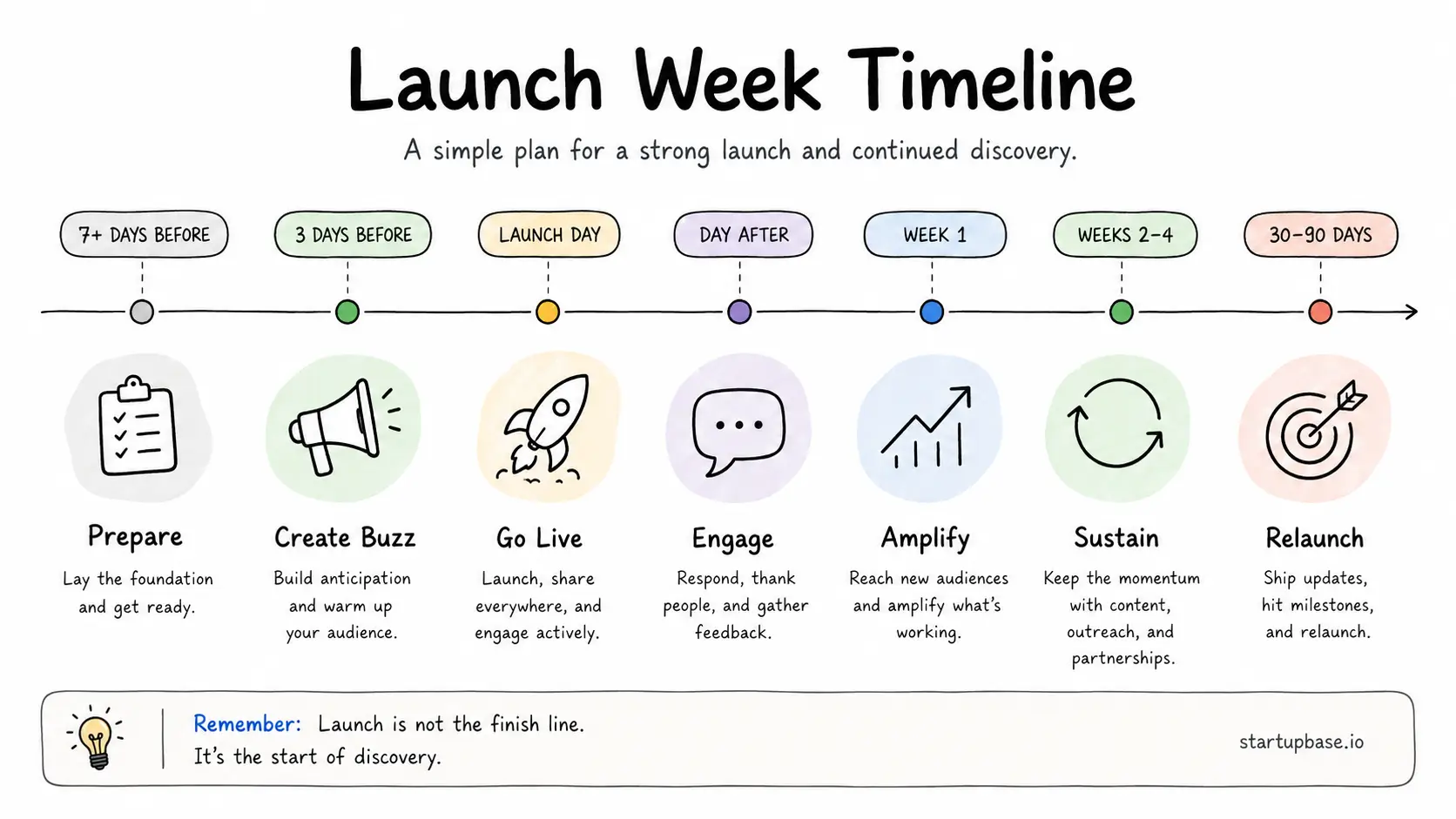
Prepare your assets once and reuse them everywhere, so each submission takes twenty minutes instead of two hours.
You need a sharp one line description, a short and long version, a logo, three to five screenshots that show the product in use, a demo video or GIF, pricing, a launch offer if you have one, a first comment, and UTM tracked links so you can measure which channel actually sends signups.
Lead with the problem, not the feature list. "An AI powered dashboard with integrations" says nothing. "Track every customer conversation and product request in one place so your team knows what to build next" says everything. Clarity is what every platform on this list rewards.
A simple launch week plan
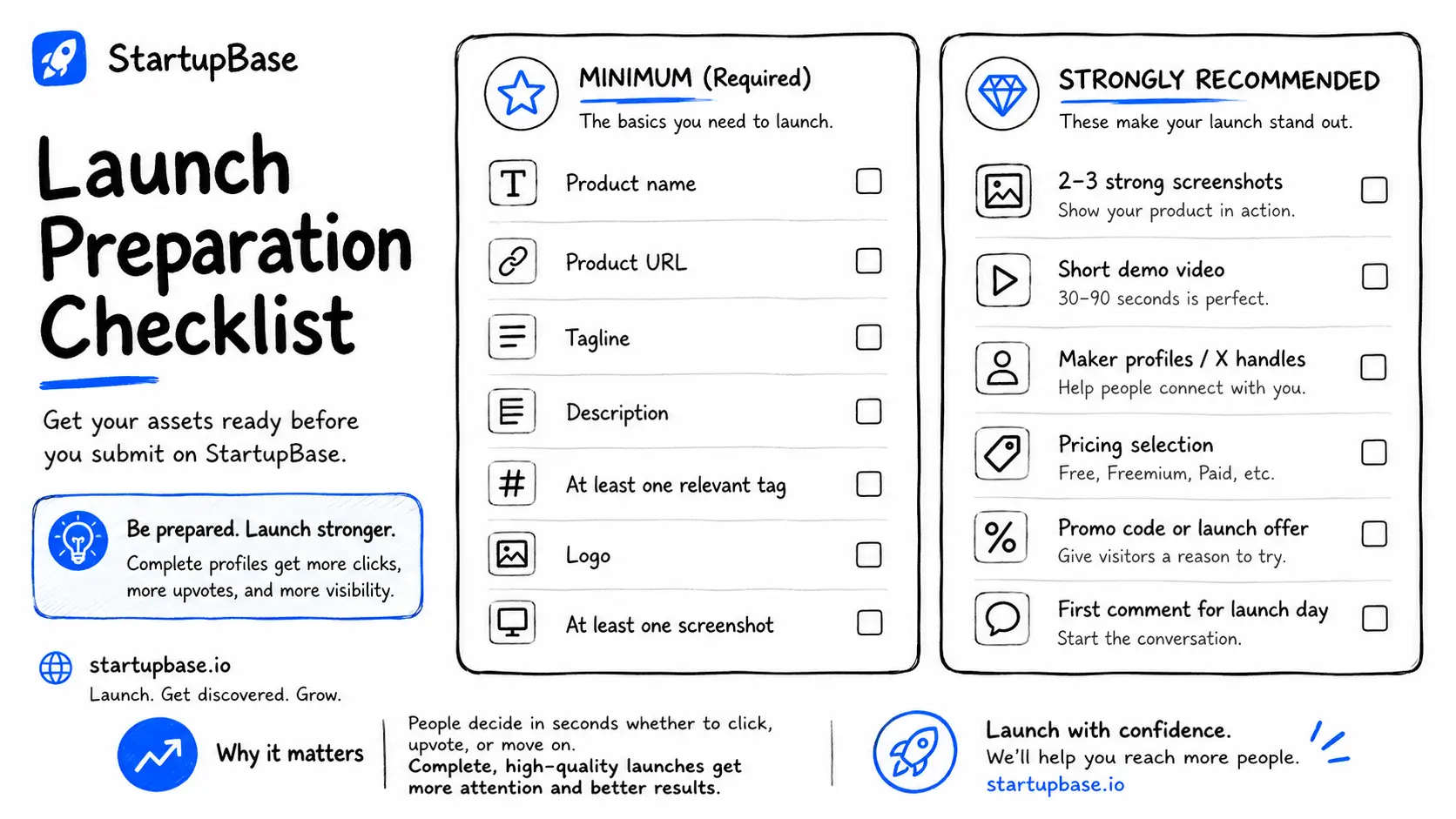
Seven days out: finalize positioning, screenshots, demo, launch copy, and your first comment.
Three days out: warm up your network. Do not ask for blind upvotes. Tell people what you are launching, who it is for, and why it matters.
Launch day: focus on Product Hunt and your email list. Reply to every comment. Thank people. Collect the objections and questions, they are your next round of copy.
The day after: submit to StartupBase, so your product gets a second discovery moment while momentum is fresh and a listing that keeps working after the spike.
The rest of the week: add the Tier 2 channels that fit, one properly done at a time.
Over the next month: work the long tail that fits your product, and plan your relaunch.
FAQ
What are the best places to launch a product in 2026?
Start with Product Hunt for the spike, StartupBase for the spike plus ongoing discovery, and your own email list for your best early users. Then add the one channel that fits your product, whether that is Show HN, AI directories, or your G2 and Capterra profiles. A tight stack beats a long list.
Should I submit my product to 100 directories?
No. Submitting to a hundred low authority directories dilutes your time and does little for SEO. Pick the few that fit your product type, do each one properly, and add more only as you have capacity. Quality and fit beat quantity every time.
Where should I launch after Product Hunt?
StartupBase is built for exactly that: it gives your product a second discovery moment and a listing that keeps working after the Product Hunt spike fades. From there, add the Tier 2 platforms and directories that fit what you built.
Do launch directories help SEO?
The good ones help through referral traffic, indexed pages, and dofollow backlinks. Bulk submitting to low quality directories does almost nothing and can dilute your backlink profile. See do startup directories help SEO.
How many places should I launch on?
Three or four in launch week, one or two more per quarter after that. Depth beats breadth. It is better to do five platforms well than fifty badly.
Final thoughts
A launch is not a lottery ticket, and it is not a checklist of a hundred directories either. It is a system: a tight stack of places that actually give you something, worked properly, then expanded over time and relaunched when you have a reason.
Product Hunt gives you the spike. StartupBase gives you the spike and the tail. Your list gives you your best users. Everything else is a smaller bet you place only when the big ones are done.
Rank by what you get back, not by how many you can list.
Launching something new?
Startup Marketing
Product Launch
Startup Directories







 Continue with Google