
Most new product pages now read the same, because the same models wrote them and hedged into a category description any competitor could publish. Use the swap test to find out: put a competitor's name on your headline, and if it is still true you have not written a headline. A startup landing page has one job, which is to answer "is this for me" in about five seconds. Lead with a specific person and a specific outcome, use AI for structure rather than final copy, and test on five real humans instead of waiting for traffic you do not have.
Quick Answer
Three hundred and six products launched on StartupBase in July, and every one of them arrived with a link to its landing page. Read individually, almost all of them are fine: clean layouts, sensible sections, no typos, sentences that parse. Read three hundred of them in a row and something uncomfortable starts happening.
You begin finishing their sentences.
Not because the pages are bad. Because they are the same. A striking number describe completely different products in what is unmistakably the same voice:
X provides a platform designed to simplify the [category] process. Users can [verb] through automated tools that streamline [noun] workflows.
Y is an AI-powered platform that provides structured [category]. By connecting your data, the system generates a comprehensive analysis.
Different founders, different products, different markets. Same sentence shape, same hedged register, same absence of anything a competitor could not also claim.
You know why. So does everyone else scrolling past.
The problem is not that AI wrote it. It is what AI writes by default.
To be clear, this is not an argument against using AI to build your page. We use it. Almost everyone does now, and pretending otherwise is theatre.
The problem is what you get when you accept the first draft.
Ask a model to write a landing page for your product and it will produce something reasonable, structured, and utterly average, because average is what it is built to give you. It has read millions of landing pages and returns the centre of that distribution. The result reads like the category rather than like your product, and it hedges: broad enough to be defensible, vague enough to be useless.
That was survivable when it was expensive to produce a decent page. It is not survivable now, because your competitors have the same model and are accepting the same first draft. When everyone's page is competently average, competent average stops being a floor and becomes camouflage.
There is a second failure that comes with it. AI copy tends to overpromise in a strangely non-committal way. "Transform your workflow." "Unlock your team's full potential." Big claims, no specifics, nothing falsifiable. A reader cannot check any of it, so they do not believe any of it, and the page reads as noise rather than as a promise.
The scarce thing in 2026 is not a well structured page. It is a page that sounds like it was written by someone who has actually spoken to the customer.
Why you cannot test your way out of this
The standard answer would be: fine, test it. Run two headlines, watch the numbers, iterate.
You cannot, yet. Meaningful A/B testing needs hundreds of conversions per variant. At the traffic a new product gets, you would reach significance some time next year, by which point the product has changed twice and the test is meaningless.
So the startup version of this problem is not "how do I optimise a page." It is "how do I get version one close enough to work, using judgement instead of data." That puts almost all the weight on being specific, because specificity is the one thing that reliably works without testing.
For a sanity check on where you are aiming: Unbounce's analysis of 41,000 landing pages puts the median conversion rate across industries at roughly 6.6%, with SaaS notably lower at around 3.8%. Useful as orientation. Not a target for a page in its first month.
The only question your page has to answer
A visitor arriving cold is not asking what your product does. They are asking something faster and ruder:
Is this for me?
They answer it in about five seconds, mostly from the headline. If the answer is unclear, they leave, and unclear reads exactly like no.
This is also why the AI sameness problem is expensive rather than merely aesthetic. A generic page cannot answer that question, because it was written to be true for everyone.
Lead with a specific person and a specific outcome
This is the highest leverage line on the page, and it is the line AI is worst at, because naming a specific person means excluding everyone else and models hedge away from exclusion.
The failure mode is describing your category. "An all in one workspace for modern teams." Nobody reads that and thinks that is me.
The pattern that works names two things: who it is for, and what changes for them.
Vague: A smarter way to manage your projects. Specific: Project tracking for agencies that bill by the hour, so nothing goes unbilled.
Vague: AI powered content, made simple. Specific: Turn one podcast episode into a month of social posts, in your voice.
Two real taglines from July's launches, both good products:
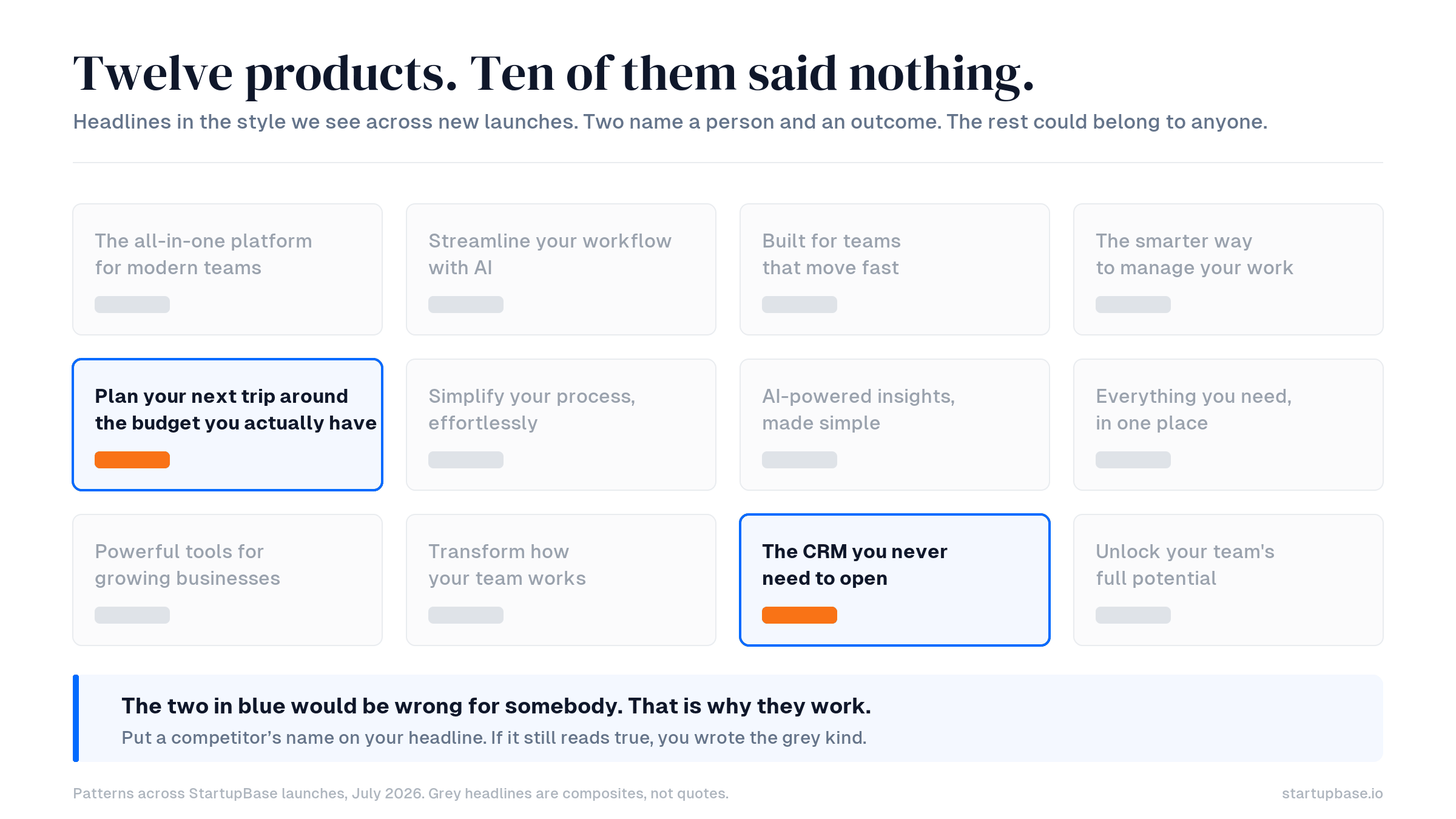
Plan your next trip based on your specific budget
The CRM You Never Need to Open
Neither describes a category. The first names the mechanism, budget first rather than destination first, so a traveller knows in one line whether it solves their actual problem. The second names the thing you hate about every CRM you have ever been made to use. Both take a position. Both would be wrong for somebody, which is the point.
Now compare that to the shape a model reaches for by default: "a comprehensive platform designed to streamline your workflow." True of a thousand products, a reason to visit none of them.
Something worth knowing from watching this at scale: the products that pull the most visits through to their own site are frequently not the ones with the most votes. Plenty of pages collect approval and no visits. A vote costs nothing and is often a courtesy. Leaving the page to go and look at your product is a decision, and the headline is what makes people take it.
Getting this sentence right is most of positioning, which is stage one of how to market a startup for exactly this reason.
The swap test
Here is the fastest way to find out whether you have written your product or your category. It takes about ten seconds and we have never seen a founder enjoy it.
Take your headline and put a competitor's name on it. If it is still true, you have not written a headline. You have written a category description that you happen to be hosting.
"A comprehensive platform designed to streamline your workflow" survives the swap perfectly. So does "the smarter way to manage your projects." So does most of what a model will hand you on the first try, because a model is producing the average of the category and the average belongs to everyone in it.
Now try it on a line that works. "Plan your next trip based on your specific budget" breaks immediately if you paste a competitor over it, because most travel tools start with a destination and this one does not. The claim is specific enough to be wrong for somebody, which is what makes it worth reading.
Run the swap test on your headline, your subheading, and the first sentence of your about section. Anything that survives it is doing no work, and every line that does no work is costing you a share of the people who arrived willing to be convinced.
How to actually use AI on your landing page
Not "do not use it." Use it for the parts where average is fine, and do the rest yourself.
Good uses. Structure and section order. Tightening a paragraph you already wrote. Generating twenty headline variants so you can react to them, since reacting is easier than starting. Catching where you have been unclear. Translating a feature into a benefit when you are too close to it.
Bad uses. The headline. Anything describing your customer. Your honest limitations. Testimonials, obviously. Anything a competitor could paste onto their own site unchanged.
The reliable method: write the ugly version yourself first. Bad grammar, no structure, just what the product does and who kept asking for it. Then let AI organise it. Feeding it your raw material produces something specific, because the specificity came from you. Asking it to invent from a product name produces the category average, every time.
One test before publishing. Paste your headline and first paragraph into a model and ask which product this is for. If it can only describe a category, so can your visitor. This is the swap test with a machine doing the swapping, and it is the single cheapest quality check available to you.
What goes on the page, in order
Sequence beats completeness. Answer questions in the order a sceptical stranger asks them.
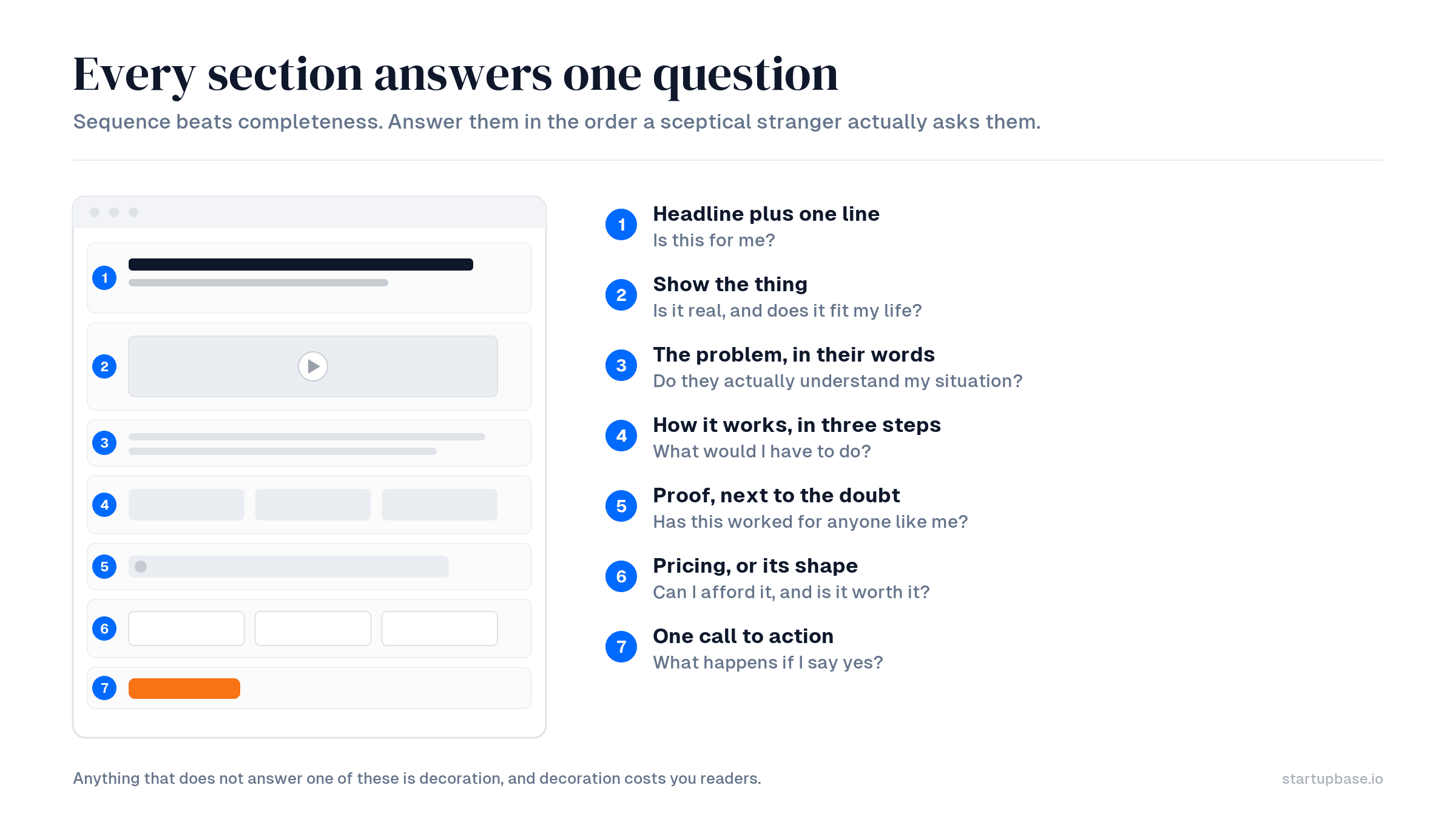
1. Headline plus one supporting line. Headline names the person and the outcome. The line beneath says what the product actually is, in plain words.
2. Show the thing. A screenshot, a loop, a demo. Not a stock illustration. Seeing the product answers three questions at once: what is it, is it real, does it fit my life.
3. The problem, in their words. Two or three sentences describing their situation accurately enough that they feel recognised. This is where your pre launch conversations get used, because you are quoting them back to themselves. It is also the section AI cannot fake, because it never had those conversations.
4. How it works, in three steps. A sequence, not a feature list. You do this, it does that, you get this.
5. Proof, placed where the doubt is. Testimonials in a row at the bottom are decoration. Put proof beside the claim it supports.
6. Pricing, or at least its shape. Hiding it behind a call is a reasonable enterprise tactic and a poor startup one. Someone deciding in five seconds will not book a meeting to find out if they can afford you.
7. One call to action, repeated. Same action, same words, several times down the page.
Proof when you have no customers yet
Weakest to strongest.
Generic praise proves nothing and can hurt, because it reads like a favour. Specific and checkable is far better: a named person with a role describing a real result beats ten five star ratings.
If you have neither, use what you do have. Screenshots of unsolicited messages. A number you can stand behind, even a small one. Integration logos rather than customer logos you have not earned. And your own honesty about what it does not do yet and who it is not for, which founders underrate and which converts precisely because it is the one thing on the page a competitor would not also say. It is also, not coincidentally, the one thing a model will not write for you unprompted.
What does not work is inventing it. Fake testimonials are spotted more often than founders think, and the people most likely to spot them are the ones you want.
The mistakes that show up again and again
Explaining the category before the product. Three paragraphs on why remote work is changing, before saying what you built.
Writing for investors. "Leveraging AI to transform workflow efficiency" is pitch deck register. Your buyer says "I keep losing track of which client I invoiced."
Too many actions. Sign up, book a demo, join the newsletter, read the docs, follow us. Every extra choice costs you some of the people who would have taken the first one.
Hiding the product behind a signup. If nobody can see it without an account, plenty will not make one.
Complexity as seriousness. One analysis of SaaS pages found copy written at a fifth to seventh grade reading level converted several times better than professionally worded copy. Plain words are not dumbing down. They are the difference between being understood in five seconds and not.
How to test with fifty visitors instead of fifty thousand
The five second test. Show the page to someone outside your bubble for five seconds, take it away, ask what it does and who it is for. Do it with five people. If three cannot answer, the headline is the problem and nothing below it will rescue the page.
Watch one person use it. Observation, not feedback. Sit quietly while someone reads and clicks. Where they hesitate is where your copy is unclear.
Ask the people who did not convert. One question: what stopped you. The answers are boring, fixable, and the most valuable thing you will read that week.
Count the right number. Visitor count is vanity at this stage. Track the ratio who did the one thing you wanted, and remember the order traffic actually arrives in so you are not comparing week one against a mature site.
What to fix first
If the page is not working and you can only do three things:
- Run the swap test on your headline, and rewrite it until it fails
- Put a real screenshot or demo above the fold
- Delete every call to action except one
Then run the five second test on five people. Most failing pages fail on the first of those, and most founders spend their time on the third.
FAQ
How do I know if my landing page is too generic?
Run the swap test. Put a competitor's name on your headline and read it again. If it is still true, you have written a category description rather than a headline, and any of your competitors could publish it unchanged. Repeat on your subheading and the first line of your about section. Anything that survives the swap is doing no work.
Is it bad to use AI to write my landing page?
No, but accepting the first draft is. Models return the centre of the distribution, so the output reads like your category rather than your product, and your competitors are getting the same draft. Use AI for structure, tightening and variants. Write the headline and anything describing your customer yourself.
Why do so many startup landing pages look the same now?
Because the same handful of models wrote them, and their default register is a hedged category description that avoids excluding anyone. Across the 306 products that launched on StartupBase in July, the repeated sentence shapes were hard to miss. It makes competent pages indistinguishable from each other, which is a worse outcome than being bad in an interesting way.
What is a good conversion rate for a startup landing page?
Unbounce's analysis of 41,000 pages puts the cross industry median near 6.6%, with SaaS closer to 3.8%. For a new product with no brand recognition, treat those as orientation and judge the page against its own previous version instead.
How do I add social proof with no customers?
Use what is checkable. A named person with a role describing a specific result beats generic praise. Screenshots of real messages, a small honest number, or integration logos all work. Saying plainly who the product is not for also builds trust and costs nothing.
How much traffic do I need before A/B testing?
More than most startups have. Meaningful tests need hundreds of conversions per variant, so at early traffic you would wait months for an answer that arrives after the product changed. Use qualitative testing with a handful of real people until volume justifies statistics.
Final thoughts
The bar moved this year, and most founders have not noticed. Producing a competent landing page used to take skill, and that skill was itself a filter. Now it takes an afternoon and a prompt, so competent has stopped being an achievement and started being the floor everybody stands on.
What is scarce now is evidence that a person was involved. A headline that excludes somebody. A sentence describing the problem the way your customer actually says it. An honest note about what the product does not do yet. None of these are hard, and every one of them fails the swap test in the right direction, which is precisely why a model will not produce them unless you make it.
Pick the person. Name what changes for them. Show the thing. Ask for one action.
Then find five humans and watch them read it. It will be uncomfortable, and it will teach you more than any amount of traffic could.
Startup Marketing
Landing Pages
AI Content
Conversion







 Continue with Google