
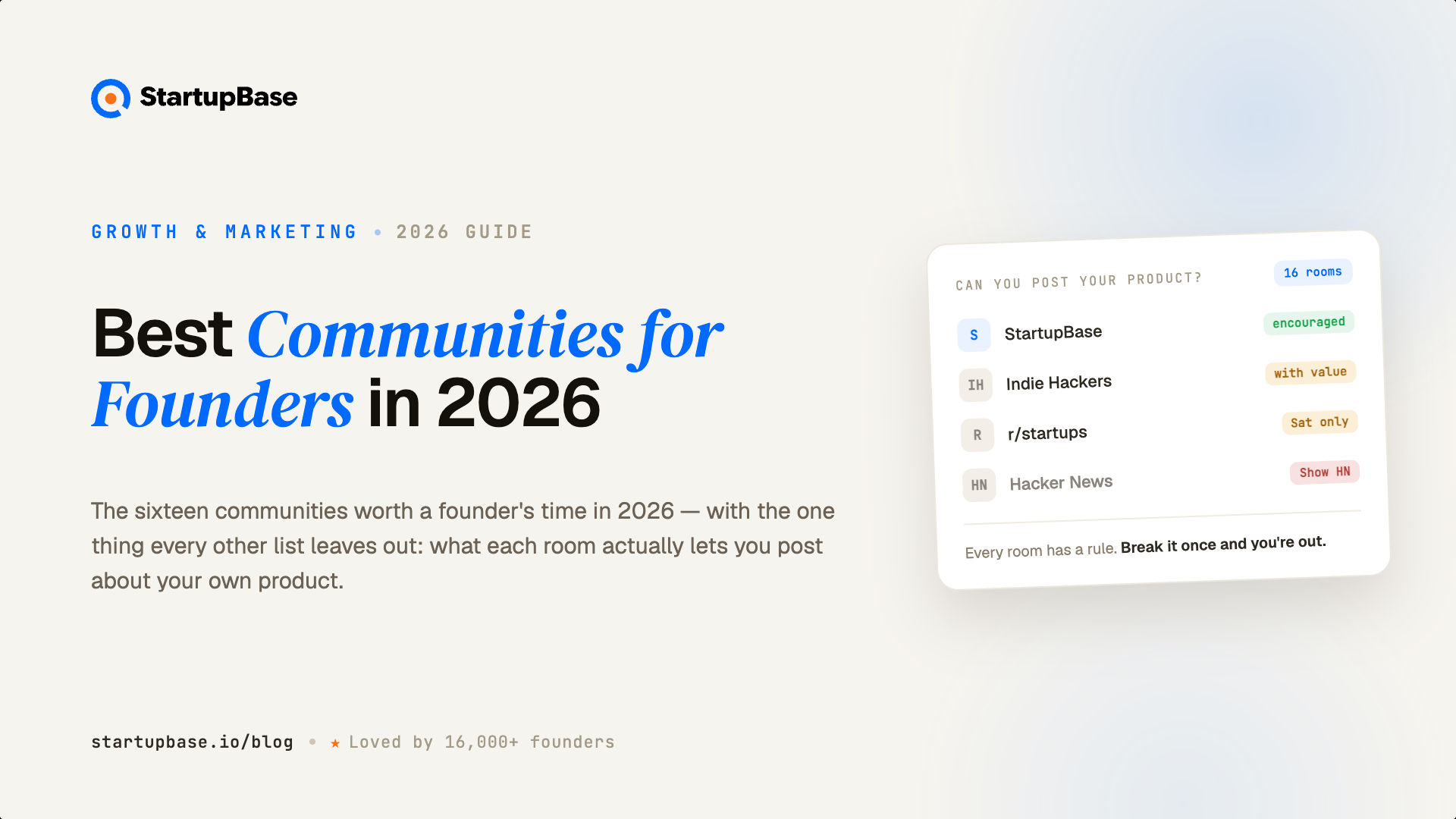
The best founder communities in 2026 are StartupBase and Product Hunt for launching, Indie Hackers for bootstrappers, Hacker News and r/startups for blunt feedback, and paid rooms like Founders Network for depth. What matters more than the list is the rule in each room, because discussion communities remove product posts on sight while launch communities are built for them.
Quick Answer
Every list of founder communities tells you which rooms to join, and almost none of them tell you what you are allowed to say once you get there.
That is the part that decides whether joining was worth it. A founder signs up to six communities in a week, posts a link to their product in each one, and is removed from four of them by Tuesday, having learned nothing except that the rules differ everywhere.
So this guide does both. Sixteen communities worth your time in 2026, grouped by what they are good for, and for each one the honest answer to the question you actually have: can I post about my product here, and how.
What a community is for, and what it is not for
Communities do four jobs well.
Feedback before you build the wrong thing. A blunt reply from another founder costs nothing and saves months.
Company. Running a startup is lonely in a specific way, and the people around you cannot always be told.
Reputation. This is the one founders underrate. Show up for six months, answer questions, be useful, and your name starts carrying weight. That is when posting about your own product finally works.
People. Co-founders, first hires, early advisors, and the person who introduces you to your first customer.
There is one job most of them do badly, and it is the one founders join for: distribution on demand. You cannot arrive in a discussion community on Monday and get users by Friday. Every room has spent years building defences against exactly that.
The exception is launch communities, which exist for that job specifically. Those are covered below too, and the difference between the two kinds is the single most useful thing on this page.
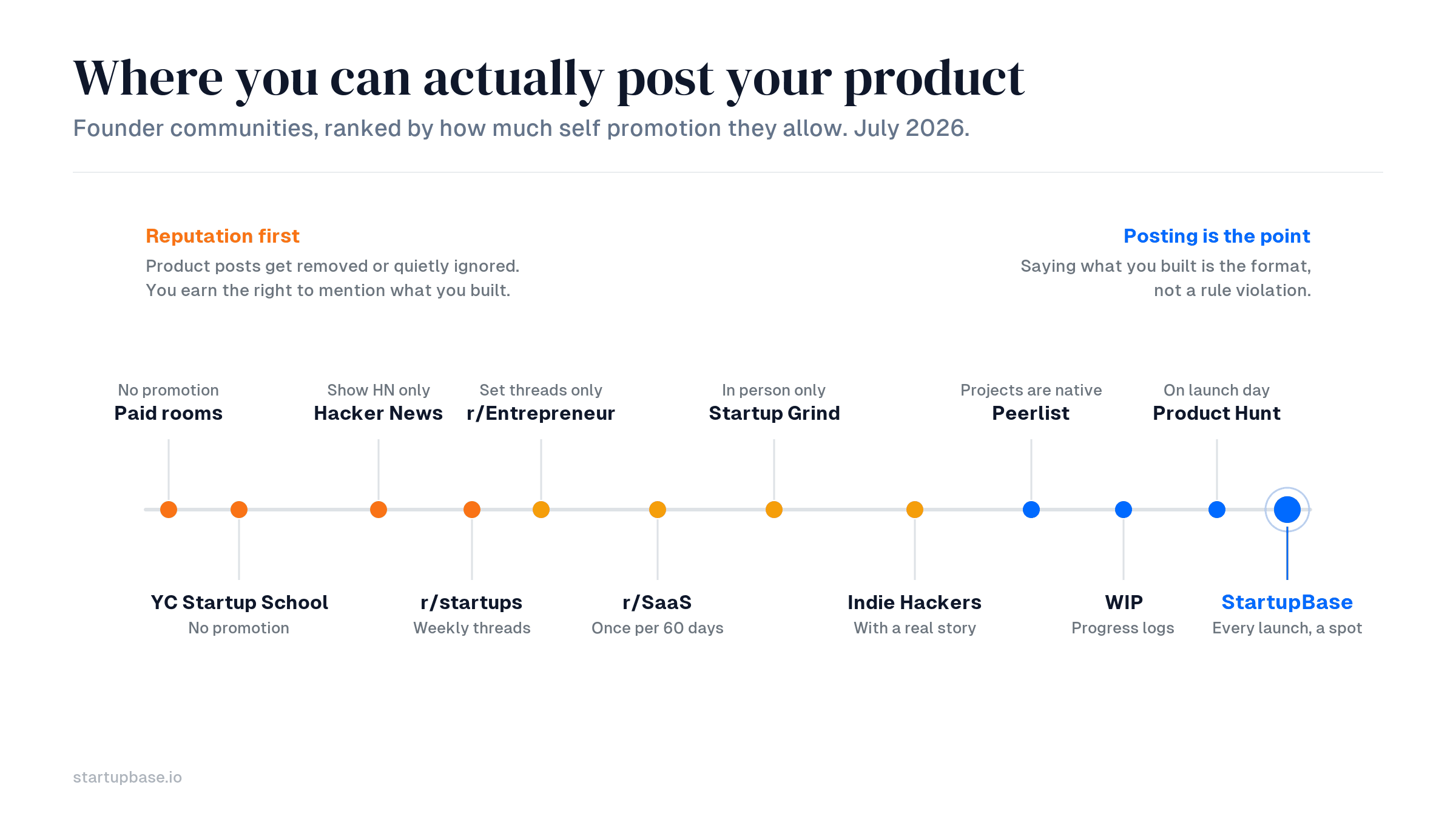
The self promotion rule, community by community
Rules change and mods update sidebars, so treat everything below as a July 2026 snapshot and read the actual rules before your first post. But the shape of each room is stable, and that is what you need.
Build in public and bootstrapped
Indie Hackers is still the default room for people building without venture money. Revenue numbers, growth problems, and failures get discussed with a candour you do not see elsewhere. It went back to founder ownership from Stripe in 2023 and the forum kept going.
Can you promote? Yes, if it is wrapped in something. A post with your numbers, what you tried, and what broke will be read. A post with a link and a tagline will be ignored, which is a slower death than removal.
WIP is a maker community built around logging what you shipped today. Smaller and more disciplined than the big forums, and useful if accountability is the thing you actually lack. Joining, creating a product page, and posting updates are free. Pro is $199 a year for extras.
Can you promote? Posting your own progress is the format, not a violation of it. This is one of the few rooms where talking about your product every day is the intended behaviour.
Peerlist is a builder network where your profile is the artifact. Projects, work history, and what you shipped, in public.
Can you promote? Posting your project is native to the platform. It is closer to a professional profile than a forum, so treat it as a place to be findable rather than a place to campaign.
High signal and blunt
Hacker News is where a large slice of the technical startup world argues. Thick skinned, light on hand holding, and genuinely high signal when it goes well.
Can you promote? Only through Show HN, which is the sanctioned channel and has its own rules: it has to be something people can actually try, and you have to be there in the comments. Dropping a link anywhere else is the fastest way to get flagged.
r/startups is the main startup subreddit and better than its reputation once you filter the noise. Good for a fast gut check.
Can you promote? Not as a standalone post. Promotion and feedback requests belong in the weekly themed threads, and a well written product post outside them still gets removed. That trips up more founders than any other rule on this page.
r/SaaS tolerates more product talk than most subreddits, which is exactly why it tightened up. As of April 2026 the mods run a once per 60 days self promotion limit and extended it to product plugs inside comments, with repeat offenders risking a blocked URL.
Can you promote? Once in a while, with substance. Your story, your metrics, or a real question. A name, a link, and a one line pitch reads as spam and is treated as spam.
r/Entrepreneur is broader, less technical, and heavier on general business talk. Useful for a non engineering perspective.
Can you promote? Rarely, and only inside the designated threads. Assume no unless the sidebar says yes.
Structured and stage based
Y Combinator Startup School is the free, open version of the most famous accelerator's playbook: courses, a forum, and co-founder matching without applying to a batch. The matching alone justifies the signup if you are still looking.
Can you promote? No. This is a learning environment, not a channel.
Startup Grind runs local chapters and events in more than 125 countries, which makes it the best route into your local founder scene if you are not sitting in a major hub.
Can you promote? In person, which is the whole point. Nobody minds you describing your product in a conversation at an event. Nobody wants it posted in the group chat.
No Code Founders is the room for people building real businesses without writing code, with tool swapping and AMAs.
Can you promote? Within reason, if your product serves that stack. Niche communities are more forgiving about on topic products than general ones.
Paid rooms
Paid communities are smaller, more curated, and more willing to dig into your actual situation. The price is doing the filtering.
Founders Network is peer mentorship for tech founders, built around warm intros and a private peer advisory board.
StartupSauce is a mastermind community for SaaS founders outside Silicon Valley, with bi-weekly calls that are the real draw and a subgroup past $1M ARR.
FounderLed is for bootstrapped SaaS founders scaling while keeping their equity. Best once you have revenue to protect.
SaaStr is the largest SaaS community, skewing later stage, built around a huge content library and its conferences.
Can you promote in any of them? No, and you would be wasting the membership if you tried. You are paying for advice, not for an audience. The one exception is answering a direct "what do you use for this" question honestly.
Launch communities
These are the rooms built around products rather than around discussion. People arrive to see what is new, which is why posting what you made is the format instead of a rule violation.
Product Hunt is the best known of them. The maker community around it is real and supportive, and a strong launch still drives meaningful early traffic. Worth being part of well before your launch day rather than showing up on it.
Can you promote? On launch day, completely. The rest of the time you are a community member like anywhere else.
StartupBase is a launch community rather than a directory. Founders comment on launches, leave reviews, and give each other feedback on products, which is the part most launch platforms skip.
The difference from every other room on this page is that you do not spend six months earning the right to say what you built. Every approved product gets a real launch spot. From there the listing keeps working: daily launches, weekly, monthly, and yearly rankings, ranking badges, curated collections, topic pages, and a feature in a newsletter that goes to 14,300+ subscribers.
Can you promote? That is the entire point, and the reviews and comments mean you get feedback out of it too, not just a listing.
👉 Submit your product to StartupBase
At a glance
| Community | Cost | Where | Can you post your product? |
|---|---|---|---|
| StartupBase | Free, $39 to launch now | Web | Yes, and you get reviews and feedback |
| Product Hunt | Free | Web | On launch day, yes |
| Indie Hackers | Free | Web | Yes, with a story and numbers |
| WIP | Free, $199/yr Pro | Web | Yes, it is the format |
| Peerlist | Free | Web | Yes, as a profile and projects |
| Hacker News | Free | Web | Show HN only |
| r/startups | Free | Weekly threads only | |
| r/SaaS | Free | Once per 60 days, with substance | |
| r/Entrepreneur | Free | Designated threads only | |
| YC Startup School | Free | Web | No |
| Startup Grind | Free | Events | In conversation, not in posts |
| No Code Founders | Free | Web | If it fits the niche |
| Founders Network | Paid | Web | No |
| StartupSauce | Paid | Web + calls | No |
| FounderLed | Paid | Web + events | No |
| SaaStr | Free, paid events | Web + events | No |
Self promotion rules as of July 2026. Mods change them without notice, so read the sidebar before your first post.
How founders actually get users from a community
The pattern is the same everywhere, and it is slower than anyone wants.
Pick two rooms, not ten. One broad, one narrow. Ten memberships means lurking in ten places and being recognised in none.
Spend the first month answering, not asking. Find questions you can answer properly. This is the entire investment and most founders skip it.
Put your product in your profile, not in your posts. Every community lets you say what you build in your bio. That link works quietly while you are being useful.
Post the process, not the pitch. "Here is what happened when we changed our pricing" gets read. "Check out my new tool" gets scrolled past. The first one mentions your product naturally, which is the point.
Answer the "what do you use" questions honestly. These come up constantly and naming your own product in a genuine answer is fair game in almost every room.
That is a three to six month arc, not a launch week tactic. Which raises the obvious question of what to do in launch week.
Run both tracks at once
Discussion communities and launch communities do different jobs, and the mistake is picking one.
Discussion rooms are a slow investment. You show up, you are useful, and months later your name carries enough weight that mentioning your product lands instead of getting removed. That is worth starting today precisely because it takes so long to pay off.
Launch communities are the fast track, and there is no reputation tax on the way in. You post what you built, people who came looking for new products see it, and on StartupBase they comment and review it so you get feedback rather than just a link.
Do the slow one in the background. Do the fast one whenever you have something worth showing.
👉 Submit your product to StartupBase
For the wider map of where to spend launch effort, see best places to launch your product, and if launch week is close, how to get your first 100 users after launch covers what happens next. Communities run through every stage of how to market a startup, which is the sequence this fits into.
FAQ
What is the best free community for founders?
It depends on your stage. Indie Hackers for bootstrappers, Hacker News and r/startups for blunt technical feedback, YC Startup School for structure and co-founder matching, Startup Grind for local in person events. Start with the one that matches this year, not the biggest one you can find.
Can I promote my startup in founder communities?
It depends which kind. Discussion communities like r/startups and Hacker News either ban standalone product posts or route them into weekly threads, so the reliable version there is to build a reputation first and mention your product inside genuinely useful posts. Launch communities like StartupBase and Product Hunt are the opposite: posting what you built is the format, and on StartupBase you get comments and reviews on it as well.
Are paid founder communities worth it?
Once you have a specific, expensive problem and want people who will dig into it, usually yes. The price filters out noise and the rooms are smaller. For a quick gut check on an idea, a free community does the same job.
Which subreddits are best for startup founders?
r/startups for general founder discussion, r/SaaS for software specific problems, r/Entrepreneur for broader business talk. Each of the three restricts self promotion in a different way, so read the sidebar before posting rather than assuming the rules carry over. If you are shipping an iOS or Android app, the app specific subreddits and their rules are covered in where to launch a mobile app.
How long before a community produces results?
Assume three to six months of showing up before your name carries weight. Founders who get users out of communities were already members when they launched, not new arrivals with a link.
Final thoughts
The best community for you is the one you will still be posting in six months from now. That is the whole selection criteria, and it rules out most of the joining people do.
Pick two. Learn the rules before your first post. Be useful for a while. Then the room will happily hear about what you built, because by then you are not a stranger with a link.
And when you want a day where saying what you made is the actual point, that is what a launch is for.
Startup Marketing
Reddit for Startups
Indie Hackers
Founder Communities







 Continue with Google