
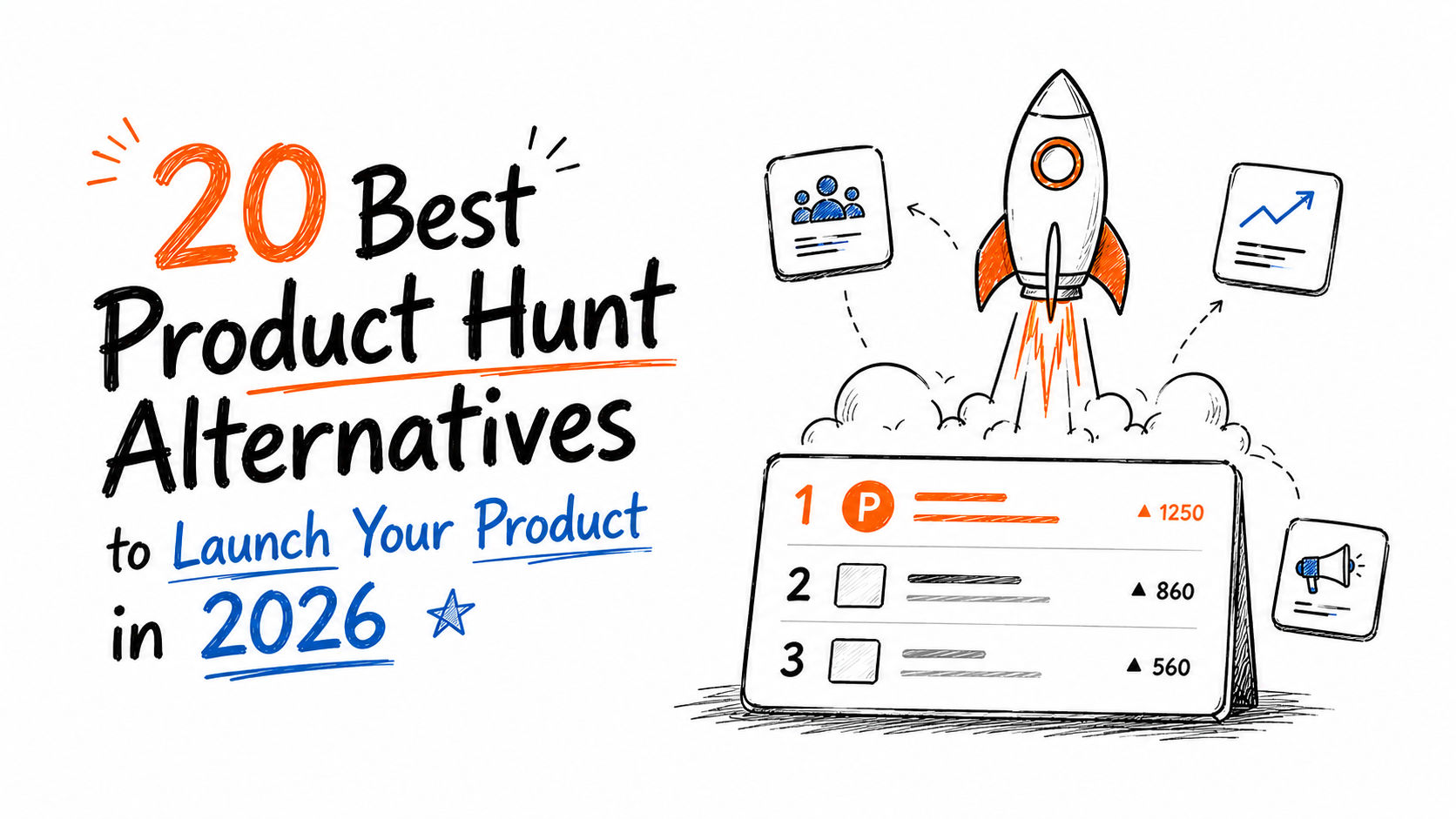
Product Hunt is still useful, but it should not be your only launch channel. The best Product Hunt alternatives in 2026 include StartupBase, Uneed, BetaList, Fazier, Hacker News, Indie Hackers, SaaSHub, AlternativeTo, and AI directories like There’s An AI For That and Futurepedia. StartupBase is the best first alternative if you want every approved product to get a real launch spot and keep getting discovered after launch day through product pages, rankings, collections, reviews, and newsletter exposure.
Quick Answer
Product Hunt is still one of the first places founders think about when launching, and it deserves that spot. It gives you a launch day event, a leaderboard, comments, upvotes, and a reason to rally your network around a single moment.
But relying only on Product Hunt is a weak launch strategy, because that spike fades by the next morning. Most founders need more than one homepage feature. They need early users, feedback, backlinks, newsletter exposure, community attention, and product pages that keep working after launch day.
That is why smart founders now treat Product Hunt as one part of a bigger launch system.
You launch on Product Hunt. Then you keep pushing your product across startup directories, product discovery platforms, founder communities, developer communities, SaaS marketplaces, AI tool directories, and niche launch channels.
This guide covers the best Product Hunt alternatives for founders launching SaaS products, AI tools, indie projects, apps, developer tools, and early stage startups.
Quick comparison
| Platform | Best for | Cost | Traffic type |
|---|---|---|---|
| StartupBase | Startups, SaaS, AI tools, indie products | Free + premium options | Launches + ongoing discovery |
| Uneed | Indie makers and SaaS tools | Free + paid | Launch spike + ongoing discovery |
| BetaList | Products preparing to launch | Free + paid | Early adopters |
| Fazier | SaaS, AI tools, indie projects | Free + paid | Extra launch visibility |
| MicroLaunch | Indie products and small SaaS tools | Free + paid | Monthly launch visibility |
| OpenHunts | Makers and developers | Free | Product launch discovery |
| Hacker News / Show HN | Developer tools and technical products | Free | Unpredictable traffic spike |
| Indie Hackers | Bootstrapped founders | Free | Community + referral traffic |
| Niche products and communities | Free | Spike if post gains traction | |
| Dev.to | Developer tools and technical content | Free | SEO + developer community |
| X / Build in Public | Products built by founders | Free | Audience driven traffic |
| Peerlist | Designers, developers, and builders | Free | Professional community |
| SaaSHub | SaaS products | Free | Steady organic discovery |
| AlternativeTo | Apps and software products | Free | Long tail SEO traffic |
| There’s An AI For That | AI tools | Free + paid options | High intent AI discovery |
| Futurepedia | AI tools and software | Free + paid | AI category browsing |
| Launching Next | Startups and apps | Free | Startup directory visibility |
| TinyLaunch | Small products and side projects | Free + paid | Lightweight launch visibility |
| TinyStartups | Tiny startups and indie tools | Free + paid | Small product discovery |
| DevHunt | Developer tools and open source projects | Free | Technical product discovery |
Best Product Hunt alternatives by use case
The best Product Hunt alternative depends on what you are trying to achieve. Some platforms are better for launch day attention, some are better for beta users, and some are better for long term search discovery.
Best overall Product Hunt alternative
StartupBase is the best first alternative if you want launch visibility, product discovery, rankings, collections, reviews, and a product page that keeps working after launch day.
Best for beta users
BetaList is a strong option if your product is not fully launched yet and you want early users, waitlist signups, or validation before a bigger public launch.
Best for indie makers
Uneed, MicroLaunch, TinyLaunch, and TinyStartups are good options for small teams, indie products, bootstrapped tools, and maker led launches.
Best for developer tools
Hacker News / Show HN, Dev.to, Peerlist, and DevHunt are better for technical audiences. Do not use generic marketing copy here. Developers want specifics.
Best for AI tools
StartupBase, There’s An AI For That, Futurepedia, and Fazier give AI tools both general startup discovery and AI specific directory exposure.
Best for ongoing search discovery
StartupBase, SaaSHub, AlternativeTo, Launching Next, and DevHunt can help your product remain discoverable after the launch day spike is gone.
How we picked these Product Hunt alternatives
Not every platform belongs on this list.
Some directories are outdated. Some communities are too broad. Some launch sites look good but send almost no useful traffic. And some are only worth using if your product fits a very specific audience.
This list focuses on platforms that can help with at least one meaningful launch goal: launch visibility, early adopters, feedback, trust, category placement, search discovery, founder audiences, SaaS audiences, AI audiences, developer audiences, or visibility beyond one single day.
The best Product Hunt alternative depends on what you are launching.
A developer tool does not need the same launch strategy as a consumer app. An AI writing tool does not need the same channels as a B2B sales product. A startup preparing for launch should not use the same approach as a mature SaaS doing a relaunch.
With that in mind, here are the best Product Hunt alternatives to consider.
1. StartupBase
StartupBase is one of the best Product Hunt alternatives for founders who want more than a one day spike.
It is a platform for launching and discovering new products every day. Founders can submit their startup, create a public product profile, and get exposure through launches, rankings, collections, reviews, comments, newsletters, and featured placements.
That makes it especially useful after a Product Hunt launch.
Product Hunt is great for creating a launch day moment. StartupBase is built for continued startup discovery.
A good StartupBase listing can include your product name, tagline, description, website, logo, screenshots, video, team details, pricing, promo offer, and launch context. Once published, your product can appear in daily launches, weekly rankings, monthly rankings, curated collections, topic pages, and newsletter placements.
Best for
StartupBase is a strong fit for SaaS products, AI tools, indie products, startup launches, product relaunches, developer tools, products built by founders, and products looking for ongoing discovery.
Why StartupBase is different
StartupBase is not just another place to submit a product link. It is built around a different launch philosophy.
On many launch platforms, founders submit their product and hope it gets picked, noticed, or pushed into the right place at the right time. That can work if you already have an audience, a network, or enough launch momentum. But for smaller teams, solo founders, bootstrapped startups, and early stage products, that approach can feel like a black box.
StartupBase gives founders a clearer path.
Every approved product gets a real launch spot. Launch visibility is not only for insiders with big audiences or strong network effects. And once your product is live, it does not disappear after the first day.
Instead of getting attention for one day and then vanishing, your product gets a dedicated page that can keep working after launch day. That matters because most users do not discover products on the exact day they launch.
Some find them through rankings. Some find them through collections. Some find them through search. Some find them through newsletters. Some find them because they are browsing for new tools in a specific category.
That is where StartupBase fits.
It is not just about the launch. It is about giving your product more places to be discovered.
When to use StartupBase
Use StartupBase when you want to launch a new product, relaunch an improved product, get listed in startup discovery pages, build trust with a public product profile, get more visibility after Product Hunt, or add another strong launch channel to your distribution plan.
If you are launching something new, StartupBase should be one of your first submissions.
👉 Submit your product on StartupBase
2. Uneed
Uneed is a clean product discovery platform for makers, startups, indie products, and SaaS tools.
It has become one of the more popular Product Hunt alternatives because it feels simpler and less crowded than Product Hunt. The platform is focused on helping people discover useful products, and makers can use it as another launch surface for their tools.
Best for: Indie makers, SaaS tools, AI products, side projects, and products built by founders.
Why it works: Uneed gives founders another place to launch and be discovered by people who actively browse new products.
It is especially helpful for smaller products that may get buried on bigger platforms. If your product has a clear use case and a simple pitch, Uneed can be a good addition to your launch list.
Use it when: Your product is ready for public discovery and you want another maker focused platform beyond Product Hunt.
If you are weighing Uneed against other launch platforms, see our full guide to the best Uneed alternatives.
3. BetaList
BetaList is one of the older and more recognized platforms for early stage startups.
It is especially useful before a full public launch. If your product is still in beta, collecting early users, or testing demand, BetaList can help you reach people who like discovering startups early.
Best for: Products preparing to launch, beta products, waitlists, MVPs, and early access campaigns.
Good fit if: You are still validating demand and want early users before a bigger public launch.
Product Hunt is better for a public launch moment. BetaList is better when you are still early and want beta users, feedback, and early signups before a bigger launch.
Use BetaList before launching widely. It can help you validate interest, collect emails, and get early users before a bigger launch on Product Hunt, StartupBase, or other platforms.
If you are weighing BetaList against other early stage options, see our full guide to the best BetaList alternatives.
4. Fazier
Fazier is a product discovery platform where people can find and submit tech startups and products.
It is a good option for SaaS tools, AI products, indie projects, and smaller startups that want extra visibility without a complicated submission process.
Best for: SaaS tools, AI products, indie projects, small startups, and products built by makers.
Worth using because: Fazier gives founders another simple launch and discovery channel.
It may not have the same reach as Product Hunt, but that is not always a bad thing. Smaller platforms can have less noise and a more focused audience.
If you are building a launch distribution list, Fazier belongs on it.
Use it when: You want another product discovery listing for your SaaS, AI tool, app, or indie product.
5. MicroLaunch
MicroLaunch is a launch platform for indie products, small SaaS tools, and maker projects.
It is useful for founders who want visibility without competing directly with large companies and heavily funded launches.
Best for: Indie SaaS, small products, AI tools, maker projects, and bootstrapped startups.
Where it fits: MicroLaunch works well for smaller launches.
Not every product needs a massive launch campaign. Some products need a focused launch, a few early users, feedback, backlinks, and visibility inside a maker focused space.
That is where MicroLaunch can help.
Use it when: Your product is small but real, and you want another place to get seen by makers and early adopters.
6. OpenHunts
OpenHunts is a product launch and discovery platform for makers and developers.
It lets founders submit products, get discovered, and collect upvotes. It is positioned as a Product Hunt alternative for people launching tech products.
Best for: Makers, developers, tech products, SaaS tools, and indie products.
Why it works: OpenHunts follows a familiar launch and discovery model.
You submit a product, people browse, vote, and discover new tools. For founders, that means another launch surface and another chance to get attention outside Product Hunt.
Good fit if: You want a simple Product Hunt style launch channel for a maker, developer, or startup audience.
7. Hacker News / Show HN
Hacker News / Show HN is one of the strongest launch channels for technical products.
It is part of Hacker News and works best when your product is genuinely useful, technical, interesting, or built for developers.
If you are launching a developer tool, open source project, infrastructure product, API, technical AI tool, or engineering product, Show HN can be powerful.
Best for: Developer tools, open source projects, APIs, infrastructure tools, technical AI products, and engineering focused SaaS.
Use it carefully: The Hacker News audience is sharp.
That is good and painful.
If your product is vague, overhyped, or weak, people will call it out fast. But if your product is useful and technically interesting, Show HN can bring serious attention, feedback, and early users.
The key is to avoid marketing fluff.
Explain what you built, who it is for, how it works, and why it matters.
Good fit if: Your product has a technical audience or an interesting engineering angle. Do not post a generic sales pitch. It will fail.
8. Indie Hackers
Indie Hackers is a community for bootstrapped founders, solo founders, makers, and people building internet businesses.
It is not just a launch platform. It is a place to share lessons, milestones, revenue updates, product stories, and honest founder experiences.
Best for: Bootstrapped SaaS, indie products, founder stories, build in public updates, revenue milestones, and feedback requests.
Works best when: You share the story behind the product.
A lazy “we launched, check us out” post will probably get ignored.
A useful post about what you built, why you built it, what you learned, what failed, and where you need feedback has a much better chance.
Use Indie Hackers when you have a founder story, lesson, milestone, or honest build in public update to share.
Use it for conversation, not just promotion.
9. Reddit
Reddit can be one of the best or worst launch channels depending on how you use it.
If you drop a link and leave, most subreddits will ignore it or remove it. If you join the right communities, understand the rules, and share something useful, Reddit can send targeted feedback and traffic.
Best for: Niche products, founder feedback, developer tools, AI tools, SaaS products, and consumer apps with strong subreddit fit.
What makes it useful: Reddit is not one platform. It is thousands of communities.
That makes it powerful.
A productivity tool might fit one subreddit. A developer tool might fit another. An AI design product might fit a completely different audience.
The trick is relevance.
Do not ask, “Where can I spam my launch?”
Ask, “Where does my target user already hang out, and what would actually help them?”
Use it when: Your product fits a specific community and you can share it in a way that adds value.
Bad Reddit launch posts get ignored. Good ones can create real discussion.
10. Dev.to

Dev.to is a strong channel for developer tools, APIs, open source projects, technical SaaS products, and engineering focused launches.
It works best when you publish useful content instead of a direct launch announcement.
Best for: Developer tools, APIs, open source products, engineering SaaS, technical tutorials, and developer focused AI tools.
Why it works: Dev.to gives you a way to reach developers through education.
Instead of saying “we launched this tool,” write a useful post around the problem your tool solves.
For example:
- How we reduced build times by 40%
- How to monitor API errors in production
- How to automate changelog generation
- How to build an AI support bot with your docs
Then mention your product naturally inside the post.
Good fit if: Your product has a developer audience and you can create a useful technical post around it.
11. X / Build in Public
X / Build in Public is not a traditional launch platform, but it can be one of the most effective launch channels if you already build in public.
Founders use X to share product updates, lessons, launch threads, demos, revenue milestones, and customer wins.
Best for: Products built by founders, indie startups, build in public updates, SaaS launches, AI tools, and audience driven products.
Worth using because: X lets you build attention before launch day.
That matters because most launches fail before they launch. The founder starts posting only when the product is ready, but nobody is watching.
If you build in public early, your launch has a warmer audience.
Use X before, during, and after launch.
Share the problem, the building process, the demo, the launch, the results, and the lessons.
12. Peerlist
Peerlist is a professional network for builders, designers, developers, and startup people.
It is useful for portfolio based visibility and sharing what you are building with a high quality professional audience.
Best for: Designers, developers, indie makers, portfolio projects, technical products, and founder built tools.
Good fit if: The maker behind the product matters.
If you are building a design tool, developer tool, AI utility, portfolio project, or founder built SaaS, Peerlist can give your work visibility inside a community of builders.
Use Peerlist when your product is tied to your personal profile, portfolio, or maker identity.
13. SaaSHub
SaaSHub is a software marketplace and alternatives platform.
It is not a launch day community like Product Hunt, but it is valuable because people use it to research software, compare tools, and find alternatives.
Best for: SaaS products, B2B tools, software alternatives, comparison traffic, and category discovery.
Worth using because: SaaSHub can capture stronger intent discovery.
Someone browsing Product Hunt may be casually exploring. Someone searching for software alternatives may be closer to making a decision.
That makes SaaSHub a strong ongoing discovery channel for SaaS products.
Use it when: Your product competes in an existing software category and users might search for alternatives to known tools.
If you are weighing SaaSHub against other options, see our full guide to the best SaaSHub alternatives.
14. AlternativeTo
AlternativeTo is a large software alternatives directory.
People use it to find replacements for apps, tools, and software products they already know.
Best for: Apps, SaaS products, desktop tools, mobile apps, open source tools, and software with clear competitors.
What makes it useful: AlternativeTo is based on user intent.
People often arrive there because they are looking for an alternative to a specific product. If your tool competes with a known product, being listed there can help you show up in comparison driven discovery.
Use it when: Your product can be positioned as an alternative to existing software.
For example:
- An alternative to Notion
- An alternative to Buffer
- An alternative to Typeform
- An alternative to Zapier
- An alternative to Intercom
That comparison angle can bring ongoing discovery.
15. There’s An AI For That
There’s An AI For That is one of the most well known AI tool directories.
If you are launching an AI product, it should be on your submission list.
Best for: AI tools, AI SaaS, AI agents, productivity AI, marketing AI, design AI, and developer AI tools.
Worth using because: AI products need AI specific discovery channels.
Product Hunt can still work for AI tools, but AI directories attract people who are specifically searching for AI software. That intent is valuable.
If your product is an AI tool, directories like There’s An AI For That can help people find you by category, use case, and problem.
Use it when: Your product has a clear AI use case and fits a category people actively search for.
16. Futurepedia
Futurepedia is another major AI tool directory.
It helps users discover AI software across many categories, including productivity, marketing, automation, image generation, writing, business, and more.
Best for: AI tools, AI SaaS products, productivity tools, marketing tools, AI automation products, and AI education products.
Good fit if: Your product is built around AI and you want to be found by users browsing tools by category.
Futurepedia is useful because AI buyers and enthusiasts use directories to explore tools by category.
If your AI product solves a clear problem, being listed in AI directories can help with both discovery and credibility.
For the full picture, see our guide to the best AI directories to submit your AI tool, including which ones actually send AI shoppers and which are link farms.
17. Launching Next
Launching Next is a startup discovery site where founders can submit new startups, apps, and tech products.
It has been around for years and can still be useful as part of a broader launch and directory submission strategy.
Best for: New startups, apps, SaaS products, early stage companies, and general startup listings.
Why it works: Launching Next is not just about launch day attention. It gives your startup another public listing and another place where users can discover your product.
That may not sound exciting, but startup directories can still help with referral traffic, backlinks, and branded search.
Use it when: You have your core launch assets ready and want more directory visibility.
18. TinyLaunch
TinyLaunch is a launch platform for small products, indie tools, and side projects.
It is useful for founders who want a lightweight way to showcase what they built.
Best for: Small SaaS products, indie tools, side projects, micro startups, and early stage apps.
Good fit if: Your product is small but real.
Not every product needs a massive launch. Sometimes you just need another launch page, another backlink, and another chance to get seen by early adopters.
Use TinyLaunch when your product is simple, early, or built by a small team.
19. TinyStartups
TinyStartups is focused on small startups and maker built products.
It fits the current reality of many founders: small team, lean product, fast launch, public iteration.
Best for: Tiny startups, maker projects, indie SaaS, simple tools, and early products.
Where it fits: TinyStartups is useful because not every launch needs to compete with big products and funded teams.
If you are launching something small and useful, a smaller startup discovery platform can be a better fit than a crowded launch site.
Use it when: Your product is early, small, and built for a focused audience.
20. DevHunt
DevHunt is a launch platform focused on developer tools and technical products.
It is a better fit than broad startup directories if your product is built for developers, engineers, technical founders, or open source users.
Best for: Developer tools, APIs, open source projects, infrastructure products, technical SaaS, and developer focused AI tools.
Good fit if: Your product is built for developers or technical teams and you want a launch channel with better audience fit than a general startup directory.
DevHunt gives technical products a more focused discovery surface. Instead of competing with every kind of consumer app, startup, AI tool, and SaaS product, developer products can reach an audience that actually understands the problem.
If you are weighing DevHunt against other launch platforms, see our full guide to the best DevHunt alternatives.
Directories worth knowing that are not launch platforms
Everything above is a launch platform. You post, you get a day of attention, and the traffic arrives as a spike.
Software directories work the other way around.
Nobody browses them for fun. People arrive with a budget and a problem, search a category, and compare what comes up. There is no launch day and no upvotes, and visibility builds slowly instead of arriving all at once.
For business software, that is often the better trade. The person reading your listing is already shopping.
Here are three worth a profile. None of them will do anything for you on launch day.
G2
G2 is the largest software review platform, and a free profile is enough to get started.
Best for: Horizontal SaaS, B2B tools, and products with a self serve signup.
Why it works: G2 is review driven, so an empty listing does nothing. A handful of real reviews will put your product into the category comparisons buyers search directly.
Use it when: You have customers who would say something nice, and your product sits in an established software category.
Software Finder
Software Finder is a software discovery and review platform that helps businesses compare tools, read reviews, and shortlist options before they buy.
It is narrower and more vertical than the general directories, with over 100,000 listings concentrated in business software: ERP, HR, healthcare and EMR, LMS, legal practice management, project management, and field service.
Best for: B2B software, ERP platforms, HR software, healthcare and EMR products, LMS, legal software, project management tools, and business applications.
Why it works: Vendors get a dedicated profile covering features, pricing, and reviews, where a buyer can evaluate the product properly instead of skimming a tagline. You can claim an existing profile or submit a new product for consideration.
Use it when: You sell into one of those verticals and want to reach businesses actively researching and comparing software. It is less useful for consumer apps and developer tools, because that is not who is searching there.
Capterra
Capterra covers a similar buyer with a broader catalogue, and listing is free.
Best for: Small and mid sized business tools across most software categories.
Why it works: Capterra buyers are usually comparing three or four options on price and features. Being inside that shortlist matters more than being new.
Use it when: Your product competes in a category people search by name, and you want to be in the comparison rather than outside it.
If this section sounds more like your product than the launch platforms above, we covered the whole category in our guide to the best SaaS review sites to get listed on.
Product Hunt vs StartupBase
Product Hunt and StartupBase are not exactly the same.
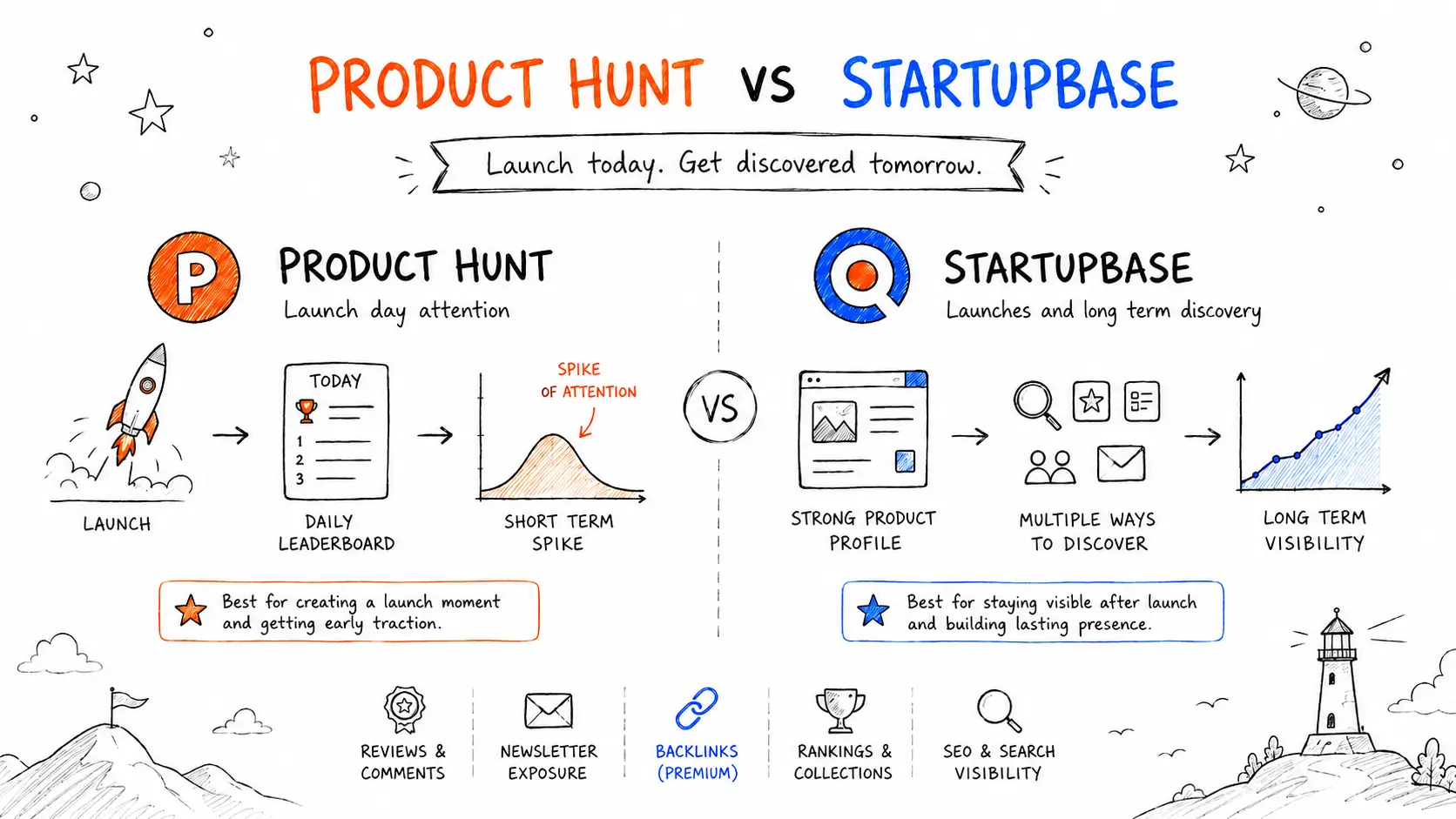
Product Hunt is best known for launch day attention. StartupBase is built around ongoing startup discovery and a clearer path to visibility for founders.
| Feature | Product Hunt | StartupBase |
|---|---|---|
| Main focus | Launch day attention | Ongoing startup discovery |
| Best for | Big launch spike | Continued product visibility |
| Product pages | Yes | Yes |
| Daily launches | Yes | Yes |
| Rankings | Yes | Daily, weekly, and monthly rankings |
| Collections | Limited and curated | Curated startup collections |
| Reviews/comments | Yes | Yes |
| Newsletter exposure | Possible | Yes |
| Good after launch day | Limited | Stronger ongoing discovery angle |
Product Hunt is great for a launch day spike, especially if you already have an audience, a network, or strong early momentum.
StartupBase is better for founders who want their product to keep being discovered after launch day. Every approved product gets a real launch spot, visibility is not only for insiders, and product pages can continue working through rankings, collections, reviews, newsletter distribution, search visibility, and ongoing discovery.
That is the key difference.
If you want a deeper comparison, read our full guide on Product Hunt vs StartupBase.
If you are serious about launching, use both.
A simple launch sequence for founders
The biggest mistake founders make is treating launch as one event.
A better launch is a sequence.
Start with the main launch platforms, then keep expanding into founder communities, niche directories, AI directories, SaaS marketplaces, and long term discovery channels.
Here is a simple launch plan:
- Prepare your launch assets.
- Launch on Product Hunt.
- Submit your product to StartupBase.
- Share your launch story on X and LinkedIn.
- Post a founder story or lesson on Indie Hackers.
- Submit to Uneed, Fazier, MicroLaunch, and OpenHunts.
- If your product is technical, share a useful post on Hacker News or Dev.to.
- If your product is built around AI, submit it to There’s An AI For That and Futurepedia.
- Add your product to SaaSHub and AlternativeTo for comparison traffic.
- Relaunch when you ship a major update.
This gives your product more than one shot.
Instead of hoping one launch day carries everything, you create multiple discovery moments.
For a bigger list of launch channels, directories, communities, and marketplaces, read our full guide on the best places to launch your product.
What to prepare before submitting your product
Before you submit to any launch platform, prepare your launch assets.
You will need your product name, product URL, short tagline, clear description, logo, screenshots, demo video or GIF, founder or maker profile, pricing details, launch offer or promo code, category, tags, first comment or founder note, and UTM links.
Most founders do not fail because they picked the wrong launch platform.
They fail because their product listing is lazy.
Do not write vague copy like:
An AI powered platform to improve productivity.
That says almost nothing.
Write something specific:
Plan, schedule, and track your team’s weekly content calendar without juggling spreadsheets, Slack threads, and reminder tools.
Clarity wins.
People should understand what your product does in a few seconds.
Final thoughts
Product Hunt is still useful.
But depending only on Product Hunt is not a real launch strategy.
The better move is to build a launch system around multiple discovery surfaces. Use Product Hunt for the launch day spike. Use StartupBase for continued product discovery. Use communities like Indie Hackers, Reddit, Hacker News, and Dev.to for feedback and conversation. Use directories like SaaSHub, AlternativeTo, There’s An AI For That, and Futurepedia for ongoing discovery.
Do not treat launch as one day. Treat it as a distribution system.
Your launch should not disappear after one day.
It should keep creating visibility, traffic, trust, and users over time.
Launching something new?
Startup Launch
Product Discovery
Product Hunt Alternatives







 Continue with Google