
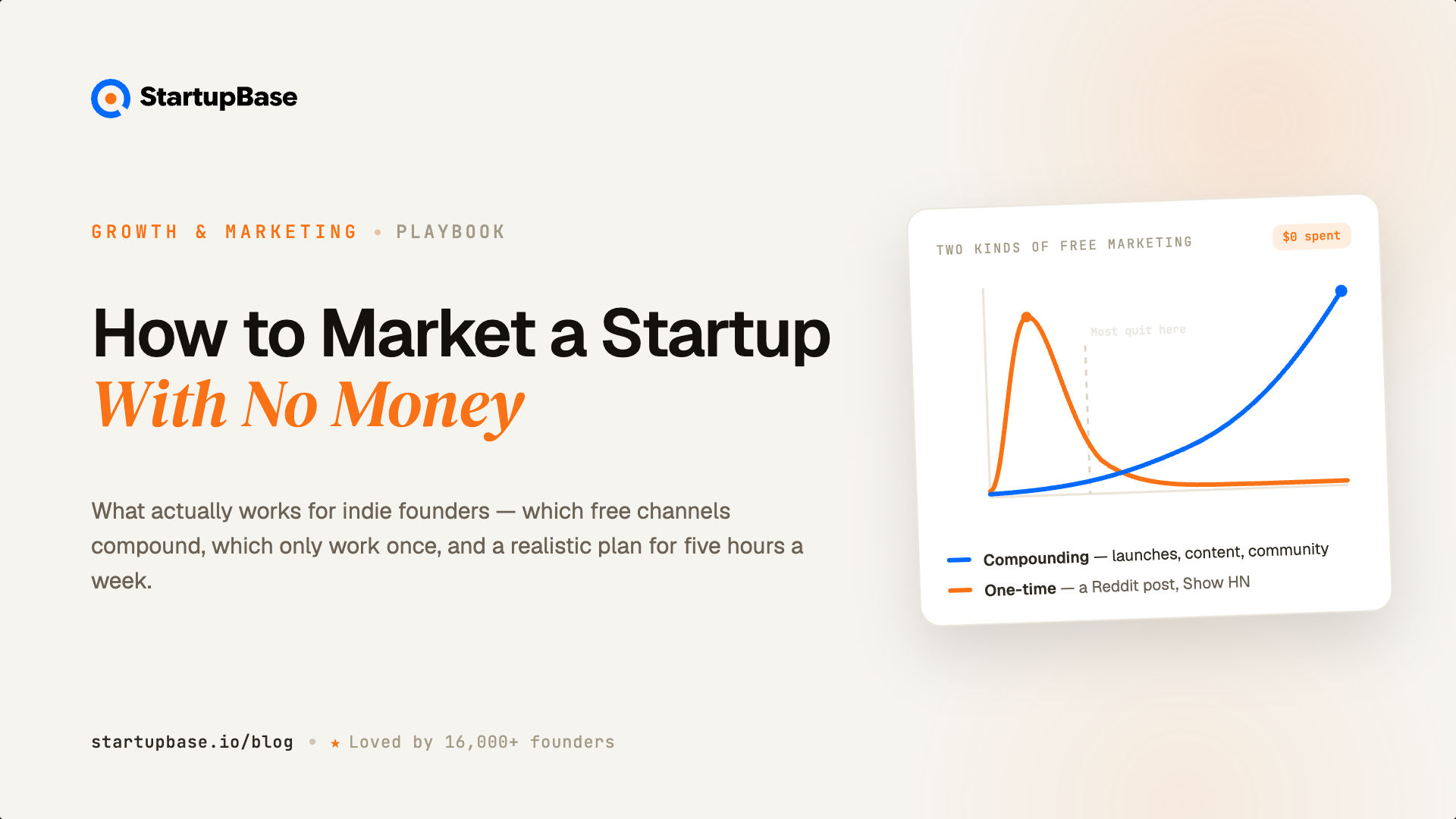
You can market a startup with no money, but free is not free: you pay in time. Pick two channels that compound, such as launching on free platforms and writing content aimed at what your buyers actually search, plus one direct channel like founder outreach for users right now. Give it five hours a week, sustain it for months, and measure what sends real signups.
Quick Answer
Most advice about marketing with no money was written for a florist.
Post on social media. Attend local networking events. Start a referral program. Send an email newsletter. It is not wrong, exactly. It is just so generic that it helps nobody, and it was clearly written by someone who has never had to find the first hundred users for a product that did not exist six months ago.
So here is the version for indie founders, SaaS builders, and people shipping AI tools out of a bedroom with no budget and no audience.
It starts with the part nobody says out loud.
Free marketing is not free
Every free channel costs you time. You are not escaping the price, you are paying it in the only currency you have less of than money.
That matters because your time budget is brutal. If you are building the product, doing support, and handling everything else, you might have five to ten hours a week for marketing. That is it.
Which means the real question is not "what are all the free marketing channels?" There are hundreds, and you can find a listicle for any of them. The real question is: which two or three channels can I actually sustain for six months?
Founders do not fail at free marketing because they picked the wrong channel. They fail because they picked eleven channels, did each one badly for two weeks, and burned out.
Pick fewer things. Do them longer.
The two kinds of free channels
Before you pick anything, understand the difference. Free channels split into two groups, and they do completely different jobs.
| Type | What it does | Payback | Examples |
|---|---|---|---|
| Compounding | Builds an asset that keeps working | Slow, then steady | Launches and listings, SEO content, building in public, community presence, your email list |
| One time | Creates a spike, then stops | Immediate, then zero | Founder outreach, a single Reddit post, Show HN, a launch day push |
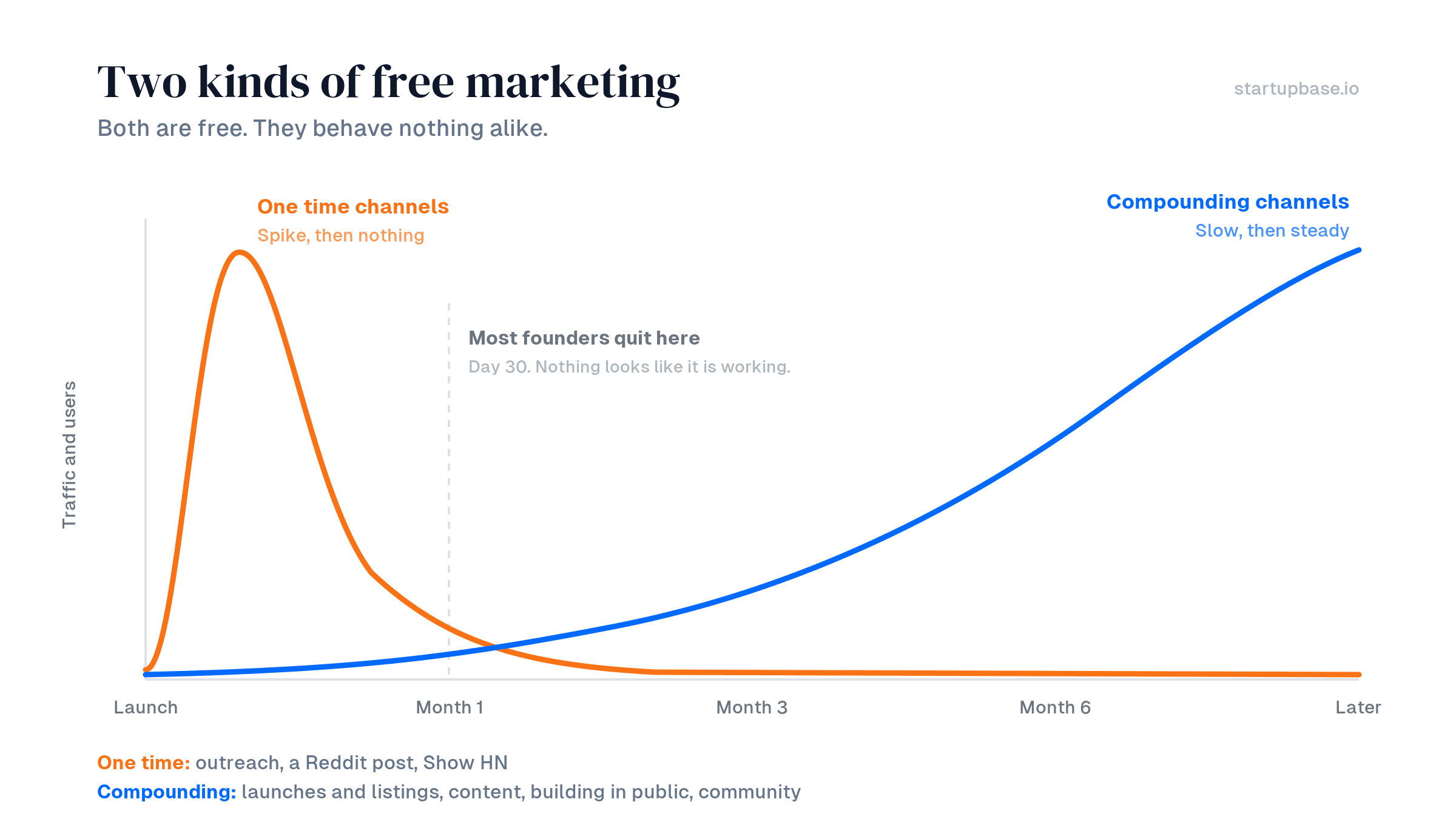
Both are useful. The mistake is expecting one to behave like the other.
One time channels feel productive because something happens today. Compounding channels feel useless for about two months, and then they quietly become the reason people find you at all.
You need both. One time channels keep you alive while the compounding ones warm up. If you only do one time channels, you are on a treadmill forever. If you only do compounding channels, you starve before they pay off.
The plan below is two compounding channels plus one direct channel. That is the whole strategy.
Channels that compound
1. Launch platforms and directories
This is the highest leverage free channel for a new product, because it is the only one where the whole point of the platform is helping people find products like yours. You are not interrupting anyone. They came looking.
The honest version: a launch is not a growth strategy on its own. A single launch day spike fades. What makes launches compound is the listing that stays behind, keeps getting indexed, keeps showing up in category and search pages, and keeps sending trickle traffic months later.
StartupBase is built around exactly this problem. Launching is free. Every approved product gets a real launch spot rather than an editorial lottery, so visibility is not reserved for founders with a network. And your product page keeps working after launch day through rankings, collections, topic pages, reviews, and the newsletter, which is the part that matters when you have no budget: one submission, still sending you traffic in six months.
Free launches join a priority queue, and that is exactly what the free tier is there for. There is a $39 plan that skips the wait and adds a dofollow backlink if you want it later, but you do not need it to launch.
Product Hunt is still worth the launch day if you have any network at all. Then keep going: Uneed, Fazier, Peerlist, and the directories that fit your category. For the full map, see 100+ places to launch, relaunch, and list your product and our guide to the best startup directories to submit your startup.
Time cost: a few hours to prepare your assets once, then twenty minutes per submission.
Do not bulk submit to two hundred directories. It does nothing. Here is why directory submissions help or do not help SEO.
2. Content aimed at what your buyer actually searches
Not "content marketing." That phrase has been ruined by people who publish eight hundred word posts about industry trends and wonder why nothing happens.
Write the specific thing your buyer types into Google when they have the problem you solve. If you built an AI meeting assistant, that is not "the future of work." It is "how to get a transcript of a Zoom call" or "Otter alternative."
This works for founders with no money because it is the only channel where a small site can beat a big one, as long as you are more specific than they are. Big sites write for everyone. You can write for exactly one person with exactly one problem, and you can write from real experience they do not have.
Time cost: high per post, and honestly the slowest channel here. Expect three to six months before anything moves. Which is precisely why you start now instead of later.
Do not publish weekly filler to hit a cadence. One genuinely useful post a month beats four thin ones, and thin content is now actively worthless.
3. Building in public
If you have no audience and no budget, your unfair advantage is that you are doing something most people find interesting: making a thing from nothing.
Share the process. The bug that took two days. The pricing you got wrong. The feature nobody used. Real numbers, including bad ones. Founders and early adopters follow that, and some of them become users. It compounds because the audience persists between launches: by the time you ship, people are already watching.
Time cost: low, maybe twenty minutes a day, but it only works if you keep going for months.
Do not perform it. Announcement posts with no substance get ignored. The currency here is specificity and honesty, especially about failures.
4. Showing up where your users already are
Indie Hackers, Reddit, Hacker News, and whatever niche community your users live in. Discord servers, Slack groups, subreddits with four thousand members who all have your exact problem.
The distinction that matters: this is presence, not posting. Presence compounds. Answer questions for two months without linking anything and you become a person people recognize. Then when you do mention what you built, it reads as a recommendation rather than an ad.
Dropping a link and leaving is the one time version, and it usually gets removed.
Time cost: thirty minutes a day, and it has to be genuine. This does not work if you are faking interest.
Do not treat a community as a distribution channel. They can tell, they have seen a thousand founders do it, and they will punish you for it.
5. Your own email list
The only audience you own. Every other channel on this list rents you attention that can be taken away by an algorithm change.
Start collecting emails before you think you should, even if it is a bare landing page. A hundred people who asked to hear from you are worth more than ten thousand followers.
Time cost: low to set up, moderate to keep interesting.
Channels that work now but do not compound
These do not build anything. They just work, today, which is exactly what you need while the compounding channels warm up.
Founder outreach. Direct messages and emails to people who have the problem. It does not scale, it feels uncomfortable, and it is the single most reliable way to get your first users. Everyone who tells you it does not work has sent forty templated messages and no personal ones.
What a real one looks like: you saw someone describe the problem three days ago, so you reference what they actually said, explain what you built in one line, and ask a question. No pitch, no feature list.
Saw your post about losing track of client feedback across email and Slack. I built a small tool that pulls it into one place, mostly because I had the same mess with three clients. Want me to send a link, or is that not really your problem right now?
Four minutes to write. It works far more often than a template, and it does not scale. All three of those are the point.
A well aimed community post. Not a link drop. A real post in a real subreddit where your users are, sharing something useful with your product as context.
Show HN. Free, huge technical audience, and brutal. If your product is technical and genuinely interesting, it can be the best day you have. It is also a lottery.
Cross posting. You already made the thing. Put the launch on X, LinkedIn, relevant Slack and Discord communities. Costs nothing extra.
If you have literally just launched and need your first users right now, that is a different job from ongoing marketing, and we wrote it up separately: how to get your first 100 users after launching. Money is one way to think about the problem. If you would rather sequence it by stage, that is how to market a startup.
So which two should you pick?
Two compounding channels plus one direct channel. Which two depends on what you built and where your users already are.
| What you are building | Your two compounding channels | Plus one direct channel |
|---|---|---|
| AI tool | Launches and AI directories, plus content aimed at the task it does | Posts in AI subreddits and on X |
| Developer tool | Building in public, plus launches on developer focused platforms | Show HN |
| B2B SaaS | Content aimed at buyer searches, plus launches and review listings | Founder outreach by email |
| Consumer app | Building in public, plus presence in the communities your users live in | A well aimed community post |
| Niche or vertical tool | Content aimed at the exact problem, plus presence in that niche | Direct outreach to people in that niche |
If you cannot tell which row you are, default to launches plus content, with outreach alongside. That combination works for almost every product, and you can adjust once you have sixty days of data.
The wrong answer is all five rows.
A realistic plan for five hours a week
Most marketing advice assumes you have a marketing team. You have Sunday afternoon. So here is what five hours actually buys.
Week one, roughly six hours. Prepare your assets once and reuse them everywhere: a sharp one line description, screenshots, a demo GIF, pricing, and UTM tracked links. This is the boring work that makes every submission afterwards take twenty minutes instead of two hours.
Then, every week:
- Two hours: one piece of content. One post, aimed at one real search, written from experience only you have.
- Two hours: direct outreach. Ten to twenty personal messages to people with the problem. Not templated.
- One hour: presence. Answer questions in two communities. Post one honest build in public update.
Every month or two: a launch or relaunch when you have shipped something real. New directory submissions that fit. A relaunch when you ship a major update, which is the part most founders forget: you are allowed to launch again.
That is it. It is unglamorous and it works, mostly because almost nobody sustains it.
The important part is the measurement. After sixty days, look at which channel sent actual signups, not traffic. Kill the ones that sent nothing. Double the one that worked. You will probably find that one channel is doing eighty percent of the work, and it is rarely the one you expected.
How to measure this without paying for anything
You do not need an analytics stack. You need to answer one question: which channel sent people who actually signed up?
- Put UTM links on everything. Every submission, every post, every message. It takes ten seconds and it is the difference between knowing and guessing. Without them, every channel looks like "direct" and you learn nothing.
- Use Google Search Console. Free, and the only honest source for what people actually search to find you. It is also how you find out your content is ranking for something you never targeted, which happens more than you would think.
- Ask at signup. One optional field: "How did you find us?" It is crude, people skip it, and it is still the most useful early data you will get, because it catches the things analytics cannot see, like someone recommending you in a Slack group.
- Count signups, not visits. A thousand visitors who bounce are worse than useless: they will convince you a bad channel is working. Traffic is a vanity number when you have no budget to waste on it.
Then the rule: at sixty days, any channel that sent zero signups gets dropped. No sentiment. You do not have the hours.
What to expect at 30, 60, and 90 days
Most founders quit free marketing in week three, because they compare week three to what a funded competitor looks like in year two. Here is the honest curve.
Day 30. Launches and outreach are the only things that have produced anything. Your content is invisible. Your build in public posts get four likes, two of them from friends. This is not failure, it is what day 30 looks like for everyone.
Day 60. Community presence starts paying: people recognize your name, and someone else mentions your product without you asking. Your first posts are indexed and ranking somewhere on page four. Outreach is still doing most of the work.
Day 90. Content starts sending its first real trickle. Your launch listings are still bringing in people months later, which is the moment the compounding idea stops being theoretical. You now have enough data to know which channel deserves the next ninety days.
Month six. The compounding channels overtake the one time ones, and marketing stops feeling like pushing a boulder every week.
If you quit at day 30, you paid the entire cost of the compounding channels and collected none of the payoff. That is the actual mistake, and it is more common than picking the wrong channel.
What not to do when you have no budget
- Do not bulk submit to two hundred directories. It feels productive and does nothing. A focused listing on a few real platforms beats a hundred autogenerated ones.
- Do not buy followers, upvotes, or engagement. It fools nobody, and on launch platforms it gets you removed.
- Do not run ads yet. With no budget and no proven conversion, ads burn money you do not have to buy traffic you cannot convert. Ads amplify a working funnel. They do not create one.
- Do not spray eleven channels at once. Two compounding, one direct. That is the plan.
- Do not wait until the product is perfect. The first launch gives you data, and the relaunch is where you use it.
FAQ
Can you really market a startup with no money?
Yes, and most bootstrapped products are marketed this way. But free is not free: you pay in time. The realistic version is two compounding channels and one direct channel, sustained for months, rather than eleven channels done badly for two weeks.
What is the best free marketing channel for a startup?
For a brand new product, launch platforms and directories, because the audience is already there looking for new products. For the long game, content aimed at what your buyers actually search. Most founders should do both, plus direct outreach while those warm up.
How long does free marketing take to work?
Direct outreach and launches work immediately. Content and SEO typically take three to six months. Building in public and community presence take about two months before they mean anything. That gap is why you run both types at once.
How much time does marketing a startup take?
Five to ten hours a week is realistic for a solo founder, and enough if you are focused. One content piece, some real outreach, and consistent presence in two communities will outperform a scattered forty hour month.
Should I launch on Product Hunt if I have no money and no audience?
Yes, launching is free, but do not stake everything on it. The 24 hour format rewards existing networks and the spike fades. Pair it with a platform where your listing keeps working afterwards, and treat launch as one day in a sequence rather than the whole plan.
Do I need to be on every social platform?
No. Pick the one where your users already are and be genuinely present there. Five platforms updated occasionally is worse than one platform where you actually show up.
Final thoughts
Marketing with no money is not about finding a clever free hack. It is about accepting the constraint honestly: you have time, not money, and less time than you think.
So spend it on things that keep working after you stop touching them. A listing that keeps getting found. A post that answers a question people search every month. A reputation in a community. An email list you own. Then, while those warm up, talk to people directly, because that is what actually gets you your first users.
Product Hunt gets you attention. StartupBase keeps you discoverable. Both are free to launch on, and that is the point: with no budget, the channels that keep working are the only ones worth your Sunday.
Launching something new?
Startup Marketing
Bootstrapped Founders
Free Marketing
Startup Growth







 Continue with Google