
Twelve newsletters worth launching a startup in, covering general launch newsletters like Product Hunt, StartupBase and Uneed, developer newsletters like Console.dev and Cooper Press, and audience-specific ones like Android Weekly and Dense Discovery. Each entry covers who reads it, how to submit, what it costs, and what to expect afterwards.
Quick Answer
A newsletter feature is an unusual kind of marketing, because the audience already did the hard part. Nobody subscribes to a launch newsletter by accident. They signed up to be told about new products, they open the email deliberately, and they arrive willing to click. An ad has to interrupt someone doing something else first.
That gap shows up in the numbers publishers are willing to print. Console.dev, which is one of the smaller lists here at 30,000 subscribers, states on its advertising page that 68 percent of its readers have signed up for a tool the newsletter featured. Very few publishers put a figure like that in public, and it explains why a small list matched to your audience will usually do more than a large one that is not.
This list is the sequence we would work through, not a ranking by size. It starts with the general launch newsletters, which suit almost any product, moves to the ones tied to a specific audience, and ends with two that ask something extra of you first. Subscriber counts and prices come from each publisher's own site and were checked in August 2026.
The twelve at a glance
| Newsletter | Audience | Subscribers | Cost to get in |
|---|---|---|---|
| Product Hunt | Founders, makers, early adopters | 800,000 | Free |
| StartupBase | Founders, makers, early adopters | 14,300 | Free, or $39 for a set date |
| Uneed | Founders, indie hackers | 22,000 | From $14.99 |
| BetaList | Early adopters, pre-launch products | 60,000 | Paid, refunded if not selected |
| Smol Launch | Indie makers | 2,500 | Free |
| Console.dev | Senior developers, engineering leads | 30,000 | Free |
| Cooper Press (seven titles) | Developers by language | 443,777 total | Free, or classifieds from $180 |
| Android Weekly | Android and Kotlin developers | 57,000 | Free |
| iOS Dev Weekly | Swift and Apple developers | 40,000 | Free |
| Dense Discovery | Designers, developers, creatives | 36,000 | Classifieds from $79 |
| Hacker Newsletter | Developers, technical founders | 70,000 | Free via Hacker News, or $150 |
| Starter Story | Aspiring founders | 247,000 | Free |
1. Product Hunt
The default, and the largest audience on this list. The sponsorship page puts the newsletter at 800,000 subscribers, though a lower figure of 500,000 appears elsewhere on the same page, so treat it as large rather than precise.
Listing is free and takes about ten minutes once you have an account. The daily email carries only a few of the day's launches, so the newsletter is the upside rather than the plan. The listing earns its keep on its own, since a Product Hunt page ranks, collects reviews and gives you something to point at for years afterwards. Editorial pitches go to [email protected], and the .co is deliberate rather than a typo.
2. StartupBase
Ours, and it sits second because it is the other general launch newsletter where a small product still gets in for nothing.
The newsletter goes to 14,300 subscribers, the site sees over 40,000 monthly visitors, and the Domain Rating is 72, which matters if the link is worth as much to you as the traffic.
Launching is free and joins the queue, which runs about four to five weeks, and the free tier asks for a StartupBase badge on your site. Products that do well on launch day appear in the newsletter, and there is an editor picks section each week drawn from a submission thread we post on X, which costs nothing to reply to.
If you want a date you control rather than a queue position, a Premium launch is $39 one time and guarantees a homepage feature on the day you pick. A newsletter sponsorship, one sponsor per issue at the top of the email, is $59.
3. Uneed
A daily launch platform reaching 22,000 subscribers at a 40 percent open rate, which is high for this category.
A lot of older advice about Uneed is now wrong. The free waiting line closed on 17 August 2026, after the queue passed six months. Submitting is still free, but launching goes through a paid route: $14.99 to fast track, $29.99 to skip the line. A newsletter sponsorship is $399.
A short queue you pay $14.99 for is arguably more useful than a free one that took half a year, though it does mean the free option people remember is gone.
4. BetaList
The long-running home for products that have not launched yet, reaching around 60,000 early adopters who enjoy trying unfinished things.
All submissions are paid now, which their support page states directly. The part worth knowing is that if your product is not selected, the payment is refunded in full and automatically, so the fee filters the queue rather than buying you a place in it. Boost placements run $99 a week on what they describe as introductory pricing.
Pre-launch and private beta is a slot almost nothing else covers. Most launch platforms want something people can sign up for today.
5. Smol Launch
The newest platform here and the easiest to do well on. The newsletter goes to about 2,500 makers, and the competition is correspondingly light. When we looked, the product sitting at the top of the week had 20 upvotes.
Free submissions get one of thirty launch slots a week, and the free tier covers your first launch. Relaunches are paid.
Twenty supportive people is a bar you can clear by asking, which is not true anywhere else on this list. That makes it a good rehearsal before a launch that matters more.
6. Console.dev
The one we would send a developer tool to before anything above it.
The list is around 30,000 people and unusually senior, with 77 percent having written code for five or more years. Paired with that 68 percent signup figure, it is the clearest case on this list for choosing a small audience over a large one.
Submissions are an email to [email protected], and they publish the criteria they judge against, which is worth reading even if you never submit. Roughly: a developer has to be the actual user, signup has to be self-service, and it needs to suit power users through an API or a command line. There is a separate track for beta releases.
One warning. Their write-ups include a section on what they did not like, so submit only if you can take that in public.
7. Cooper Press
Seven newsletters under one publisher totalling 443,777 subscribers, split by language and framework: JavaScript Weekly, Frontend Focus, Node Weekly, React Status, Go Weekly, Ruby Weekly and Postgres Weekly.
Editorial contact is [email protected], and replying directly to an issue works too. Free inclusion strongly favours open source tooling with a real repository behind it. Commercial products tend to get pointed at the classifieds, which start at $180 an issue for a short line and a link.
Aim at the smaller titles first. Postgres Weekly is 17,282 subscribers with a 47 percent open rate, the highest in the group, and it is far easier to get into than JavaScript Weekly at 166,592.
8. Android Weekly
The simplest submission mechanics of anything here. One field on the homepage, no account, no sign-in, no rule against commercial products.
The newsletter reaches 57,000 developers. A larger figure appears on the site, but that combines the email list with social following, so 57,000 is the number to plan around. They also give you a badge for a repository README once you have been featured, which tells you how they see the relationship.
9. iOS Dev Weekly
The Apple platform equivalent, reaching more than 40,000 developers, with a submission form that includes an option for saying you wrote the thing yourself. Self-submission is expected rather than tolerated.
One change most lists have not caught. Dave Verwer handed the newsletter over in May 2026 after running it for more than a decade. It was acquired by Mobile Seasons GmbH, the company behind droidCon, and issues are now written by a rotating team of iOS developers. Still weekly, still good, different voice.
10. Dense Discovery
A weekly for designers, developers and people who care about how things are made, at 36,000 subscribers. What makes it interesting is a 63 percent open rate and 13 percent click rate, both far above normal here.
There is no free route, so this one is paid. Classifieds start at $79, priced deliberately for independent makers, with a discount for members of their supporter programme. Slots go quickly, so book further ahead than you expect to need.
11. Hacker Newsletter
A weekly digest of the best of Hacker News, reaching around 70,000 developers and technical founders.
There is no submission form and no point looking for one, because everything is curated from what already performed on Hacker News. The free route in is therefore to do well on Hacker News itself, which is a separate project with its own rules and its own failure modes.
The paid route is a $150 classified, a short line of text alongside a few others. For a technical product that is a lot of attention from the right people for the money.
12. Starter Story
The largest free route here at 247,000 subscribers, and the one that asks most of you.
Starter Story publishes founder interviews built around revenue, and states plainly that there is no cost to be featured. Submission is free but now sits behind a login. They were acquired by HubSpot in February 2026, which has not changed the format.
The barrier is not money, it is timing. This works once you have a revenue figure you are willing to publish. If you launched last week, come back later.
What changed this year
Three things happened in 2026 that make older advice on this subject unreliable, and they are worth knowing before you follow a list written last year.
Free submission routes tightened. Uneed closed its free waiting line in August after the queue passed six months. BetaList moved to paid submissions across the board. Neither publisher was being greedy: building and shipping software got much cheaper over the past two years, a great many more products exist, and a free queue only works while a human can read it.
Ownership changed at two of the biggest. Starter Story was acquired by HubSpot in February. iOS Dev Weekly changed hands in May. Both still run well, but the people deciding what gets featured are not the people who decided a year ago.
And some of the newsletters still being recommended have stopped publishing. It is worth opening the most recent issue of anything you are about to spend a week preparing for.
What actually happens after you get featured
Nobody writes about this part, so here is what to expect.
The traffic arrives in one day and then stops. A newsletter feature is a spike, not a channel. You will see most of the visits within about six hours of the send, a smaller second wave from people who open the email late, and very little after 48 hours. Plan the landing page and the signup path before the send, because there is no second chance at that audience.
The signups convert better than almost anything else you will do. These readers arrived deliberately, from a source they trust, having read a sentence that told them what your product does. That is a much warmer visitor than a click from an ad.
The lasting value is usually the archive rather than the email. Most of these publishers keep their issues on the web, several rank, and a few give you a followed link. Six months later the email is long gone and the archive page is still sending occasional visitors, which is the same reason getting listed on review sites pays off slowly rather than immediately.
And one feature is rarely enough. The founders who get real results from this treat it as a run of six or eight submissions over a couple of months, not a single launch day.
How to submit without being ignored
Most submissions fail for a handful of reasons, all fixable.
Read the criteria first. Console.dev publishes exactly what it judges against. Starter Story wants a revenue number. Cooper Press leans toward open source. Sending the same paragraph everywhere is obvious to someone who reads a hundred of them a week.
Write the sentence they would have written. These editors are assembling a list, not judging a pitch. Give them one clean sentence saying what the product is and who it is for. A submission that can be pasted straight into the issue beats one that needs rewriting.
Start with the smaller lists. Postgres Weekly is easier than JavaScript Weekly, and Smol Launch is easier than Product Hunt. Being featured somewhere small helps the next submission too, because curators look at what other curators picked.
Submit earlier than feels necessary. Most of these publish weekly and several have queues. If you want coverage in launch week, send it a month before.
Expect silence. Very few of these reply to say no. One follow-up after two weeks is reasonable. A second is not.
Questions people ask
Which newsletters can I get featured in for free?
Product Hunt, StartupBase, Smol Launch, Console.dev, Cooper Press by email, Android Weekly, iOS Dev Weekly and Starter Story all take free submissions. Uneed keeps submissions free but charges to launch, and BetaList charges up front while refunding automatically if you are not selected.
How many subscribers does a newsletter need to be worth it?
Fewer than you would think. Console.dev is 30,000 people and reports that 68 percent of readers have signed up for a tool it featured, which beats a much larger list with a passive audience. Relevance and your odds of being included matter more than reach.
What is the cheapest paid placement?
Uneed's fast track at $14.99, StartupBase at $39 for a launch date you choose or $59 for a sponsored slot in the newsletter, Dense Discovery classifieds from $79, and Hacker Newsletter at $150 in front of around 70,000 developers.
Should I submit to all of them at once?
No. Pick two or three that match your audience and give each a proper submission, then work through the rest over the following weeks. Ten rushed submissions perform worse than three considered ones.
Do newsletter features help with SEO?
Indirectly. The email is traffic rather than a link, but most publishers keep a web archive and several launch platforms give you a followed link from your product page. Check the link attributes before buying anything on that basis alone.
What if I am launching a browser extension or a mobile app?
The stores matter more than the newsletters in both cases, since that is where people search. We covered the extension version of this in where to launch a Chrome extension.
Where to start
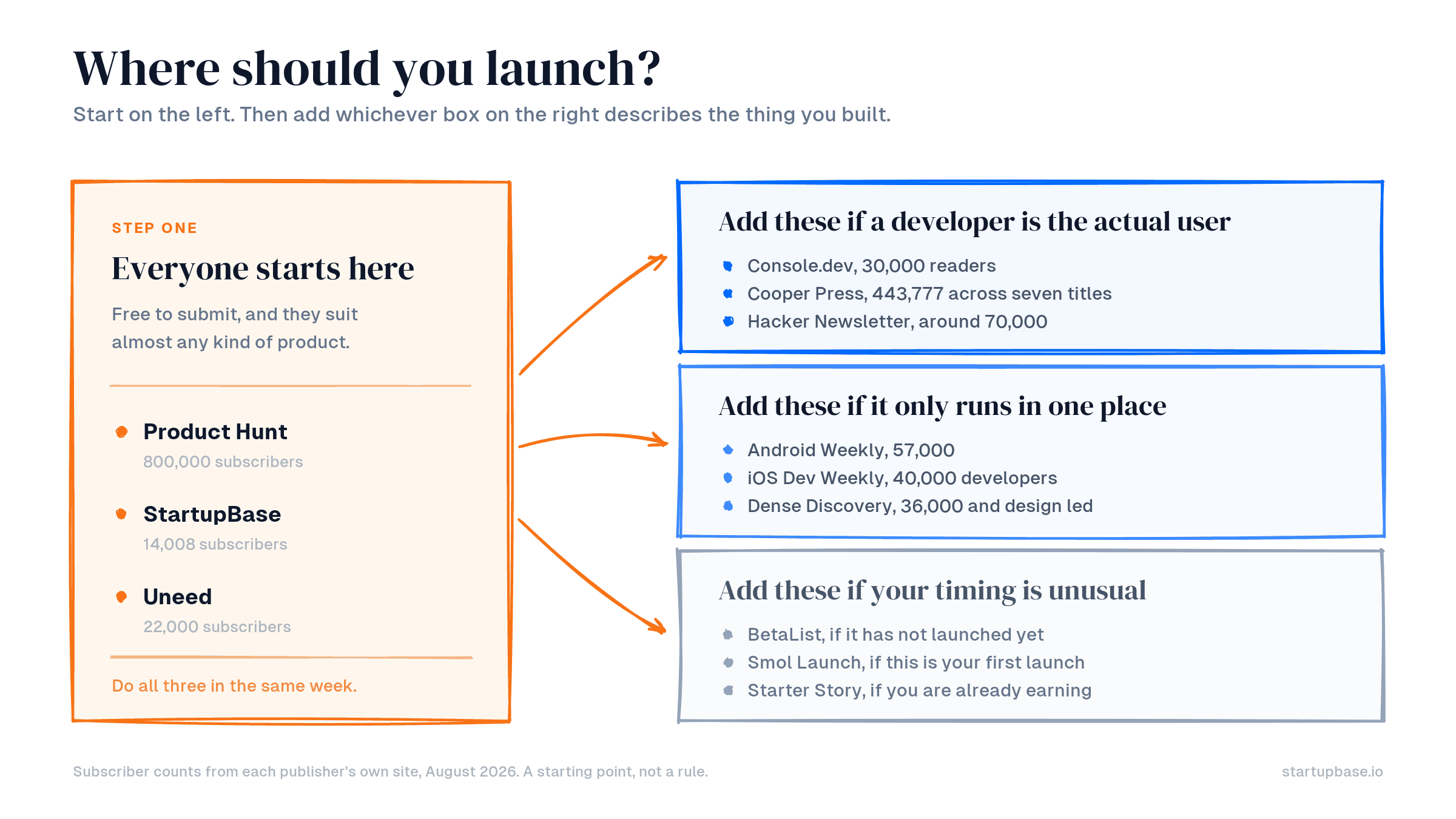
If you are building a developer tool, go to Console.dev first, then Cooper Press at the smallest relevant title, then Android Weekly or iOS Dev Weekly depending on your platform.
If you are building something general, launch on Product Hunt and StartupBase in the same week, and use Uneed's fast track for a third at a low price. Add Smol Launch if this is your first launch and you want an easy win to build on.
If your product is not finished, BetaList exists for exactly that, and almost nothing else does.
If you are already making money, spend an afternoon on a Starter Story submission. It is the largest free audience here, and revenue is the only ticket it asks for.
Startup Launch
Product Discovery







 Continue with Google