
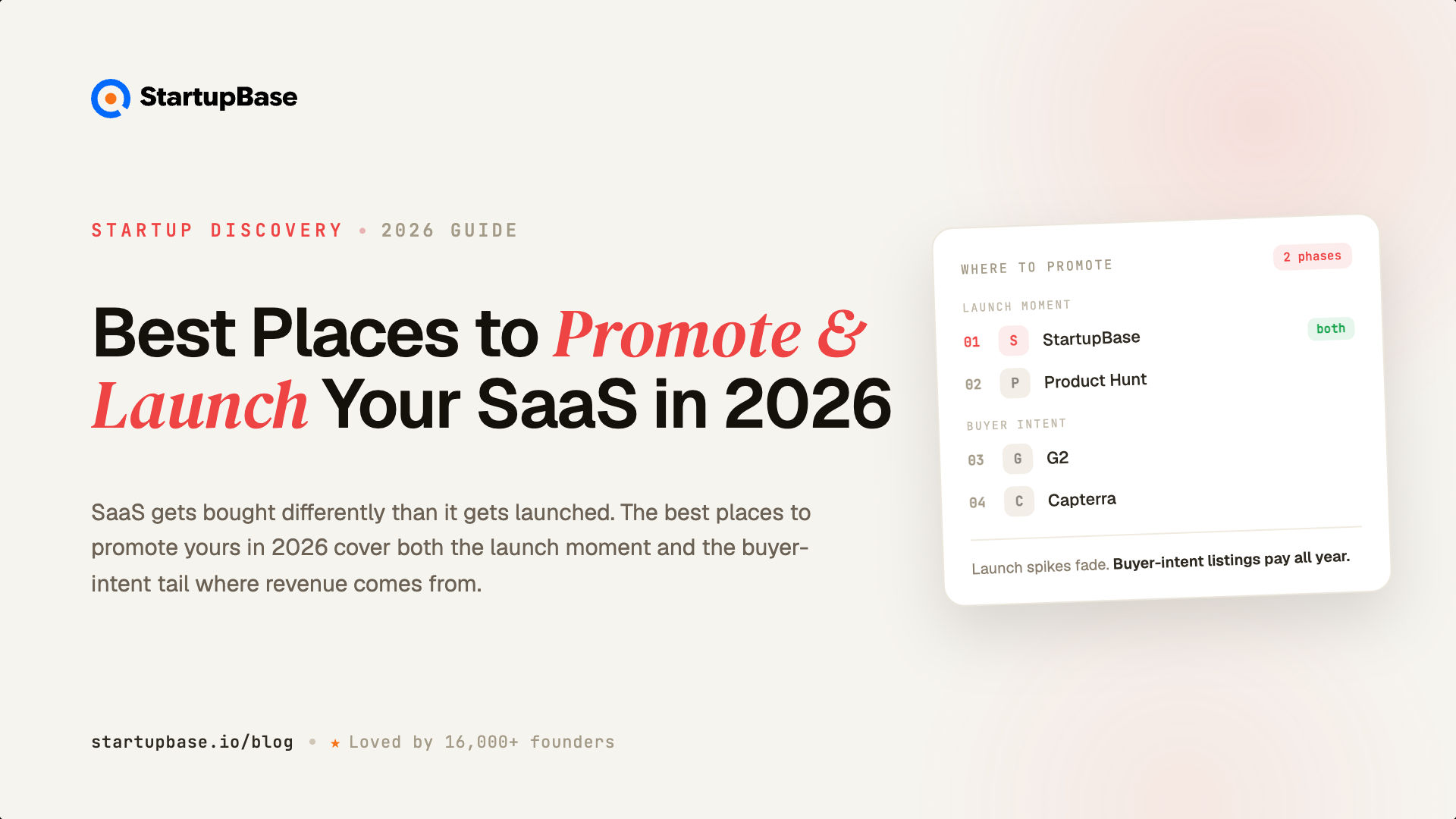
SaaS gets bought differently than it gets launched. Launch day brings a spike of makers and early adopters, but your paying buyer shows up months later comparing tools with intent, so you have to promote for both. Start with a real launch on StartupBase and Product Hunt, then build the buyer intent tail: reviews on G2 and Capterra, and listings on SaaSHub and AlternativeTo where buyers compare. Match the channels to whether your SaaS is B2B, self serve, or developer facing.
Quick Answer
Most SaaS promotion advice treats launching and selling as the same job. They are not.
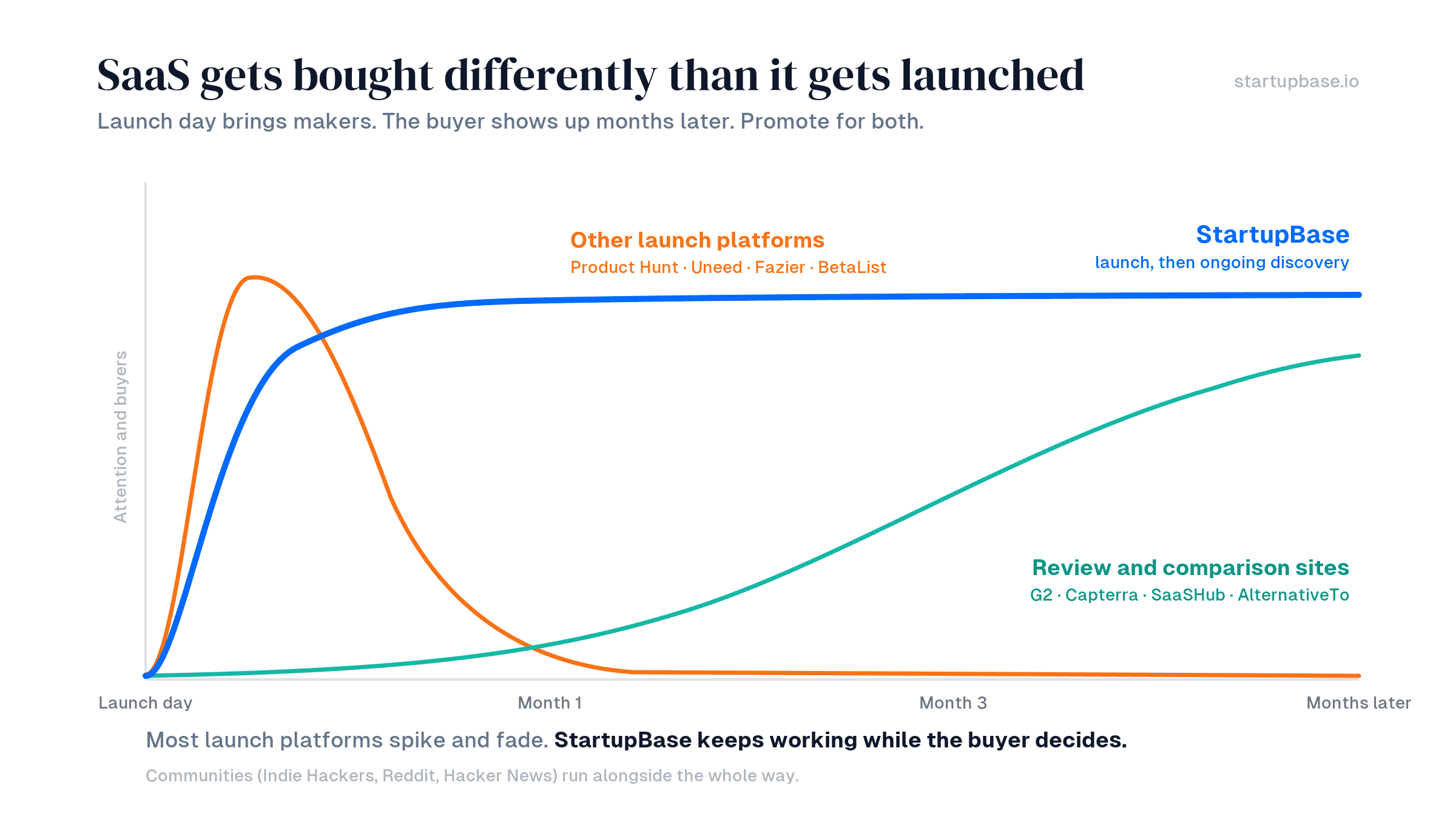
Launch day brings you a spike of makers, early adopters, and other founders. Useful people, but mostly not your buyer. Your actual paying customer usually shows up months later, when they have the problem, a budget, and three tabs open comparing tools.
That gap is the whole thing. Promote only for the launch and you get a good day and a quiet quarter. The SaaS that compound promote for both: the launch moment, and the long buyer intent tail where the revenue actually is.
This guide covers the best places to promote and launch your SaaS in 2026, split by the job each one does. It starts with StartupBase.
Two audiences, not one
Before the list, the idea that should shape all of it.
The launch crowd is browsing. They like new products, they will try yours, they will give feedback, and a good number will churn in a week. This audience is real and worth having. It is just not where most SaaS revenue comes from.
The buyer is searching. They are not on a launch platform on a Tuesday for fun. They are on G2 reading reviews, on AlternativeTo looking for a replacement, or asking an AI assistant which tool fits their team. They arrive with intent, weeks or months after your launch day, and they convert far better.
Most founders pour everything into the first audience and almost nothing into the second. Then they wonder why a big launch day did not turn into customers.
You need channels for both.
The launch: get seen
Launch platforms give you the moment: a spike of attention, early users, feedback, and social proof. Start here, but do not stop here.
StartupBase (our pick)
We put StartupBase first because it does both jobs, the launch and the tail, which most launch platforms do not.
- Every approved product gets a real launch spot. No black box, no lottery. If it is approved, it launches.
- Your product keeps working after launch day. It keeps surfacing through daily launches, weekly and monthly rankings, curated collections, topic pages, and the newsletter. That is the tail most launch platforms do not have.
- You can collect reviews right on your listing. Social proof starts building from launch day, on the same page people discover you, instead of waiting until you have earned a profile elsewhere.
- The $39 plan includes a DR 72 dofollow backlink, plus a guaranteed homepage feature and the option to launch the same day.
Use it when you are launching or relaunching a SaaS and you want it to keep getting found. Here is how to launch on StartupBase.
👉 Submit your product to StartupBase
Product Hunt
Product Hunt has the biggest launch day audience anywhere. If you can rally support, the reach and social proof are unmatched, but the spike fades after 24 hours and the crowd skews maker rather than buyer. See Product Hunt vs StartupBase.
Uneed
Uneed is a clean, maker friendly launch platform with rolling leaderboards and a newsletter. A good complementary launch surface alongside your main one. If you are weighing it, see the best Uneed alternatives.
Fazier
Fazier is a simple product discovery platform for SaaS, AI, and indie tools. Another credible launch surface without a complicated submission.
BetaList
BetaList takes early stage products, so it fits if you are still collecting early users before a full public launch. It is curated and slow, typically about two months, so submit early. Compare it in the best BetaList alternatives.
The buyer intent tail: be there when they compare
This is the part most founders skip, and it is where SaaS is different from a consumer app. Your buyer does independent research before they ever contact you. They compare tools, read reviews, and increasingly ask an AI assistant to shortlist options. The sites below are where that happens.
This is also where StartupBase keeps earning its place after launch day. The listing does not expire at midnight: it keeps surfacing through search, rankings, collections, and topic pages while buyers are still looking, which is the whole reason we put it first. The review and comparison sites below are where the highest intent buyers actually commit, so you want both.
G2 and Capterra
The biggest shift in SaaS discovery in 2026: G2 acquired Capterra, GetApp, and Software Advice from Gartner early in the year. That puts the largest B2B review sites under one roof, with millions of verified reviews and a very large buyer audience.
Why it matters for you: a growing share of buyers research these sites, and the AI assistants they now ask for recommendations lean heavily on review site content. If your product has a thin profile or no reviews, you are invisible at the exact moment a buyer is deciding. We tested how that plays out in practice in how to get your startup recommended by ChatGPT.
Best for: B2B SaaS that can gather customer reviews.
Reality check: the value is the reviews, and reviews take time and asking. A profile with none does little. A profile with fifty real ones can carry a deal.
SaaSHub
SaaSHub is a software directory and alternatives site. A listing keeps sending comparison traffic over time, and it is simpler to get onto than the big review platforms. For more options here, see the best SaaSHub alternatives.
AlternativeTo
AlternativeTo captures people searching for an alternative to a specific tool. If you compete with a known product, being listed there earns long tail comparison traffic from buyers who are already close to switching.
Community: feedback and first users
Communities run alongside both stages. They are where you get honest feedback and your first real users. Show up like a builder, not a billboard.
Indie Hackers
A community of bootstrapped and solo founders. Share a story, a lesson, or a revenue milestone, and your SaaS gets attention from people who understand what you are building.
Subreddits like r/SaaS, r/startups, and niche communities for your category are full of potential users. The right post in the right subreddit sends targeted traffic and blunt feedback. Read the rules first.
Hacker News
Hacker News works when your SaaS is technical or interesting to developers. A clear, honest Show HN post can bring serious traffic and early users, but the crowd is sharp.
Which channels for your kind of SaaS
Not every SaaS promotes the same way. What you build decides where your buyer actually is.
| Your SaaS | Launch | Buyer intent tail | Community |
|---|---|---|---|
| B2B SaaS | StartupBase, Product Hunt | G2 and Capterra, gather reviews early | LinkedIn, niche Slack groups |
| Self serve or PLG | StartupBase, Product Hunt, Uneed | AlternativeTo, SaaSHub, content and SEO | Reddit, Indie Hackers |
| Developer facing SaaS | StartupBase, Show HN, DevHunt | StackShare, AlternativeTo | Hacker News, Dev.to |
If you sell to businesses, reviews are your priority, because your buyer will not commit without them. If you are self serve, comparison and search traffic matter most, because your buyer signs up without ever talking to you. If you sell to developers, the technical communities do more than any review site.
Reviews are the moat
One point deserves its own line, because it is the thing founders under invest in most.
Anyone can launch. Anyone can list. Nobody can copy your reviews.
A competitor can clone your features, undercut your price, and out spend you on ads. They cannot manufacture two years of real customers saying your product solved their problem. On review sites, that is the asset that compounds, and it is the one that AI assistants and buyers both trust.
So start collecting reviews the day you have happy customers, not the quarter you decide to care about G2. Ask right after a win, when the goodwill is fresh. Your StartupBase listing has reviews built in, so you can start on launch day, then earn G2 and Capterra reviews as your buyer base grows. It is slow, unglamorous work, and it is the closest thing SaaS has to a durable moat.
A promotion sequence for SaaS
The mistake is treating launch as one event. A better launch is a sequence that seeds both audiences.
- Prepare your assets: a sharp tagline, screenshots, a demo, pricing, and a first comment.
- Submit your product to StartupBase for a real launch spot and ongoing discovery.
- Launch on Product Hunt for the biggest day one spike.
- Add Uneed, Fazier, and BetaList for extra launch visibility.
- Claim your G2 and Capterra profiles now, even if you cannot fill them with reviews yet. Being present early matters.
- List on SaaSHub and AlternativeTo to capture buyers comparing tools.
- Ask your first happy customers for reviews, and keep asking after every win.
- Share a story or lesson on Indie Hackers, and post in relevant subreddits.
- Relaunch when you ship a major update.
The first four steps serve the launch. The rest serve the buyer, which is the half most founders never finish. For a bigger map, see 100+ places to launch, relaunch, and list your product and our guide to the best startup directories to submit your startup. Promotion for SaaS is stages three and four of how to market a startup, if you want the sequence from the beginning.
What to prepare before you promote your SaaS
Prepare your assets once and reuse them everywhere.
You will need a clear one line description, a short and long description, a logo, two or three screenshots, a demo video or GIF, pricing, a launch offer if you have one, and UTM tracked links so you can measure what works.
Do not lead with vague copy like "an AI powered platform to boost productivity." Say what it does, who it is for, and the outcome it creates. Clarity wins, especially with buyers comparing several tools at once.
FAQ
Where should I promote my SaaS in 2026?
Cover both stages. For the launch, StartupBase and Product Hunt. For the buyer intent tail, G2 and Capterra for reviews, and SaaSHub and AlternativeTo for comparison traffic. Add communities like Indie Hackers and Reddit for feedback throughout.
What is the best place to promote a SaaS for free?
StartupBase, Product Hunt, AlternativeTo, Indie Hackers, and Reddit all have free paths. StartupBase free launches join a priority queue, while the $39 plan skips the wait and adds a dofollow backlink.
Are G2 and Capterra still separate?
No. G2 acquired Capterra, along with GetApp and Software Advice, from Gartner in early 2026. They are now part of the same company, which makes a strong review presence there more important, not less.
Do SaaS directories and review sites help SEO?
Good listings support brand discovery, referral traffic, indexed pages, and backlinks, and review sites increasingly feed the AI assistants buyers use to shortlist tools. Low quality bulk submissions do little. For the full picture, read do startup directories help SEO.
How many places should I promote my SaaS?
Start with a launch platform or two, your G2 and Capterra profiles, two or three comparison listings that fit your buyers, and one or two communities. Measure which send real signups, then expand.
What is the difference between a launch platform and a review site?
A launch platform creates a moment of attention and early adopters. A review site captures buyers who are already comparing tools with intent to buy. SaaS needs both, because they reach two different audiences at two different times.
Final thoughts
Promoting a SaaS is not about finding one magic channel. It is about respecting the fact that the people who show up on launch day and the people who actually buy are usually not the same people, and they do not arrive at the same time.
Launch for the first audience. Build reviews and comparison presence for the second. StartupBase is built to be the first of those, the launch that keeps getting discovered long after day one, so your product is still there when the buyer finally starts looking.
Launching something new?
Startup Launch
Product Discovery
SaaS Marketing
SaaS Directories







 Continue with Google