
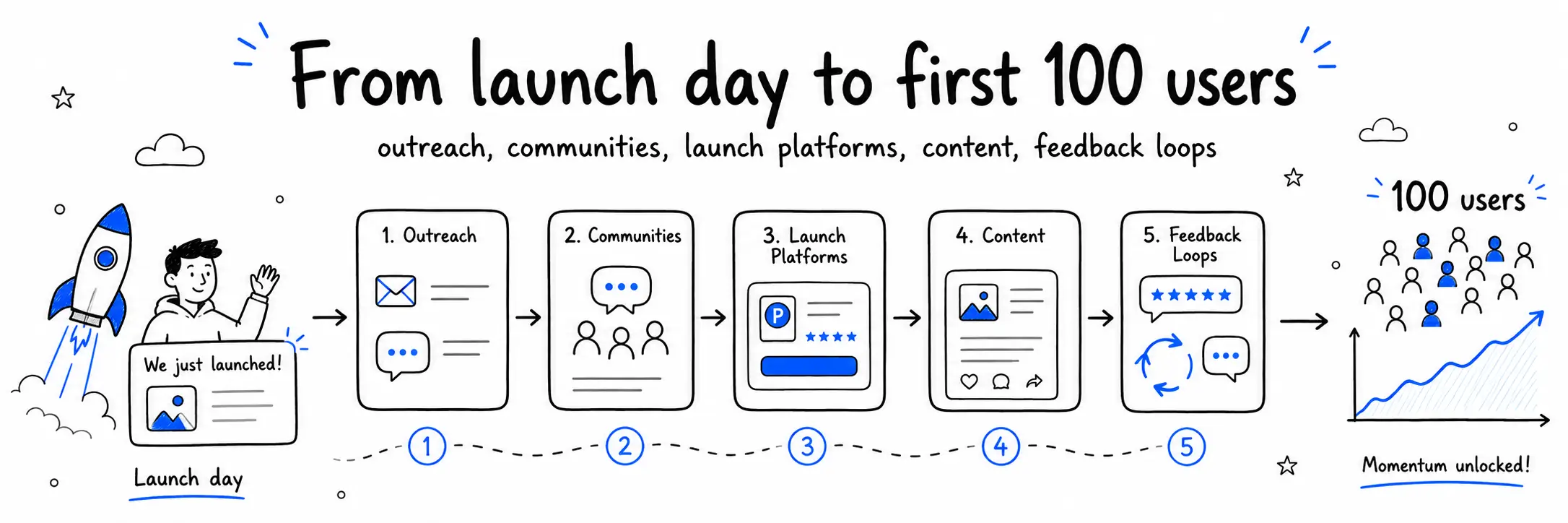
Getting your first 100 users after launch is not about waiting for a viral moment. It is about manually creating momentum. Start with the exact people who feel the problem, reach out directly, share your story in the right communities, launch on discovery platforms, and collect feedback as fast as possible. The first 100 users are not just a growth milestone. They are the signal that tells you what to fix, what to repeat, and where your startup actually has a chance.
Quick Answer
Launching your startup feels like a big moment.
You publish the website, share the link, and announce it on X, LinkedIn, Product Hunt, StartupBase, Reddit, and maybe a few communities.
Then reality hits.
The traffic spike fades within a day or two and the signups slow to nothing. The product is live, and now you need real users.
This is the part many founders underestimate. Launching is not the finish line. It is the beginning of distribution.
Your first 100 users will usually not come from one viral post, one listing, or one launch day. They come from repeated visibility, direct outreach, community sharing, feedback loops, and showing up in the places where your target users already spend time.
The goal is not just to get 100 random signups. The goal is to get 100 people who can teach you what your product should become.
Start with a clear first user profile
Before you chase traffic, get clear on who you are trying to reach.
A weak answer sounds like this:
Our product is for startups.
That is too broad.
A better answer sounds like this:
Our product is for solo founders launching AI tools who need their first users without spending money on ads.
Now you know where to look, what to say, and what pain to lead with.
Your first user profile should answer a few simple questions:
- Who has the problem right now?
- Where do they already talk about this problem?
- What are they using today instead of your product?
- Why would they care enough to try something new?
- What outcome would make them tell someone else?
Most founders skip this and start posting everywhere. That is lazy distribution. It feels productive, but it usually brings weak traffic.
You do not need everyone. You need the right first 100.
Do founder led outreach first
Your first users should come from manual work.
That means sending messages. Asking for feedback. Replying to people. Joining conversations. Looking for people already complaining about the problem you solve.
This does not scale, and that is exactly why it works.
At the start, scalable marketing is often a trap. You do not yet know which message works, which segment cares most, or what makes someone sign up. Founder led outreach gives you that learning fast.
Start with people close to the problem:
- People in your network
- People who liked or commented on your launch post
- People who use competing tools
- People asking related questions on Reddit, X, LinkedIn, Slack, or Discord
- People who recently launched a similar product
- People who joined your waitlist but did not activate
Do not send a long pitch.
Send a short, specific message.
Example:
Hey, I noticed you are building a hiring tool for startups. I just launched a product that helps founders get more visibility after launch. Thought it might be useful. Want me to send it over?
That is better than dumping a full product description into someone’s inbox.
Your only job in the first message is to start a conversation.
Share your launch story, not just your link
Most launch posts are boring because they only say, “We launched.”
Nobody cares.
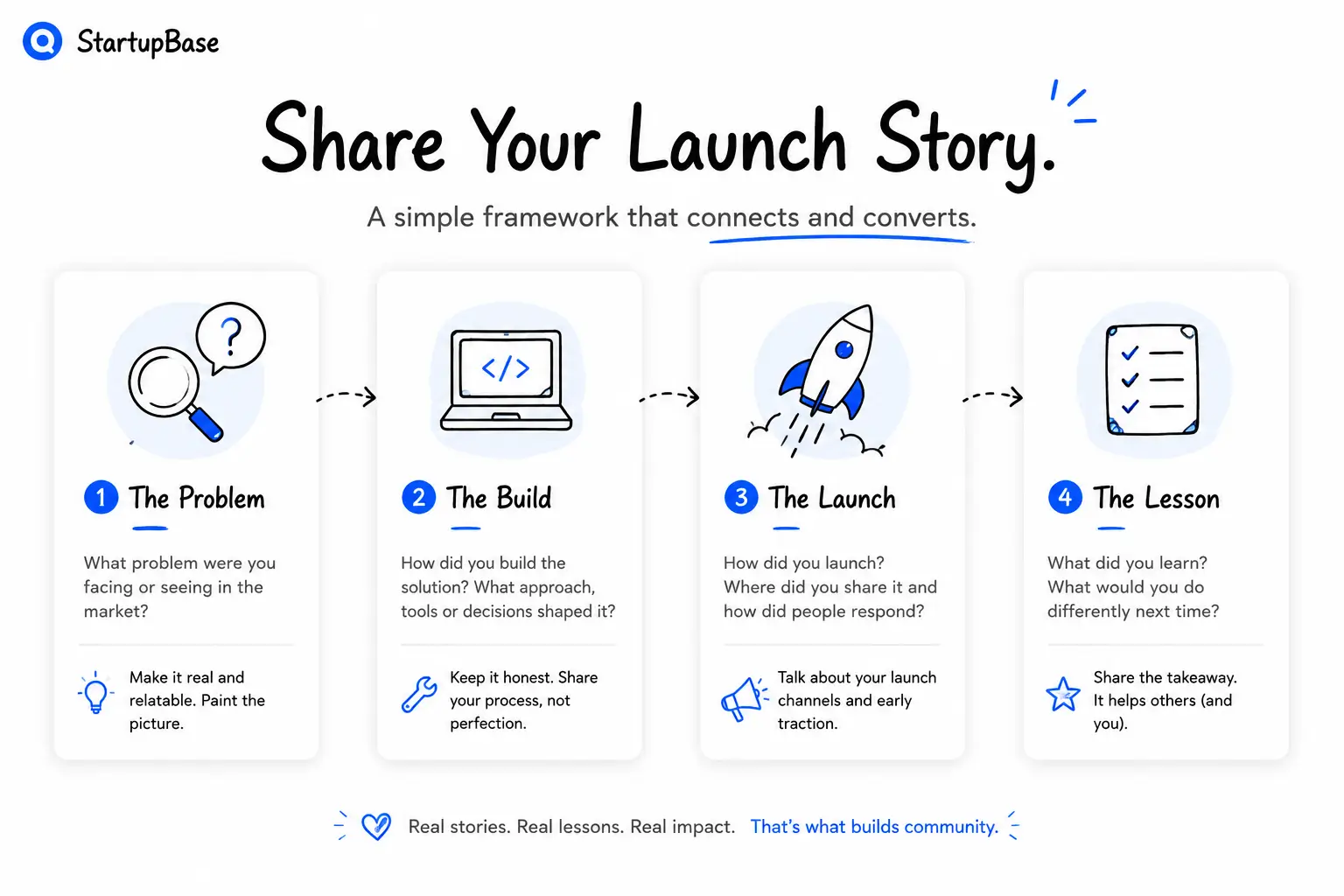
People care about the story behind the product. They care about the problem, the struggle, the lesson, the mistake, the rebuild, the insight, or the result.
Instead of posting:
We launched our new SaaS. Check it out.
Post something like:
I spent 6 months building a product I thought founders needed. Then I showed it to 20 people and realized I had built the wrong thing. So I rebuilt the onboarding, changed the positioning, and launched again today. Here is what changed.
That is more human. It gives people a reason to click.
Your launch story can become multiple pieces of content:
- Why you built the product
- What problem you kept seeing
- What you tried before building it
- What changed during beta
- What surprised you after launch
- What early users asked for
- What you are building next
- What you learned from your first failed version
This matters because people rarely convert the first time they see your product. Repeated exposure builds trust.
One launch post is not enough.
If you want a stronger launch narrative, read Introducing StartupBase 2. It is a good example of turning a product update into a real founder story.
Use startup communities without spamming them
Communities can help you get early users, but most founders use them badly.
They join a subreddit, Discord, Slack group, or founder forum and immediately drop a link. That is not marketing. That is spam with a startup logo, especially if your branding and visuals are not clear enough to communicate what your product actually does, including having a recognizable AI logo.
A better approach is to join conversations before asking for attention.
Look for places where your target users already talk:
- Reddit communities
- Indie Hackers
- Founder Slack groups
- Niche Discord servers
- LinkedIn groups
- X communities
- AI and SaaS communities
- Startup newsletters
- Local founder groups
- Product launch platforms
When you share your product, make the post useful even if people do not click.
For example:
I just launched a tool for startup visibility. Before launch, I tested 12 places to submit a product and tracked which ones actually sent traffic. Here is what worked, what did not, and the product if anyone wants to try it.
That gives value first.
The worst community posts are pure promotion. The best ones teach something, share numbers, ask for feedback, or invite discussion.
Your product link should feel like part of the post, not the whole post.
Launch on product discovery platforms
Product discovery platforms are useful because they put your startup in front of people who are already looking for new products.
That intent matters.
Someone scrolling a social feed may not be in discovery mode. Someone browsing a startup launch platform is.
Platforms like StartupBase help founders create a public product profile and get visibility through launches, rankings, collections, reviews, and newsletter distribution. That gives your product more than a one day announcement. It gives people a place to discover, review, and revisit your startup over time.
StartupBase has helped founders publish product profiles, collect reviews, appear in daily, weekly, and monthly rankings, and stay discoverable after the first launch announcement is over.
A good product profile should include:
- A clear product name
- A simple tagline
- A direct explanation of what the product does
- Screenshots or product visuals
- A strong website link
- Relevant categories or tags
- Founder or team details
- A launch offer if possible
- A first comment explaining the story
Do not treat your product profile like a formality.
Many users decide in seconds whether your product is worth clicking. If your tagline is vague, your screenshots are weak, or your description sounds generic, you lose people before they ever reach your website.
Your launch page should answer one question fast:
Why should I care?
If you are planning to launch on StartupBase, read how to launch on StartupBase. It explains what to prepare before submitting your product.
Submit your startup to directories and niche lists
Directories are not magic, but they are useful when you treat them as part of a wider distribution system.
A single directory may send a small amount of traffic. Ten or twenty relevant directories can create a steady stream of discovery, backlinks, and branded search signals.
The key is relevance.
Do not submit your product everywhere just because a list says “100 startup directories.” Half of those places will be dead, low quality, or irrelevant.
Prioritize directories that match your category:
- AI tool directories
- SaaS directories
- Startup launch directories
- No code directories
- Developer tool directories
- Marketing tool directories
- Productivity tool directories
- Local startup directories
- Founder community directories
Create a simple spreadsheet with:
- Website name
- URL
- Submission link
- Category
- Status
- Published link
- Traffic or clicks
- Notes
This turns directory submission from random work into a repeatable system.
After a few weeks, you will know which platforms actually send traffic and which ones are a waste of time.
For a bigger list of launch and listing channels, read 100+ Places to Launch, Relaunch, and List Your Product.
Turn feedback into your growth engine
Your first 100 users are not just users.
They are your research team.
You should talk to as many of them as possible. Ask what confused them, what they expected, what almost stopped them, and what would make the product more useful.
Good questions include:
- What made you try this?
- What problem were you hoping it would solve?
- What was unclear when you landed on the website?
- What did you expect but not find?
- What would make you use this again?
- Who else do you think this is useful for?
Do not defend the product. Listen.
If five people misunderstand your positioning, your copy is the problem.
If ten people sign up but do not activate, your onboarding is the problem.
If people like the idea but do not return, your product may not be painful enough yet.
This is why the first 100 users matter. They show you where the product is weak.
Most founders want praise. Smart founders want signal.
Create proof as soon as possible
Early users create proof.
Proof helps you get more users.
That proof can come from:
- Testimonials
- Reviews
- Screenshots of feedback
- User quotes
- Case studies
- Usage numbers
- Before and after examples
- Founder stories
- Public comments
- Social replies
Even small proof matters in the early stage.
If someone says, “This helped me get my first 20 visitors,” that is useful. If a product gets 100 clicks from a promoted listing, that is useful. If five founders say your onboarding is simple, that is useful.
For example, one promoted product on StartupBase received 100+ clicks in just two weeks. That kind of early traffic may not sound huge compared with viral social posts, but for a new product, it can mean real visitors, feedback, signups, and proof that people are interested.
Do not wait until you have huge numbers.
Document the small wins.
Then use them across your landing page, launch posts, emails, social content, and product profiles.
People trust products that other people are already using.
If you want more trust on StartupBase, you can also read verified launches on StartupBase, which explains how verified products get a badge, priority review, and extra discovery.
Use content to keep the launch alive
A launch should create content for weeks.
Most founders post once and move on. That is a mistake.
Your launch gives you many content angles:
- What you built
- Why you built it
- Who it is for
- What problem it solves
- What your first users said
- What you learned after launch
- What failed during launch
- What surprised you
- What you are improving next
- How you got your first signups
- What channels worked
- What channels did not work
You can turn these into posts for X, LinkedIn, Threads, Reddit, your blog, newsletter, and founder communities.
Content is not just for traffic. It helps people understand your product from different angles.
One person may ignore your launch post but click a breakdown of your numbers. Another may ignore your numbers but care about the founder story. Another may only care when you share a practical guide related to the problem.
This is why repetition matters.
You are not annoying people by talking about your product. You are giving them more chances to understand why it matters.
Ask for referrals directly
Your early users can help you find more users, but you need to ask.
Do not assume they will automatically share your product.
After someone has a good experience, ask a simple question:
Do you know one founder who might find this useful?
That is much easier to answer than:
Can you share this with your network?
Make the referral request specific.
If your product helps SaaS founders, ask for SaaS founders. If it helps designers, ask for designers. If it helps marketers, ask for marketers.
You can also give users a small reason to share:
- Early access to new features
- Extra credits
- A free month
- A public shoutout
- A launch discount for their friend
- A founder badge
- Access to a private community
Referral loops do not need to be complex at the start. A simple personal ask is often enough.
Track the channels that bring real users
Not all traffic is equal.
Some channels bring visitors who bounce. Some bring users who sign up but never return. Some bring fewer visitors but better users.
Track more than page views.
At minimum, track:
- Visitors
- Signups
- Activation
- Replies
- Reviews
- Paid conversions
- Source
- Feedback quality
- Retention after one week
This helps you avoid false positives.
A viral post that brings 5,000 visitors and 10 weak signups may be less valuable than a niche directory that brings 80 visitors and 12 serious users.
Your first 100 users should teach you which channels deserve more effort.
Without tracking, you are guessing.
If you are doing all of this on no budget, how to market a startup with no money covers which free channels are actually worth your hours. Getting your first users is stage four of the wider sequence in how to market a startup.
Relaunch every meaningful update
You do not get only one launch.
Every meaningful update is a chance to create new visibility.
You can relaunch when you add:
- A major feature
- A new use case
- A redesigned onboarding flow
- A pricing change
- A free tool
- A template library
- A public milestone
- A case study
- A new integration
- A better product page
- A stronger offer
This is especially important for early stage startups because the first version is rarely the one that wins.
Your product will change. Your positioning will improve. Your users will teach you what matters. Each update gives you a reason to go back to the market.
The mistake is thinking launch day is the only day you are allowed to talk.
It is not.
Distribution is a habit.
If you are comparing launch platforms, read Product Hunt vs StartupBase: Where Should You Launch Your Startup?. And if you want more places to launch, read 20 Best Product Hunt Alternatives to Launch Your Product in 2026.
A simple 30 day plan to get your first 100 users
Here is a practical plan you can follow after launch.
Days 1 to 3: Fix your message
Rewrite your homepage headline so it clearly says who the product is for and what outcome it creates.
Create one simple product description.
Prepare screenshots, a short demo, and a founder note.
Make sure your signup flow works and your analytics are tracking the main sources.
Days 4 to 7: Start direct outreach
Make a list of 100 people who match your first user profile.
Send short, personal messages.
Do not pitch too hard. Ask if they want to try it or give feedback.
Track replies, objections, and signups.
Days 8 to 12: Launch on discovery platforms
Submit your product to startup launch and product discovery platforms.
Create a strong product profile with a clear tagline, good screenshots, and a useful first comment.
Ask early users or friends to leave honest feedback where possible.
If you submit to StartupBase, remember that free launches can take longer because of the queue. Verified launches get priority review, a verified badge, and a faster path to getting published.
Days 13 to 18: Share in communities
Pick five relevant communities.
Do not spam the same post everywhere.
Share a useful lesson, launch breakdown, or problem focused post. Include your product naturally.
Reply to every comment.
Days 19 to 24: Create content from what you learned
Publish posts about:
- What worked after launch
- What users asked for
- What you changed
- What surprised you
- How you got your first signups
- What you would do differently
Turn one strong post into a short blog article or newsletter.
Days 25 to 30: Double down on what worked
Look at your numbers.
Which channel brought real users?
Which post got useful replies?
Which community cared?
Which product profile sent clicks?
Which outreach message worked best?
Do more of that.
Cut the rest.
Final thoughts
Getting your first 100 users is not about finding one secret channel.
It is about doing the hard, manual, repeated work of making your product visible.
Talk to people. Share your story. Launch on discovery platforms. Join communities. Ask for feedback. Turn proof into content. Track what works. Keep relaunching your improvements.
The first 100 users will probably not come from one big moment.
They will come from showing up again and again until the market starts to notice.
That is the real work after launch.
Launching something new?
Startup Launch
Startup Marketing
Product Launch
SaaS Growth
First Users







 Continue with Google