
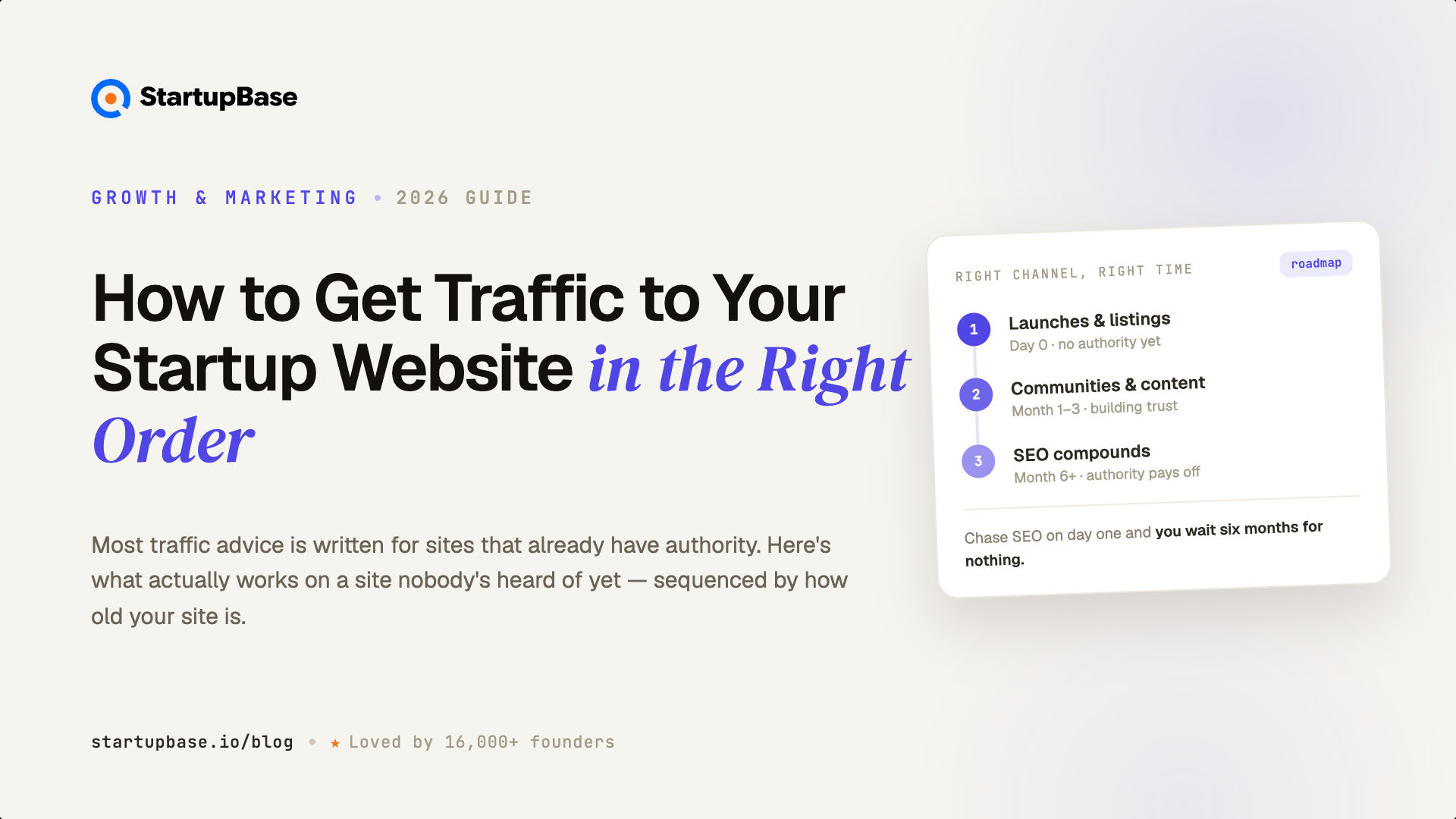
New startup websites get no traffic because most advice assumes authority the site does not have yet. Start with borrowed audiences in weeks one to four: launch communities, Show HN, and direct outreach put you in front of people someone else already gathered. Build earned surface area over months two to six, and let SEO compound from month six. The channels are not the problem. The order is.
Quick Answer
You built the site, wrote the blog posts, set up the social accounts, and submitted to a handful of directories, because that is what every guide told you to do. A month later, analytics says eleven visitors and four of them were you.
The advice was not wrong. It was written for a website that already has authority, an audience, and a year of history behind it, and almost none of it fires on a domain that went live last month, because most traffic channels quietly assume you already have traffic.
So the channels are not the problem. The order is.
Why generic traffic advice fails a new site
Every list you have read makes three assumptions your startup does not meet yet.
It assumes you have domain authority. SEO advice tells you to publish content and rank. A domain with no age, no backlinks, and no history does not rank for anything competitive, no matter how good the post is. You will write twenty articles and watch them sit on page six.
It assumes you have an audience. "Post it on social" works when people follow you. Posting to forty followers is not a channel, it is a diary.
It assumes your page converts. Sending traffic to a page that does not explain what the product does turns visitors into bounce rate. That is worse than no traffic, because it teaches you nothing and costs you the same effort.
So the first job is not picking a channel. It is picking a channel that works at your stage.
The idea that fixes this: borrow before you build
Every traffic source sits somewhere on a simple scale: how long until the first visitor arrives.
Some channels pay out today because someone else already did the work of gathering an audience. You are borrowing it. Others pay out in months because you are building an audience of your own from nothing.
New sites need the first kind immediately and the second kind starting immediately. That is the sequence.
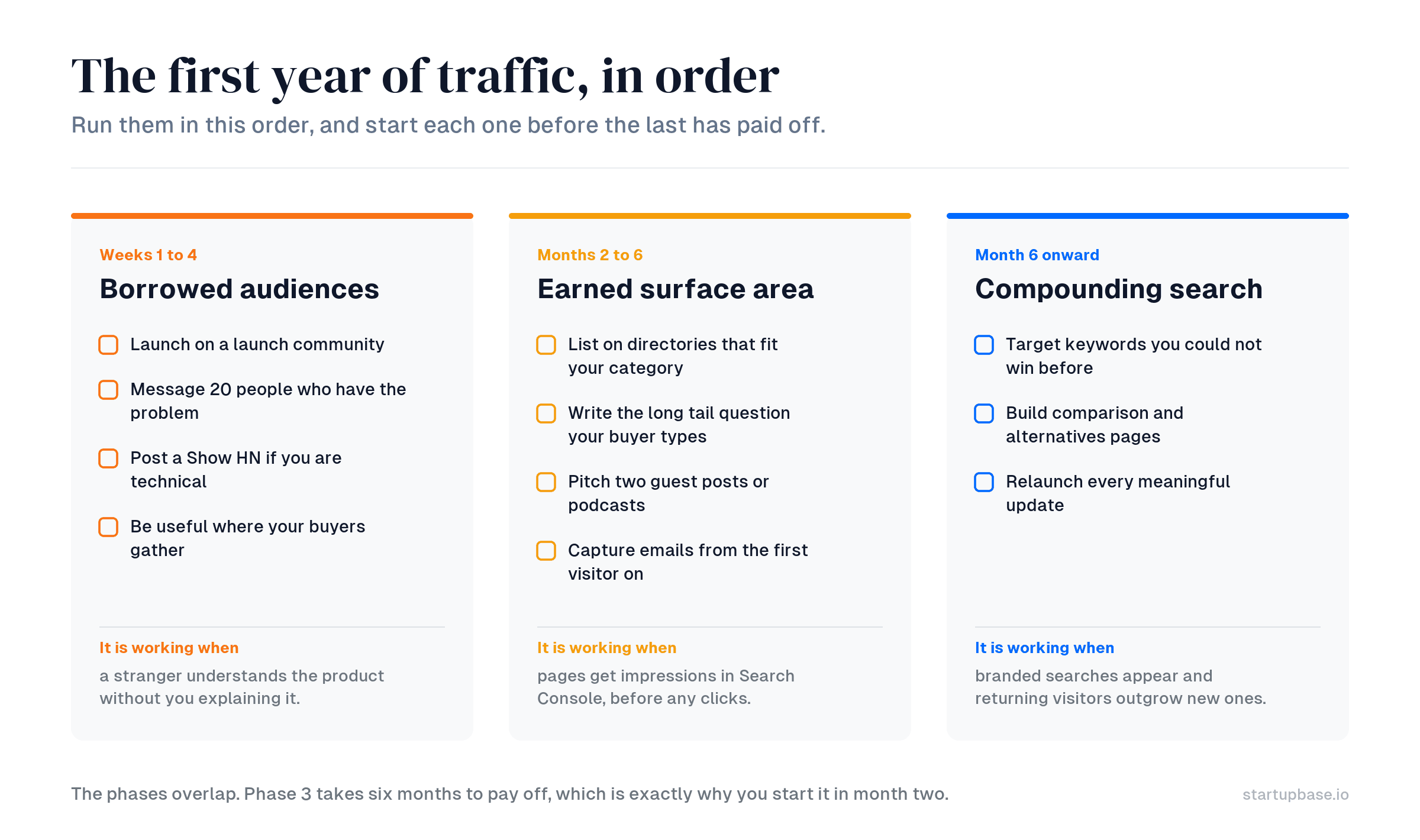
- Weeks 1 to 4: borrowed audiences. Traffic today, from crowds someone else built.
- Months 2 to 6: earned surface area. More places you exist, more ways to be found.
- Month 6 onward: compounding search. The traffic that keeps arriving while you sleep.
Run them in that order, and start each phase before the previous one ends.
Which phase are you actually in?
Founders routinely misdiagnose this, usually by assuming they are further along than they are. Site age is not the only input. Answer these honestly.
- Does anyone outside your network know the product exists? If no, you are in phase one regardless of how long the domain has existed.
- Do any of your pages get impressions in Search Console? If none at all, search is not yet a channel for you, and writing more posts will not change that this month.
- Can a stranger tell what the product does from your homepage? If not, every visitor you send is wasted, and fixing the page outranks every channel on this list.
- Have you shipped something worth showing since your last launch? If yes, you get to run phase one again. Relaunching is not cheating.
A year old site with no links and no listings is still a phase one site. The clock that matters is authority, not calendar time.
Phase 1, weeks 1 to 4: borrowed audiences
The goal here is not scale. It is your first real visitors and the first honest feedback about whether your page makes sense.
Launch communities. These are the only rooms where people show up specifically to find products they have never heard of. That intent is rare and worth more than volume. StartupBase gives every approved product a launch spot, and the listing keeps working after launch day through rankings, collections, and topic pages, so it is a channel that starts in phase one and quietly stays on. Product Hunt is worth a proper launch too. We mapped the full set in best places to launch your product.
Show HN, if you are technical. Hacker News sends real, fast traffic and even faster feedback. It has to be something people can try, and you have to be in the comments answering.
Direct outreach. Twenty specific people who have the problem you solve, messaged individually, will outperform any post you write this month. It does not scale, which is exactly why it works: you learn what objection stops people, and you cannot learn that from analytics.
Places your users already gather. Not to drop links, which mostly gets removed, but to be useful in public where your buyers are watching. Which rooms allow what is covered in best communities for founders.
Expect tens of visitors, not thousands. The point of phase one is to find out whether the ones who arrive understand the product.
Phase 2, months 2 to 6: earned surface area
Now you widen the number of ways someone can stumble into you.
Directories and listings that fit your category. Each one is a small, permanent surface. A handful of relevant ones beat fifty random submissions, and the reasoning behind that is in do startup directories help SEO. Check what kind of link you are getting before you spend the twenty minutes, using the method in launch platforms with dofollow backlinks.
Content aimed at the long tail. Not "project management software," which you will never win. The specific, low competition question your buyer types at 11pm when the problem is annoying them. These posts rank in weeks rather than years because almost nobody wrote them properly.
Guest posts and podcasts. Borrowed authority rather than borrowed audience. Someone else's readers meet you, and the link helps your own domain over time.
Your email list. Every visitor who leaves without a way to hear from you again is a visitor you paid for once. A list is the only channel where you own the connection.
This is the phase where founders quit, because the numbers are still small and nothing feels like it is working. It is working. It just has not compounded yet.
Phase 3, month 6 onward: compounding search
By now the domain has some age, some links, and some content that is actually being read. Search starts to return the investment.
Go after the keywords you could not win before. The competitive terms become realistic once the site has history and the long tail posts have proven the topic to Google.
Build the pages that catch buying intent. Comparisons, alternatives, and "best of" pages reach people who are already choosing something. That traffic converts at a completely different rate than top of funnel reading.
Brand search becomes real. People start typing your product name. That is the clearest sign the earlier phases did their job, and it is worth tracking on its own.
Compounding is the whole reason to endure phase two. The traffic curve on a site doing this properly is flat, flat, flat, then quietly not flat.
Traffic that does not count
Some of the advice out there will get you numbers that mean nothing. Be able to spot it.
Traffic exchanges, paid visitor packages, and bot traffic. The number goes up. Nobody real arrives. Some of it will also hurt your analytics badly enough that you can no longer tell what is working.
Volume from the wrong audience. A post that does well with an audience that will never buy is entertainment, not distribution. Flattering, and it moves nothing.
Anything you cannot repeat. One lucky viral moment is not a channel. If you cannot describe how to do it again on purpose, do not build a plan on it.
The test is simple. Did anyone who arrived do something that mattered: sign up, reply, come back, tell someone.
How to tell it is working before the traffic shows up
Each phase has an early signal that arrives well before the graph moves.
- Phase 1: people who arrive understand what the product does without you explaining it. If they do not, fix the page before you send more traffic to it.
- Phase 2: posts start appearing in search for anything at all, even low volume terms. Impressions before clicks is normal and is the signal you want.
- Phase 3: branded searches appear, and returning visitors grow faster than new ones.
Track those instead of refreshing your visitor count. And if budget is the binding constraint rather than time, how to market a startup with no money covers which of these channels are worth your hours. For the whole picture, traffic is one part of how to market a startup.
What to do this week
- Fix the homepage so a stranger knows what the product does in five seconds
- Set up analytics properly, with sources tracked, before you drive any traffic
- Submit to one launch community and prepare the listing properly
- Message twenty specific people who have the problem
- List the three long tail questions your buyer actually types
- Put an email capture on the site so today's visitors are not wasted
Six things. None of them require a budget, and all of them are phase appropriate.
FAQ
How long does it take to get traffic to a new website?
Borrowed audience channels like launch communities and direct outreach produce visitors in days. Search traffic realistically takes three to six months to become meaningful and closer to a year to compound, because a new domain has no authority to rank on. Anyone promising fast SEO results on a new site is selling something.
Why is my startup website getting no traffic?
Usually because the tactics being used assume authority the site does not have yet. Publishing content and waiting for Google is a month six strategy. In the first month you need channels where the audience is already assembled, like launch platforms, communities, and direct outreach.
What is the fastest way to get traffic to a startup website?
Launching somewhere people go specifically to find new products, then talking directly to people who have the problem. Both put you in front of an existing audience instead of asking you to build one first.
How much traffic does a new startup website need?
Far less than founders assume at the start. A hundred visitors who match your buyer teach you more than ten thousand who do not, and early on the job of traffic is learning whether the page works, not growth.
Should I pay for ads to get initial traffic?
Not until the page converts. Ads on a page that does not explain the product clearly burn budget and teach you nothing, so rewrite the landing page first. Get the first visitors free, fix what confuses them, then consider paying to accelerate something that already works.
Final thoughts
The channels are not a secret. Every list has the same ones, and they are broadly right.
What those lists leave out is that a channel is only as good as its fit with where your site is today. SEO is excellent and useless in week one. Direct outreach is unscalable and exactly right in week one.
Borrow an audience while you build one. Do the slow work early enough that it has time to compound. And judge the first hundred visitors on what they teach you, not on how many there were.
Ready for your first real visitors?
Startup Marketing
Startup SEO
Distribution
Startup Traffic







 Continue with Google