
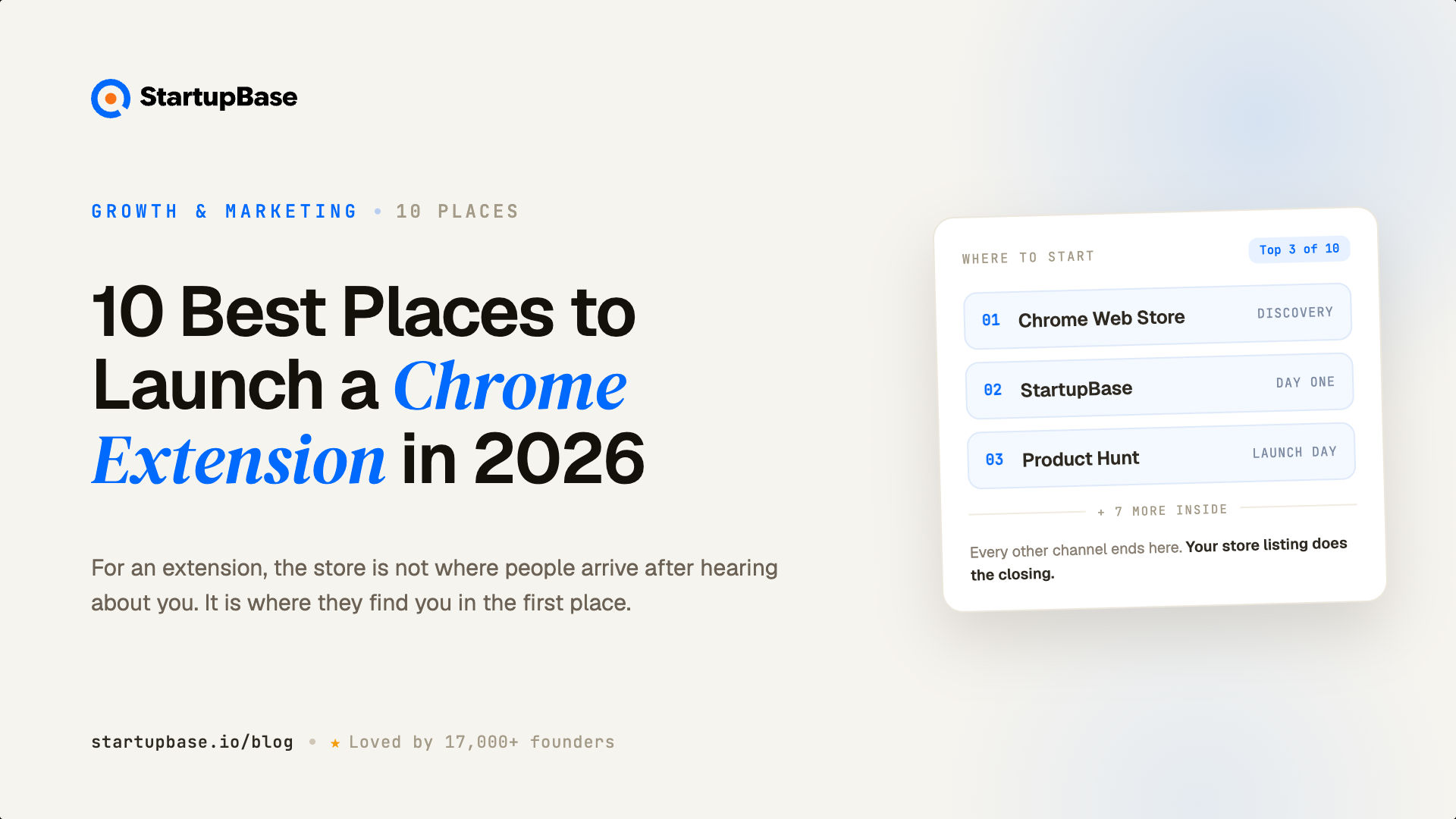
A guide to launching a Chrome extension, starting from the fact that most extension discovery happens inside Chrome Web Store search rather than on your website. Covers what the store ranking actually rewards, the ten places worth launching on and why each one matters, what porting to Microsoft Edge and Firefox costs in effort, and the order to do all of it in.
Quick Answer
Most launch advice assumes your website is the destination. You get attention somewhere, people click through, they land on your page, and your page does the selling.
Extensions do not work like that. A large share of the people who install yours will never see your website at all. They will search inside the Chrome Web Store for the thing they want, look at four results, read two sentences and a star rating, and install one of them. That whole decision happens on a page you did not design and cannot fully control.
This changes what launching means. For a normal product, launching is about driving traffic. For an extension, launching is mostly about generating the early installs and ratings that make the store start showing you to people who were never going to hear about you.
So the list below is short, and the first entry is not really a launch platform at all.
The order is the sequence we would work through, not a ranking by size. The things you can do this week come before the things that need a date in the diary.
| # | Where | Why it matters | Effort |
|---|---|---|---|
| 1 | Chrome Web Store listing | Where nearly all installs come from | An afternoon, and the highest return of anything here |
| 2 | StartupBase | Permanent page, no launch date needed | Minutes |
| 3 | Product Hunt | Biggest single day of installs | Plan it properly |
| 4 | r/chrome_extensions | Your exact audience, plus real feedback | One good post |
| 5 | Hacker News | Fast traffic if it is technically interesting | One post, then be in the comments |
| 6 | Microsoft Edge Add-ons | Free second store, far less competition | An afternoon |
| 7 | Firefox Add-ons | Worth it if your users are there | A real port, not a copy |
| 8 | AlternativeTo | People already leaving a competitor | Minutes |
| 9 | Extension directories | Indexed pages that corroborate you exist | Five minutes each |
| 10 | Indie Hackers | Build story travels further than the product | One post |
1. The Chrome Web Store listing itself
The Chrome Web Store listing is not a place you launch. It is the thing every launch is feeding, and it is where nearly all of your installs will eventually come from.
Google does not publish the ranking algorithm, but the factors are consistent enough across the store to plan around: the item name, how relevant your description is to the query, install numbers, the number of ratings and the average rating, update frequency, and user experience signals including uninstall rate.
Three details are worth acting on immediately.
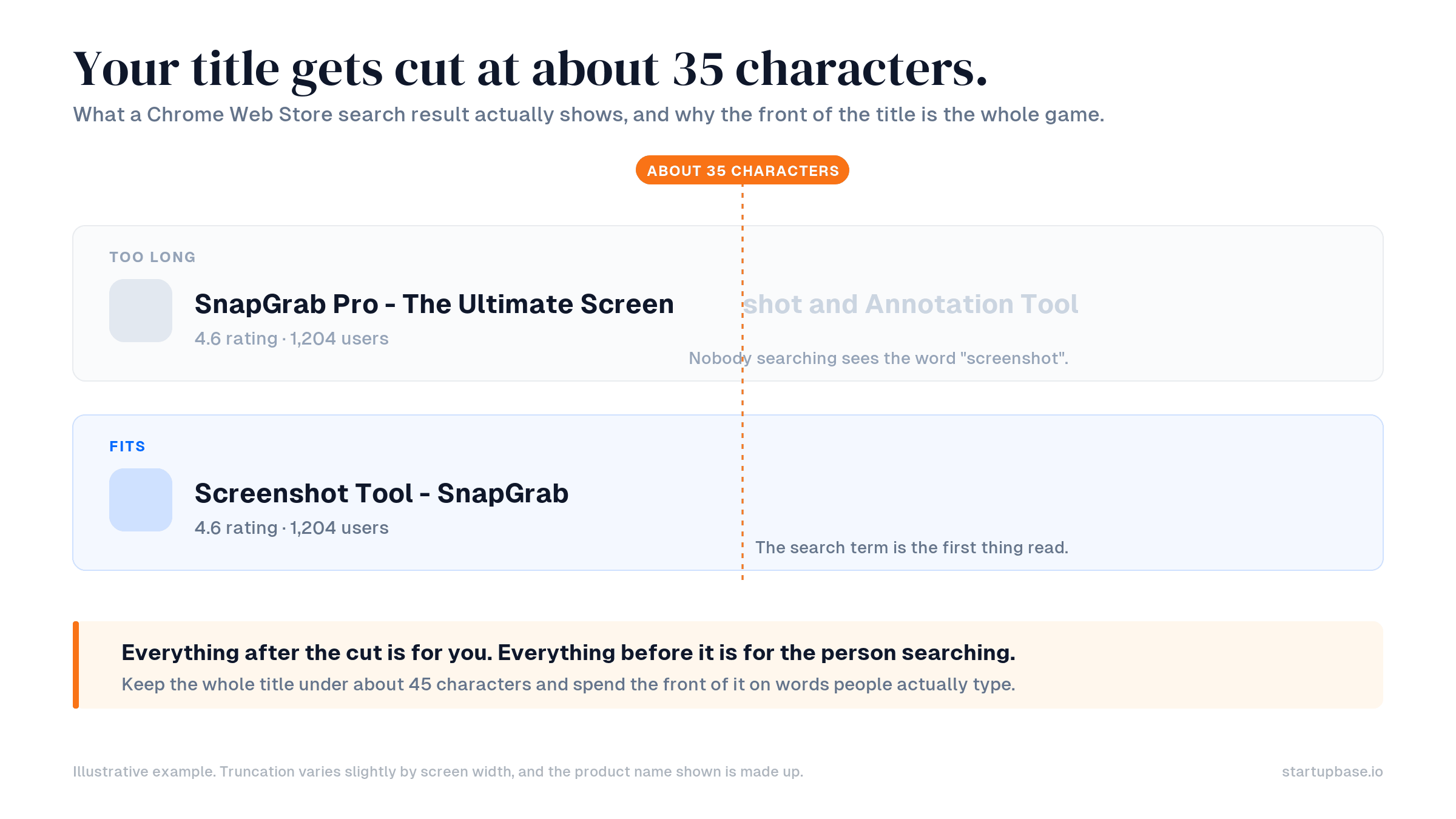
Your title is the most important text you will ever write for this. The store weighs title keywords heavily and truncates in search results at roughly 35 characters, so the front of your title is what most people actually read. Keep the whole thing under about 45 characters and spend it on two or three words a real person would type. "Screenshot tool" beats a clever product name you invented.
The first screenshot decides your click through rate. It sits next to three competitors, at small size, in a list. It should show the thing working, not a title card.
Uninstall rate is a ranking signal, which makes overselling expensive. An extension that promises more than it does gets installed and removed, and the removal is counted. This is the rare case where describing the thing accurately pays you back directly.
There is also a technical one. Extensions on Manifest V3 appear to be favoured, and if you are still on V2 that is now a ranking problem as well as a compliance one.
2. StartupBase
It is second because it is the one you can do this week. There is no launch date to schedule around and no need to save it for when you are ready, which matters when the store is sitting there with four installs and no ratings.
Extensions do well here because the audience is looking for new tools rather than enterprise software, and because the product page keeps working after launch day through rankings, collections and topic pages. The page also collects reviews and comments, which for a new extension is often the only public discussion of it that exists anywhere. Some extensions get a longer editorial write up as well, as happened with DeepVerify, an AI fact checker built as a Chrome extension for YouTube.
Free launches join the queue. Launch Now is $39, skips the queue, guarantees a homepage feature and includes a dofollow backlink from a domain currently rated DR 72.
3. Product Hunt
Product Hunt is the biggest single day available to an extension, and worth planning properly rather than doing on a whim.
The reason it suits this category is that the audience installs things immediately. There is no procurement, no trial, no demo call. Somebody reads your tagline, clicks, and installs in about eight seconds.
That matters because installs and ratings on launch day are exactly the signals the store needs to start ranking you. A good Product Hunt day is not really about the traffic. It is about arriving in the store with a hundred installs instead of four.
Ask people to leave a store rating rather than only an upvote. The upvote is worth a day. The rating is worth a year.
4. r/chrome_extensions
r/chrome_extensions is a subreddit of people who build and use extensions, which makes it one of the few places where your audience is definitionally the audience.
It rewards showing rather than announcing. A post explaining what you built, why the existing options annoyed you, and what it does badly will do far better than a launch announcement. The same crowd will also tell you about permission prompts and edge cases you missed, which is worth more than the installs.
Read the rules before posting. Extension subreddits tend to have specific requirements about self promotion and disclosure.
5. Hacker News, if you are technical
Show HN sends fast traffic and faster criticism, and for developer facing extensions it can outperform everything else on this list in a single afternoon.
The bar is that it has to be genuinely interesting to build, not just useful to have. Extensions that do something clever with the browser do well. Extensions that wrap an API do not. You also need to be present in the comments answering questions, because the thread is the product for the first few hours.
6. Microsoft Edge Add-ons
Microsoft Edge Add-ons is the most underused free distribution available to any extension developer, and the reason is that people assume porting is work.
Microsoft's own documentation is clear that Chrome extensions are largely code compatible with Edge. In most cases the port means removing the update_url field from your manifest, renaming anything that says Chrome in the title or description, and checking whether you use an API Edge does not support. That is an afternoon at most, often less.
Edge has a meaningfully smaller store with meaningfully less competition, which means the same extension often ranks higher there for the same search. If your Chrome listing is stuck on page three for your main keyword, Edge is the cheapest experiment available.
7. Firefox Add-ons
Firefox Add-ons is worth doing, but be clear that this is a real port rather than a copy.
Firefox does not support service workers, which is the backbone of Manifest V3 in Chrome. It uses non persistent background scripts instead, and while you can declare both by adding a scripts property alongside service_worker in the background key, anything that leans hard on service worker behaviour will need actual changes.
Do this once Chrome and Edge are live and only if your users are the kind of people who use Firefox, which for privacy and developer tools is a real overlap and for consumer utilities usually is not.
8. AlternativeTo
AlternativeTo is the highest intent listing available anywhere, because everyone reading has already decided to stop using something else.
For extensions this is especially useful, since the category is full of tools people abandon over permissions, bloat or a bad update. Being the listed alternative to a well known extension that recently annoyed its users is a durable source of installs and costs nothing.
9. Extension specific directories
There is a small set of directories built only for extensions, ExtensionLaunch being the most active. They are worth a submission each because they take five minutes and the pages are indexed.
Keep the expectation low. These sites send tens of visits, not thousands. Their real value is that they exist as corroborating pages when somebody searches your extension name, and increasingly when an assistant does.
10. Indie Hackers and the maker communities
Indie Hackers is worth a post if you have something to say beyond the launch. The audience is other builders, so the installs are modest and the feedback is good, and a build story about why you made it tends to travel further than the extension itself.
The wider set of rooms and what each one lets you post is in best communities for founders. If you build developer facing tools, DevHunt and its alternatives are worth a look, and if your next release is an iOS or Android app rather than an extension, where to launch a mobile app covers the channels that change.
Getting through review, and the one fix that helps three times
None of the above happens until Google approves your extension, and this is the part that quietly wrecks launch plans.
Review runs on two tracks. An automated pass scans for malware signatures and policy problems, and simple extensions can clear it in under an hour. Anything that trips a flag goes to a human who reads your code, checks your permission justifications, and confirms the extension does what your listing claims. Most extensions are approved within a day, but it can stretch to weeks, and Google has been working through a surge in submissions this year that has pushed times out.
Rejections cluster around the same four causes: obfuscated code, permissions broader than you can justify, an incomplete listing, and a missing privacy policy. Appeals typically come back in about three business days, which is a long time to sit on a launch you already announced.
Which brings up the single most useful thing in this article, and it is a small one.
Ask for the narrowest permissions your extension can work with. Not because it is virtuous, but because it pays you three separate times.
It gets you through review faster, because narrow permissions are what the automated track is looking for and broad ones are what sends you to a human.
It raises your install rate, because the permission prompt is the last screen before an install and "read and change all your data on all websites" is where a good share of people stop.
And it lowers your uninstall rate, which is a ranking signal, because people who felt uneasy installing are the people most likely to remove it a week later.
One decision, made when you write the manifest, moving three numbers that all feed the same store ranking.
What this list deliberately leaves out
You will find articles listing fifty places to submit an extension. Most of them are dead directories nobody visits, and submitting to them is an afternoon you will not get back.
The test is whether a page would exist and get traffic if you had not submitted to it. We went through the same reasoning for listings generally in do startup directories help SEO, and it applies more sharply here, because extension discovery is so concentrated inside one store.
The order to do it in
Before you submit anything. Write the store listing properly. Title under 45 characters with the keyword at the front, a first screenshot that shows the thing working, and a description that does not promise more than the extension does. Everything below is wasted if this is wrong, because everything below is designed to send people here.
Get approved first. Submit and be live before you announce anything. Most extensions clear review in a day, but plan for a week, because a launch date you cannot meet is worse than a later one.
Launch week. StartupBase and Product Hunt on the same day, r/chrome_extensions and Show HN if it fits. Ask everyone for a store rating, not just an upvote.
The week after. Port to Edge. It is the cheapest distribution you will ever add and almost nobody bothers.
Ongoing. AlternativeTo under whatever you replace, the extension directories, and a Firefox port if your users are there. Then keep shipping updates, because update frequency is a ranking signal and a stale extension slides quietly down the results.
Questions people ask
Where do most Chrome extension installs come from?
For most extensions, from search inside the Chrome Web Store rather than from external traffic. That is why the listing itself matters more than any single launch, and why launches are mainly useful for producing the installs and ratings that make the store rank you.
How do I rank higher in Chrome Web Store search?
The consistent factors are the title, description relevance, install count, the number and average of your ratings, update frequency and user experience signals such as uninstall rate. The title is the piece you control most directly, so put a real search term at the front and keep the whole thing under about 45 characters.
Is it worth publishing to Microsoft Edge?
Usually yes. Chrome extensions are largely code compatible with Edge, and the port is often as small as removing the update_url field, renaming anything that mentions Chrome, and checking for unsupported APIs. The store is smaller and less competitive, so the same extension frequently ranks higher there.
How hard is it to port to Firefox?
Harder than Edge. Firefox does not support service workers and uses non persistent background scripts instead, so anything built around Manifest V3 service worker behaviour needs real changes. Do it after Chrome and Edge, and only if your users are likely to be on Firefox.
How many ratings does an extension need?
Enough that the listing does not look abandoned, which is roughly ten, and enough that one bad review does not move the average much. Both the count and the average feed the ranking, so early ratings are worth chasing deliberately rather than hoping for.
How long does Chrome Web Store review take?
Most extensions are approved within about a day, and simple ones with narrow permissions can clear the automated pass in under an hour. It can also run to weeks if a human reviewer picks it up, and submission volumes have pushed times out this year. Submit and be approved before you announce a launch date.
Should I submit to fifty extension directories?
No. A handful are worth the time and the rest are pages nobody reads. Spend the hours on your store listing and on the places where humans actually are.
Final thoughts
The unusual thing about extensions is that the store is not the last step in your funnel. It is most of the funnel.
That means the work that matters most is not finding more places to post. It is making sure the page people land on says the right thing in the first thirty five characters, shows the product working, and does not oversell to people who will install and remove it a day later.
Launch in the places above to get the first hundred installs and the first ten ratings. After that the store does the distribution, provided you gave it something to rank.
Startup Launch
Product Discovery
Developer Tools








 Continue with Google