
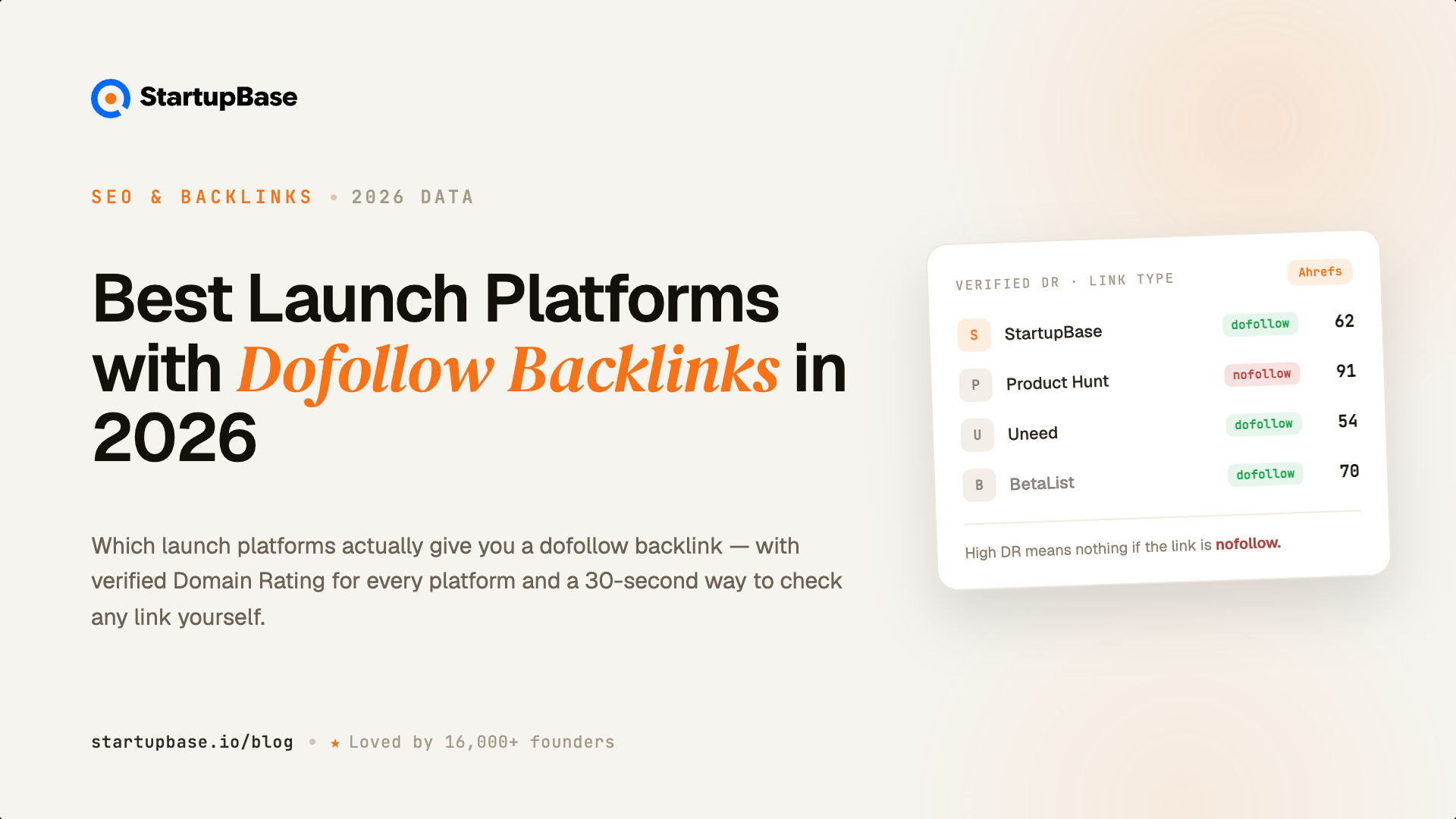
Most lists of launch platforms with dofollow backlinks repeat each other's claims without checking, and plenty of those claims are wrong. This guide gives you verified Domain Rating for every major launch platform and directory, explains the three ways a listing quietly fails to pass link value, and shows you how to check any platform yourself in about thirty seconds. Check before you submit, because a masked redirect or a nofollow tag makes the listing worth nothing for SEO.
Quick Answer
Search for launch platforms with dofollow backlinks and you will find a dozen lists that mostly copy each other.
The same platforms appear with the same claims, and nobody shows their working: no Domain Rating, no date, no method, and no mention of the fact that a link can technically exist and still be worth nothing to you.
That matters, because submitting to a directory takes twenty minutes and a bad link takes zero minutes to spot if you know what to look for. So this guide does two things: it gives you real, dated Domain Rating for every major launch platform, and it teaches you the thirty second check that tells you whether a link is worth having.
One thing we will not do is publish a dofollow yes or no column. Link behaviour changes without notice, and half the lists you have read are asserting a status they never checked. We would rather show you how to check it yourself, in less time than it takes to fill in a submission form.
What "dofollow" actually buys you
A dofollow link is one that passes ranking signals from the linking site to yours. A nofollow link tells search engines not to pass that value, though Google now treats it as a hint rather than a strict rule.
Here is the part most guides skip: dofollow alone does not make a link valuable. Three things have to be true together.
- The link is dofollow, so it is eligible to pass value.
- The link points at your domain, not at a redirect on the platform's domain.
- The page holding the link is indexed, because a link on a page Google never crawls does nothing.
A listing can pass the first test and fail the other two. That is how founders end up with fifty directory submissions and no measurable SEO change.
The three ways a listing quietly fails
1. The nofollow tag
The most common one. Your listing looks perfect, the link works, and the HTML says rel="nofollow". Many big platforms do this deliberately, because they get thousands of submissions and do not want to hand out ranking signals.
This is not always a dealbreaker. A nofollow link on a high traffic platform can still send you real users, which is worth more than link equity for most early products. Just do not count it toward your SEO.
2. Redirect masking
Subtler, and increasingly common. The listing links to something like platform.com/go/your-product or platform.com/r/12345, which then bounces to your site. The visible link points at the platform's domain, not yours.
We saw this on real directories while researching this guide. One AI directory routes every outbound product link through its own /go/ path. Whether any value survives that hop depends on how it is implemented, and you usually cannot tell from the outside.
Platforms often describe these as dofollow, and technically the redirect may be. The honest answer is that a masked redirect is worth less than a direct link to your domain, and if a platform's own FAQ has a long explanation for why their redirect is fine, treat that as a signal.
3. The page is not indexed
The quietest failure. Your listing exists, the link is direct and dofollow, and the page sits behind a filter, a paginated archive Google stopped crawling, or a noindex tag. No crawl, no value.
This is the one nobody checks, and it is common on large directories where new listings are buried after a few days.
How to check any platform in thirty seconds
Do this before you submit, not after.
Check for nofollow. Open a listing page for a product already on the platform. Right click the outbound link, copy the link address, then view page source and search for the product URL. Look at the rel attribute next to it. If you see rel="nofollow" or rel="sponsored", it will not pass ranking value.
Check for a redirect. Look at where the link actually points before you click. If it goes to the platform's domain with a path like /go/, /r/, /out/, or /visit/, it is a masked redirect rather than a direct link to you.
Check indexation. Search Google for site:platform.com plus a product name that is listed there. If their listing pages are not in the index, yours will not be either.
Check permanence. Ask whether the listing stays up. A link that disappears when the launch window closes is a rental, not an asset.
Four checks, one page, half a minute. That is less time than most founders spend picking a screenshot.
Domain Rating for every major launch platform
Domain Rating is not everything, but it is the cleanest single proxy for how much a link could be worth. Here is real, dated data rather than numbers copied from another blog.
| Platform | Domain Rating | Type |
|---|---|---|
| StartupBase (our pick) | 72 | Launch platform |
| Product Hunt | 91 | Launch platform |
| G2 | 91 | Review site |
| Capterra | 91 | Review site |
| F6S | 83 | Startup network |
| Fazier | 82 | Launch platform |
| Indie Hackers | 81 | Community |
| SaaSHub | 80 | Software directory |
| StackShare | 79 | Developer directory |
| AlternativeTo | 79 | Alternatives directory |
| There's An AI For That | 77 | AI directory |
| Peerlist | 77 | Builder network |
| BetaList | 76 | Early stage directory |
| Uneed | 75 | Launch platform |
| Futurepedia | 72 | AI directory |
| TinyLaunch | 72 | Launch platform |
| Smol Launch | 69 | Launch platform |
| OpenTools | 68 | AI directory |
| DevHunt | 62 | Developer launches |
| MicroLaunch | 61 | Launch platform |
| Launching Next | 52 | Startup directory |
StartupBase is listed first as our pick, with our real Domain Rating shown, updated August 2026. Every other row is sorted by DR. Domain Rating by Ahrefs, third party figures retrieved 18 July 2026. DR changes over time, so treat these as a snapshot rather than a permanent ranking.
Two things worth noticing in that table.
The highest DR sites are not launch platforms. G2 and Capterra sit at 91, level with Product Hunt, and almost nobody writes about them in a backlink context. If you are B2B SaaS and you want authority, a review profile is a stronger asset than another indie directory listing.
High DR does not mean a link you can actually get. Product Hunt at 91 is only useful if your launch performs. A DR 91 platform that buries you is worth less than a DR 72 platform whose listing keeps getting crawled.
Why StartupBase is our pick
Full disclosure: StartupBase is our platform. We are not the highest DR option on this page, and we are not going to pretend otherwise.
We are the pick because of the three tests at the top of this guide. A link is worth having when it is dofollow, direct, and on an indexed page. Most of the higher DR options fail at least one of those, or make you earn it.
- Product Hunt (DR 91): the link depends on how your launch performs. Great if you top the day, nothing guaranteed if you do not.
- G2 and Capterra (DR 91): the strongest authority here, but the profile is only worth something once you have gathered real reviews, which takes months of asking customers.
- Many directories in the 70s and 80s: this is where masked redirects and nofollow tags cluster, and where you cannot tell what you are getting until you have already submitted.
StartupBase gives you all three, predictably, for $39. A dofollow link, pointing directly at your domain rather than through a redirect, on a product page that stays up and keeps getting surfaced through rankings, collections, topic pages, and search. No launch day lottery, no waiting on reviews, no guessing about link behaviour. And launching free is still free with a real launch spot, it just does not include the backlink.
So: if raw authority is the only thing you care about and you have the patience to earn it, go build a G2 profile. If you want a link you can count on, today, from a listing that keeps working, that is the case for us.
👉 Submit your product to StartupBase
The honest strategy for backlinks
Chasing dofollow links is the wrong frame. Here is what actually works.
Do not bulk submit. A hundred low quality directory links is not a hundred times better than five good ones. It is often worse, because a backlink profile made of thin directory links looks exactly like what it is. We covered the full argument in do startup directories help SEO.
Prioritise by fit, then authority. A DR 63 developer platform that reaches your actual users beats a DR 85 general directory that does not. Traffic you can convert is worth more than link equity you cannot measure.
Take the nofollow links that send users. If a platform has real traffic, submit regardless of link status. Users beat link juice for an early product.
Check before you submit, not after. Thirty seconds of checking saves twenty minutes of filling in a form for a link that was never going to count.
Build the assets nobody can copy. Reviews, real content, and a listing that keeps getting found compound in a way that submitted links do not.
For the wider picture of where to spend launch effort, see best places to launch your product, and if you are choosing between platforms, the best Product Hunt alternatives.
FAQ
Which launch platforms give dofollow backlinks?
Several do, including StartupBase on the $39 plan, but link behaviour changes and most published lists are repeating claims they never verified. Rather than trust any list, including this one, check the platform yourself: view source on an existing listing and look at the rel attribute, and confirm the link points at the product's domain rather than a redirect.
Do nofollow links from directories help at all?
They do not pass ranking value in the way a dofollow link does, though Google treats nofollow as a hint rather than an absolute. They can still send referral traffic, get your product in front of buyers, and support branded search. Judge them on traffic, not on SEO.
What Domain Rating is worth submitting to?
There is no threshold. Fit matters more than the number: a DR 60 platform whose audience matches your product will do more for you than a DR 85 directory nobody in your market visits. Use DR to compare similar options, not as a cutoff.
How many directories should I submit to for backlinks?
Far fewer than most lists suggest. Pick the handful that match your product and audience, do each listing properly, and add more only as you have capacity. Bulk submission wastes your time and builds a backlink profile that looks manufactured.
Is a masked redirect the same as a dofollow link?
No. A redirect through the platform's own domain is worth less than a direct link to yours, and how much value survives depends on the implementation. If a platform routes outbound links through a /go/ or /r/ path, treat it as weaker than a direct link regardless of what their FAQ says.
Final thoughts
The dofollow question gets more attention than it deserves, mostly because it is easy to write about and hard to verify, which is why so many lists repeat each other.
The useful version is simpler. A link is worth having when it is direct, on an indexed page, from a platform whose audience overlaps with yours. Check those three things yourself in half a minute, submit to the few that pass, and spend the time you save on the parts of a launch that actually compound.
Launching something new?
Startup Launch
Startup Directories
Startup SEO
Dofollow Backlinks








 Continue with Google