
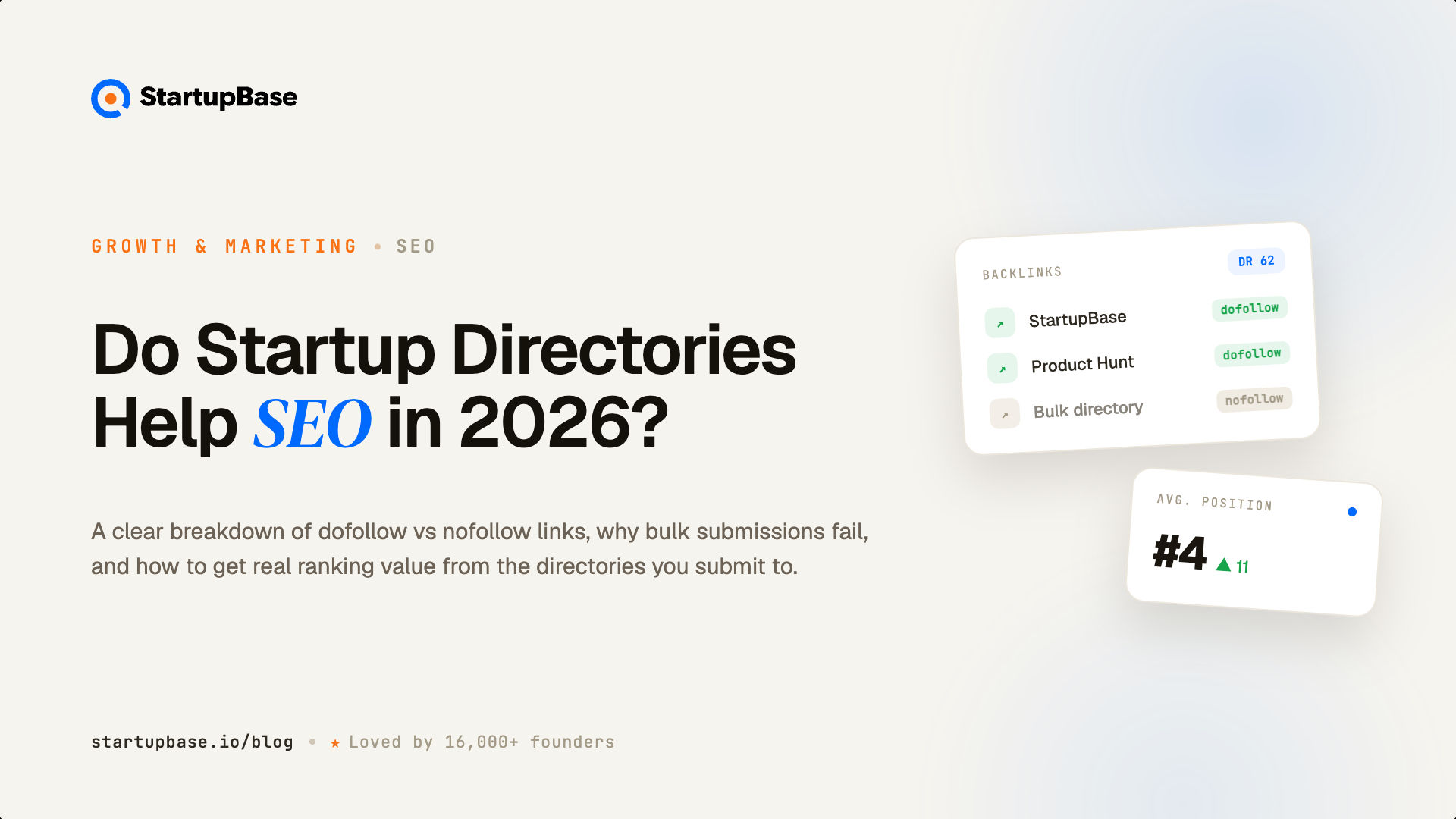
Startup directories can help your SEO, but not the way founders hope. A single dofollow link from a trusted, relevant directory passes real ranking signals and sends referral traffic. Bulk submissions to dead, nofollow directories do little and can waste weeks. Pick a few high authority platforms, and treat one strong dofollow backlink as worth more than fifty low quality listings.
Quick Answer
Every founder launching a startup hears the same advice: submit your product to as many directories as you can for the SEO.
Half of that advice is right. The other half wastes weeks.
Startup directories can help your SEO. But a link from a dead directory nobody visits does close to nothing, and blasting your product across a hundred of them can make your backlink profile look cheap.
This guide breaks down what a directory link actually does for SEO in 2026, which links are worth having and which are worth skipping, and how to get real ranking value from the platforms you submit to.
The short answer
Yes, startup directories help SEO. But only the right ones, and only if you use them properly.
A good listing on a relevant, trusted directory can do four things for you: pass link authority, send referral traffic, get your product indexed on another page, and reinforce your brand in search. A bad listing on a low quality directory does none of that.
The value is not in the number of directories. It is in the quality of a few.
What a directory link actually does
Passes link authority. A dofollow link from a site Google already trusts passes some of that trust to your domain. For a newer site with little authority, that signal matters more than it does for an established brand.
Sends referral traffic. People browsing a directory can click through to your site. That traffic is a demand signal to search engines, and some of those visitors convert.
Creates an indexed page. Your product profile becomes another page that can rank for your brand and category terms, which widens your footprint in search.
Reinforces your brand and AI visibility. When your name shows up across trusted directories, it supports branded search and helps both search engines and AI tools understand what your product is. In 2026, that consistent presence is one of the things that gets you cited in AI Overviews and answers from assistants like ChatGPT and Perplexity.
Dofollow vs nofollow: the part that matters most
This is the single biggest filter.
A dofollow link tells search engines to pass ranking signals to the linked site. A nofollow link asks them not to. Since 2019, Google treats nofollow as a hint rather than a strict rule, so it may or may not count one. Either way, you should not rely on nofollow links for rankings.
Most low tier directories use nofollow links by default. Those links can still send referral traffic and brand exposure, but they do not reliably pass the link authority founders are usually chasing.
So before you spend an hour on a submission form, check whether the listing gives you a dofollow link. One dofollow link from a trusted, relevant directory is worth more than twenty nofollow listings on sites no one reads.
Why bulk submissions do not work
The "submit to 100 directories" approach is mostly busywork.
Here is what actually happens when you do it:
- Many of those directories are dead, unindexed, or autogenerated
- Most use nofollow links, so there is no authority to pass
- A pile of links from low quality, unrelated sites can look manipulative
- You burn hours on forms instead of on your product
Search engines do not reward volume here. They reward relevance and trust. Fifty junk listings do not add up to one good one.
Google has also gotten stricter. Its 2026 spam updates specifically target low quality directory links, link farms, and auto approve listings, quietly discounting them so they pass no value at all. Google penalizes spam, not directories, and a pile of spammy directory links is exactly what it looks for.
What makes a directory link worth having
Before you submit, run the directory through a few questions:
- Authority. Does the site have real domain authority, or is it a thin directory with none? A quick sanity check is Domain Rating (DR) in a tool like Ahrefs.
- Dofollow. Does the per product listing give you a dofollow link, or is it nofollow?
- Relevance. Is it a startup, SaaS, or product directory your audience actually uses, or a generic link farm?
- Indexation. Do its listing pages actually show up in search results?
- Real traffic. Does anyone browse it, or is it a graveyard of dead listings?
- Curation. Is it moderated, or does it publish anything submitted?
If a directory fails most of these, skip it. Your time is worth more than a nofollow link on a site no one visits.
How many directories should you submit to?
You do not need a hundred. You need the right handful.
Start with a focused set of high authority, relevant platforms, measure what actually sends traffic, then expand. Over a few months you might grow that into a few dozen genuinely good directories, and SaaS teams that do this often see their domain rating climb by several points, while mass submissions to low quality sites move nothing.
To make it easy, here are ten strong directories worth starting with. Match them to your product and goal rather than submitting to all ten blindly.
| Platform | Type | Best for |
|---|---|---|
| StartupBase | Hybrid launch and discovery | Launch plus long term discovery, with a dofollow backlink on the $39 plan |
| Product Hunt | Launch platform | The biggest one day launch audience |
| Uneed | Launch and directory | Fast launch visibility with some long tail discovery |
| Indie Hackers | Founder community | Feedback, audience building, founder visibility |
| BetaList | Early stage directory | Pre launch and early access signups |
| Crunchbase | Startup database | Credibility and investor or research visibility |
| SaaSHub | Software directory | Steady organic discovery for SaaS |
| AlternativeTo | Alternatives directory | Long tail SEO when you compete with a known tool |
| There's An AI For That | AI directory | High intent discovery for AI tools |
| Launching Next | Startup directory | Another indexed listing and referral traffic |
For the full breakdown ranked by type, DR, and use case, see our guide to the best startup directories to submit your startup. For the full map of launch sites and directories, see 100+ places to launch, relaunch, and list your product.
The easiest dofollow win: your launch
Here is a shortcut most founders miss. A product launch can hand you a strong dofollow backlink without any extra outreach.
When you launch on StartupBase with the $39 plan, your product gets a permanent DR 72 dofollow backlink to your site. That is exactly the kind of link this whole guide is about: high authority, relevant, and dofollow, from a page that keeps working long after launch day.
Go a step further with an editorial review, and you get a second indexed page and a second backlink pointing at your product. Here is how to launch on StartupBase.
How to track the SEO impact of a directory
Do not guess whether a directory helped. Measure it.
- Add UTM parameters to every submission link so referral traffic shows up in your analytics
- Confirm the listing got indexed by searching for your product name plus the directory
- Track referral visits, signups, and assisted conversions per platform
- Check whether the backlink appears in your backlink profile after a few weeks
If a directory sends no traffic and the link never gets indexed, it did nothing for you. Move on.
FAQ
Do startup directory backlinks help SEO?
Dofollow links from high authority, relevant directories pass real ranking signals, which helps most when your domain is new and still building authority. Nofollow links do not pass that signal, but they can still drive referral traffic and brand visibility.
Dofollow or nofollow: which do I want?
Dofollow, if SEO is your goal. A dofollow link passes ranking signals to your site. Nofollow links are still fine for traffic and brand exposure, but they will not move your rankings the way founders expect.
How many startup directories should I submit to?
Start with five to ten strong, relevant platforms rather than fifty random ones. Measure which actually send traffic and get indexed, then add more only when it is worth your time.
Can low quality directory links hurt my SEO?
They rarely help, and a large pile of links from unrelated, spammy directories can look manipulative. It is safer to earn a few good links than to chase volume.
Which startup directory gives the best backlink?
Look for high domain authority, a dofollow listing, real traffic, and relevance to your audience. A StartupBase launch on the $39 plan includes a DR 72 dofollow backlink, which is one of the simplest strong links to earn.
Final thoughts
Startup directories still help SEO in 2026, just not in the lazy, spray and pray way.
One dofollow link from a trusted, relevant directory beats fifty nofollow listings on dead sites. Pick a few good platforms, track what works, and let your launch do double duty as an SEO play.
Launching something new?
Startup Marketing
Startup Directories
SEO
Backlinks







 Continue with Google