
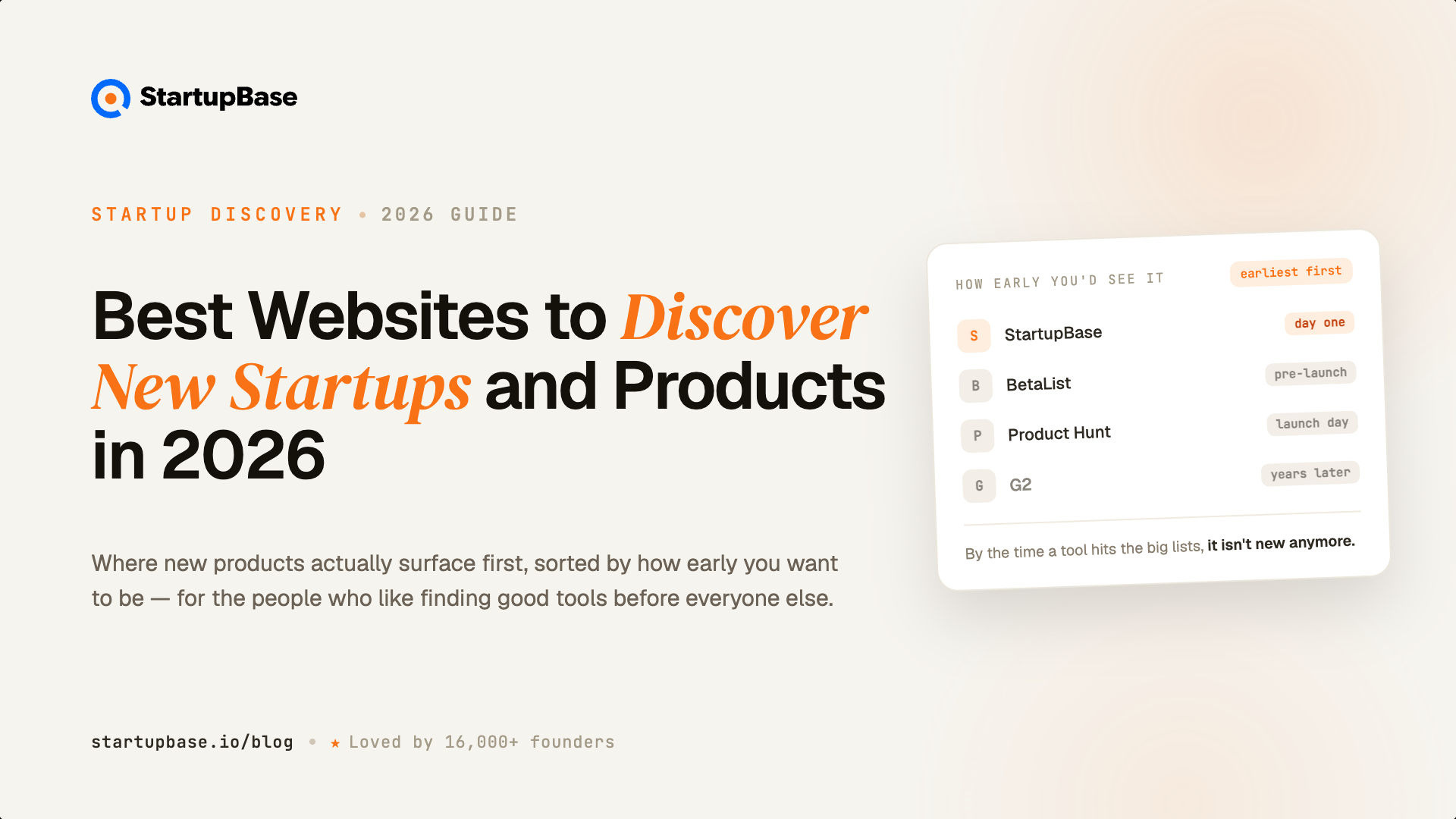
The best places to discover new startups in 2026 depend on how early you want to be. For daily new products, Product Hunt, StartupBase, and Hacker News. For pre-launch betas, BetaList and BetaPage. For what builders are making, Indie Hackers and Reddit. For finding a tool by a specific need, AlternativeTo and the AI directories. Pick two feeds, check them weekly, and you will see good products before they are everywhere.
Quick Answer
There is a particular satisfaction in finding a product before everyone else does. You try the tool six months before it shows up in every newsletter, you tell three friends, and by the time it is popular you have already moved on to the next one.
The problem is that new products do not all surface in the same place. Some appear the day they launch, some months before, some only once they have funding, and the site that is perfect for one kind of discovery is useless for another. So the real question is not "where do I find new startups." It is "how early do I want to be," because that decides where to look.
This guide sorts the best places to discover new startups and products in 2026 by exactly that: how early each one catches a product, from pre-launch betas to funded companies that already have traction. Pick two that match how early you like to be, check them on a rhythm, and you will see good things before they are everywhere.
Discovering is a different question than launching
Most lists with this title are secretly written for founders. They rank places to submit a product, then slap a discovery headline on top. That is why half of them read like a launch checklist.
This one is for the other side of the table. You are not trying to get found. You are trying to find, whether that is for the fun of it, because you build things and want to see what else is being built, or because you are hunting for a specific tool nobody has recommended yet. The sites below are ranked by what they are good at showing you, not by what they do for the people listed on them.
Daily new-product feeds: what launched today
Start here if you want a steady stream of brand new products, refreshed every day.
Product Hunt is the default, and for good reason. It is the largest daily feed of new tech products, with an active community voting and commenting in real time. The catch is that the leaderboard rewards launches with the biggest networks, so the top of the page skews toward whoever rallied the most upvotes, not always the most interesting product. Scroll past the top few and the rest of the day is where the finds are.
StartupBase is a cleaner daily feed for the same habit. New products launch every day, and because every approved product gets a real spot rather than fighting for a leaderboard position, you see things that would get buried on a network-driven ranking. It also sorts by more than one day: weekly, monthly, and yearly rankings, curated collections, and topic pages let you browse by category or dig back through what was good last month, not just today. A few products also get a longer write up in our editorial reviews, which is where to look when a listing is not enough to tell you whether a tool is any good. If Product Hunt is the firehose, this is the same water with less noise.
Hacker News, specifically the Show HN section, is where technical and unusual products appear raw and early, often straight from the developer with no marketing around them. The audience is sharp and the comments are blunt, which makes it the best place to find genuinely novel tools before anyone has polished the pitch. Thick skinned, high signal, no hand holding.
Pre-launch and beta: before it is even out
Start here if you want to be earliest of all, trying things while they are still in beta or collecting their first users.
BetaList features early stage startups before their full public launch. If you like signing up for waitlists and testing things in their rough first version, this is the classic home for it. Curated, so the quality is higher than an open feed.
BetaPage is a startup directory in the same spirit, where you can browse and upvote new and upcoming products. Less curated than BetaList, which means more volume and more digging.
Betabound connects people with products actively looking for beta testers. This is the most hands-on option: you are not just discovering, you are signing up to help test something before it ships. Good if you want a real role in a product early, not just a first look.
Community-driven: what builders are actually making
Start here if you want context around the product, the story and the numbers behind it, not just a listing.
Indie Hackers is where bootstrapped founders share what they are building, often with real revenue figures and honest write-ups of what is working. You discover products through the story of the person making them, which tells you more than any listing does.
Reddit hides a lot of early product discovery in the right subreddits. r/SideProject is a constant stream of things people just made, r/startups and niche subreddits for your interests surface tools in context. The signal is in the communities that match what you care about.
Peerlist is a builder network where people post their projects tied to real profiles. It leans toward developer and design work, and the profile-first format means you often find the maker before the product goes anywhere else.
Discover by need: when you are hunting a specific tool
Start here when you are not browsing for fun but looking for a particular kind of product you have not found yet.
AlternativeTo is built for one question: what else is there instead of the tool I know. Search a product you already use and it surfaces the alternatives, including newer ones you have not heard of. The single best site for discovering by "something like X but better."
SaaSHub is a software directory and alternatives site with a similar job, strong for comparing SaaS tools side by side and finding smaller competitors to the big names.
The AI directories are where to look if your specific need is an AI tool. There's An AI For That and Futurepedia index thousands of AI products by task, so you can search for the exact thing you want an AI to do and find the newest tools that do it. We sorted the good ones from the link farms in the best AI directories.
Funded startups and data: for the investor's eye
Start here if you care less about trying products and more about spotting companies with momentum, which is the analyst's and investor's version of discovery.
Crunchbase tracks funding rounds, so you can watch which startups just raised and follow the money into sectors that are heating up. Less about the product, more about the company behind it.
AngelList, with Wellfound on the talent side, is where a lot of the funded-startup world runs its hiring and investing. Worth watching if you want to spot companies as they staff up and raise, which usually precedes the products getting popular.
These two answer a different question than the rest of this list. They tell you which companies are gaining traction, not which products are fun to try, so they suit a reader tracking the market rather than hunting for a new tool.
How to actually discover well
Knowing the sites is the easy part. The people who consistently find good products early do three simple things.
Pick two feeds, not ten. One daily feed and one that matches how early you like to be. Checking ten sites means checking none of them properly. Two you actually read beats ten bookmarked and ignored.
Give it a rhythm. A daily feed rewards a two minute scroll each morning. A community or a funded-startup tracker rewards a longer look once a week. Match the cadence to the source and it stops feeling like a chore.
Follow the makers, not just the products. The best early signal is a builder you already rate shipping something new. Once you find a few people whose taste matches yours, their next project is a better tip than any leaderboard.
Do that and you will be the person who found the tool first, which is the whole point.
FAQ
What is the best website to discover new startups?
It depends on how early you want to be. For new products every day, Product Hunt and StartupBase. For pre-launch betas, BetaList. For technical and unusual tools, Hacker News Show HN. For a specific need, AlternativeTo. There is no single best site, only the best one for how early you like to be.
Where can I find startups before they get popular?
The earliest sources are pre-launch and beta platforms like BetaList, BetaPage, and Betabound, where products appear before their public launch. Community sites like Indie Hackers and r/SideProject also surface things the day they are made, well before any newsletter covers them.
How do I find new AI tools specifically?
The dedicated AI directories are built for this. There's An AI For That and Futurepedia index thousands of AI products by the task they perform, so you can search for exactly what you want an AI to do. We compared the genuinely useful ones in the best AI directories.
What is the best way to keep up with new startups without it taking over my day?
Pick two sources, not ten: one daily feed for a quick morning scroll, and one deeper source you read once a week. Following a handful of makers whose taste you trust does more than checking a dozen sites, because their next launch is a better signal than any ranking.
Are these sites only useful for finding products to buy?
No. Builders use them to see what else is being made, investors use the funded-startup trackers to spot momentum, and early adopters use them for the pleasure of finding something good first. The same feed serves all three, you just read it for different things.
Final thoughts
Finding new products early is a habit, not a hack. The sites are all here and most of them are free, so the only thing between you and being the person who found it first is picking a couple and actually checking them.
Choose by how early you want to be. A daily feed like Product Hunt or StartupBase if you want a steady stream, a beta platform if you want to be earliest, a community if you want the story behind the build, an alternatives site if you are hunting something specific. Two of those, checked on a rhythm, and you will always have something good to recommend.
👉 Browse the newest launches on StartupBase
And if you are the one building something, here is how to get it in front of people who are looking.
Product Discovery
Startup Discovery
Early Adopters
New Products







 Continue with Google