
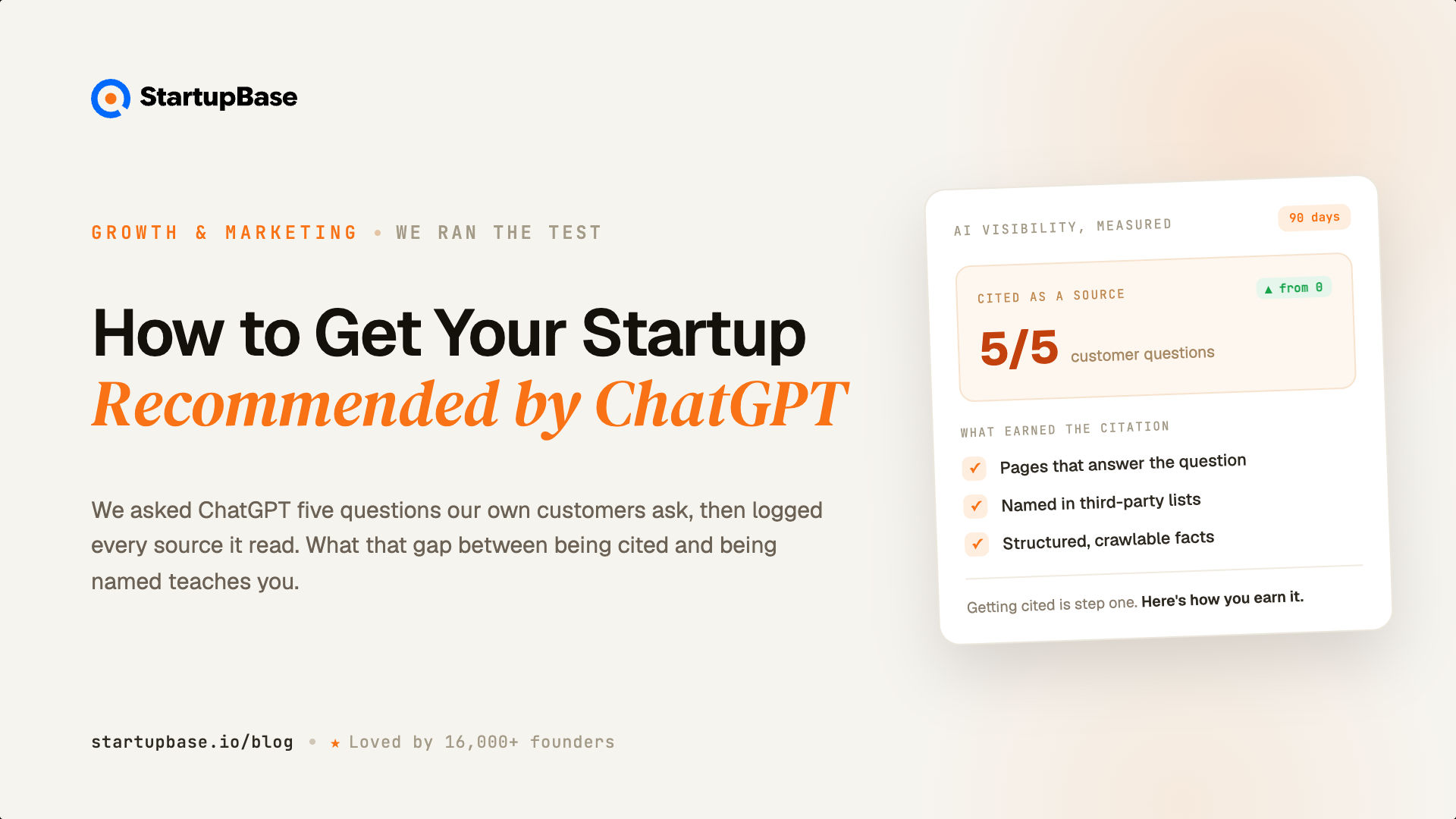
Getting recommended by ChatGPT is a two stage problem: your site has to be retrieved, then selected. In our test of five buyer queries, ChatGPT consulted between 129 and 182 sources per answer and named roughly six to eight products. Technical work gets you retrieved, and ours took about three months. Selection is won separately, by third party sources that mention you by name.
Quick Answer
Most advice about getting recommended by AI assistants is written by companies that sell on-page SEO tools, and it shows. You get told to add schema markup, publish an llms.txt file, and structure your headings for extraction. All of that is real work with real benefits, and almost none of it explains why a six month old startup is invisible to ChatGPT while its competitors are not.
So rather than write another version of that article, we ran a test on ourselves and published the numbers, including the ones that are not flattering.
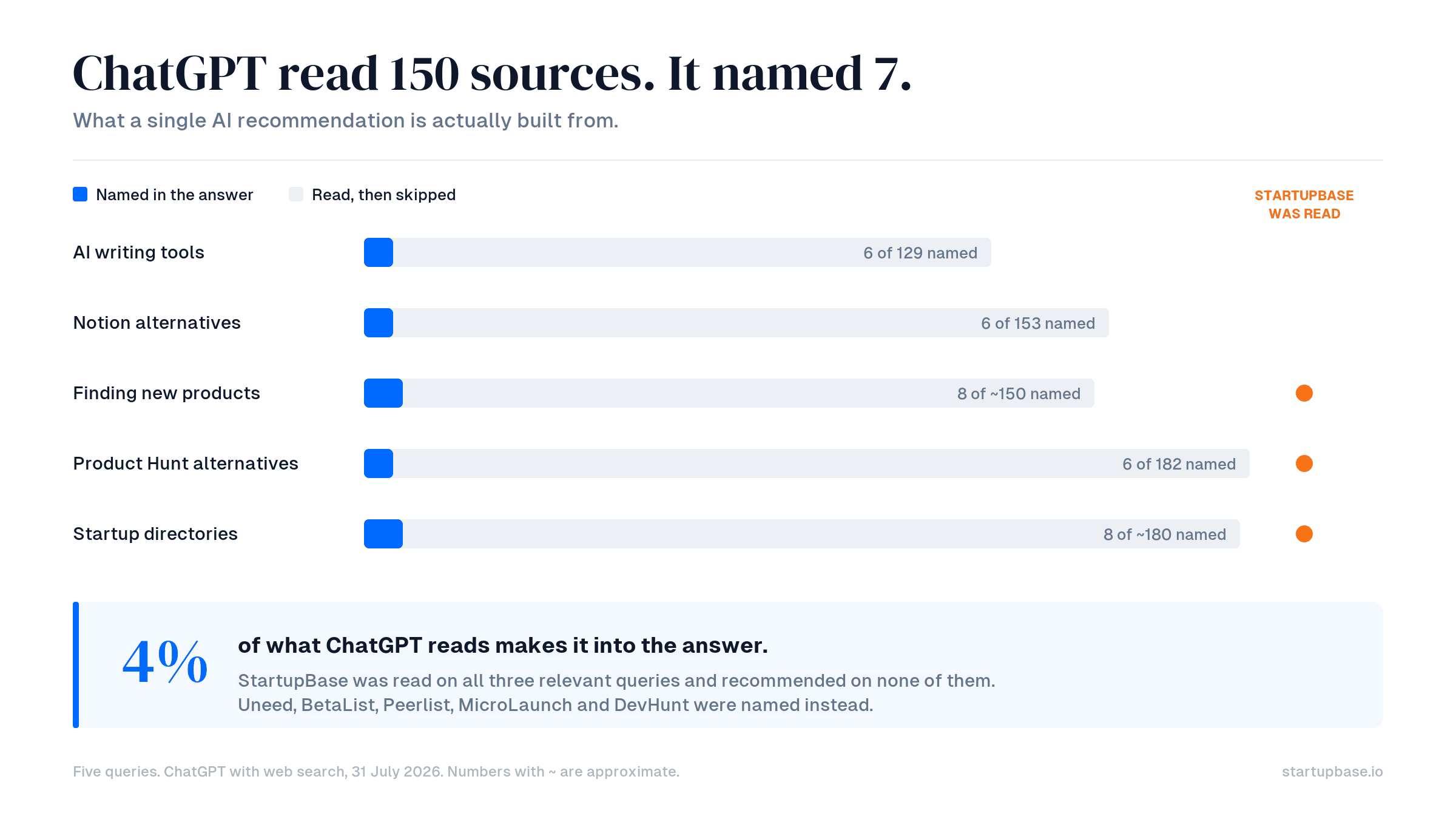
We asked ChatGPT five questions that our own potential customers genuinely ask, then logged every single source it consulted before answering. StartupBase appeared in the source list on all three queries where we were relevant. It was named in the answer on none of them. Uneed, BetaList, Peerlist, MicroLaunch and DevHunt were all named in those same answers.
The timing matters for reading that result. We shipped our own AI visibility work, structured data and an llms.txt file included, in the last week of April 2026. Roughly three months later, ChatGPT was reliably pulling our pages into the candidate set for every query where we belong. That is a real result for a young domain, and it is stage one of two.
Stage two is being chosen out of that set, and we have not earned it yet. The gap between being read and being recommended is the whole subject of this guide.
What we did
Five queries, run through ChatGPT on 31 July 2026 with web search enabled, each in a fresh chat so answers could not contaminate each other. For every answer we expanded the activity panel and recorded the full list of sources consulted, then compared that list against the products actually named in the response.
The queries were deliberately phrased the way a real person asks, not the way a founder vanity searches:
- What are the best AI writing tools for solo founders?
- What are the best alternatives to Notion for a small team?
- Where can I find new startup products to try before they get popular?
- What are the best Product Hunt alternatives to launch my startup on?
- What are the best startup directories to submit my product to in 2026?
Two honest caveats before any of the numbers, because you should weigh them accordingly. This is five queries on one logged in account, which is a sample small enough that you should treat the direction as meaningful and the precise figures as indicative. And although we used Temporary Chat specifically to avoid personalisation, one answer still referenced a product associated with the account without being asked. Personalisation leaks. If you run this yourself, expect the same.
Finding one: retrieval is not citation
The single most useful number in the test is the ratio.
| Query | Sources consulted | Products named |
|---|---|---|
| Best AI writing tools for solo founders | 129 | 6 |
| Best Notion alternatives for a small team | 153 | 6 |
| Where to find new startup products early | ~150 | 8 |
| Best Product Hunt alternatives | 182 | 6 |
| Best startup directories in 2026 | ~180 | 8 |
ChatGPT read between 129 and 182 sources to produce an answer that named six to eight products. That is a selection rate of roughly four percent.
This reframes the entire problem. Almost everything published about AI visibility is about getting crawled: make your site machine readable, add structured data, publish a file that tells the model what you do. That work gets you into the pool of 150. It does nothing to get you out of it.
Being retrieved is necessary. It is nowhere near sufficient, and it is the easier half by a wide margin.
Finding two: three months of technical work got us into the pool
On the three queries where StartupBase is genuinely a relevant answer, our domain was in the source list every time. ChatGPT found us, read us, considered us, and then recommended someone else.
It is worth separating those two facts, because founders tend to collapse them into one verdict.
Getting retrieved on every relevant query, about three months after shipping structured data and an llms.txt file on a domain that is not old, is the technical layer working. We cannot prove causation from a single case, since we changed several things at once and ran no control. But if you are wondering whether that work is wasted, our answer is no: something got us into a candidate set of 150 sources, and the honest reading is that the retrieval layer did its job faster than we expected.
What it did not do, and was never going to do, is win the selection step. That is a different competition with different rules, and no amount of on-site work enters you into it.
Look at who beat us. On the Product Hunt alternatives query the named platforms were Hacker News Show HN, BetaList, Uneed, Peerlist Launchpad, MicroLaunch and DevHunt. What those have in common is not better documentation. It is that each of them appears repeatedly, by name, inside third party roundups and comparison articles that ChatGPT also read.
The model was not evaluating our website against theirs. It was counting how many independent sources described each platform as a good answer to that specific question.
Finding three: the sources change with the question
This is the part no other guide seems to have measured, and it changes what you should actually do.
For "best [category] tool" queries, vendor owned domains dominate. The AI writing tools answer was built almost entirely from help.openai.com, support.anthropic.com, grammarly.com, notion.com, jasper.ai, copy.ai and writer.com. Documentation and pricing pages, not roundups. Help centres are a citation surface that almost nobody optimises deliberately.
For "alternatives to [tool]" queries, review platforms enter. The Notion query pulled in G2, Capterra, TrustRadius and Forbes alongside the vendor domains. If you sell software and you are absent from the review platforms, you are absent from this entire query class.
For "where do I find or submit" queries, niche roundups dominate. Our discovery and directory queries surfaced a long tail of small aggregator sites: awesome-directories, launchpedia, growthlist, launchdirectories, submittodirectories, smollaunch and blastra. Sites most founders have never heard of, doing more to shape AI recommendations in our category than any individual product page.
Wikipedia appeared in four of the five answers. Dictionary sites appeared repeatedly too, which is a useful reminder that the source list is raw retrieval rather than a curated set of endorsements.
What this means you should actually do
The order matters here, because the usual advice has it backwards.
Get mentioned in the roundups that already rank. Find the articles that answer your buyer's question today, the ones ChatGPT is already reading, and get your product into them. This is unglamorous outreach work and it is the single highest leverage action on this list. One inclusion in a roundup that gets retrieved for your category is worth more than a month of on-site optimisation.
Get on the review platforms if you sell software. G2, Capterra, TrustRadius and AlternativeTo showed up the moment the question involved comparing tools. A profile with real reviews is a citable, third party statement that your product exists and is credible. That is exactly what the selection step is looking for.
Get listed where your category gets aggregated. For most products that means the directories and launch platforms that AI assistants read when someone asks where to find things like you. We covered which ones are worth the time in the best startup directories to submit your startup, and for AI products specifically in the best AI directories. The relevant point here is different from the SEO one: a listing is a corroborating source, whether or not the link is dofollow.
Be consistent about what you are. If your homepage, your directory listings and your review profiles each describe you differently, you are giving the model three weak signals instead of one strong one. Pick one sentence that says what you do and who it is for, and use it everywhere without variation.
Then do the on-site work. Clear structure, a direct answer near the top of important pages, honest comparison content, and documentation written to be read. This genuinely matters, particularly the help centre finding above. It is simply not the first thing to fix when you are new, because it only improves how you are represented once something else has got you selected.
If you want the sequence for everything around this, it sits inside the wider startup marketing playbook, and the traffic side is covered in how to get traffic to your startup website.
What does not work
Treating llms.txt as the whole strategy. We publish one and we would do it again, since it is cheap and it is part of the retrieval layer that got us into the candidate set within three months. What it will not do is get you named. If you ship it and then wait, you are waiting on the wrong step.
Bulk submitting to two hundred directories. The same logic that makes this bad for SEO makes it bad here. Aggregators that nobody reads do not get retrieved, so a listing on one corroborates nothing. We went through the reasoning in do startup directories help SEO.
Generating volumes of AI written content about your own category. Selection rewards being described by other people. Describing yourself more often, in more words, is not the same signal and the model can tell the difference.
Asking the assistant about yourself. Typing "what is [your product]" tells you almost nothing, because you have handed the model the answer inside the question. Real visibility is whether you appear when your name is never mentioned.
It is also worth knowing that ChatGPT is openly sceptical of our category. Asked about Product Hunt alternatives, it volunteered that most of them "are glorified backlink farms" that "will not produce meaningful users." Assistants make quality judgements about categories, not just about products, and being lumped in with low quality peers is its own visibility problem.
Audit your own AI visibility in ten minutes
Run this before you change anything, so you have a baseline.
- Write down five questions a buyer would ask that your product genuinely answers. Never include your product name.
- Run each one in ChatGPT with web search on, using a fresh chat every time.
- For each answer, record which products were named and in what order.
- Expand the sources panel and check whether your domain appears at all.
- Sort yourself into one of three buckets: not in the sources, in the sources but not named, or named.
- Repeat in Claude, Perplexity and Gemini, because they retrieve differently.
The bucket you land in tells you what to fix, and they need opposite responses.
Not in the sources at all is a retrieval problem. Your pages are not being found, so the on-site work is where you start.
In the sources but not named is a corroboration problem, which is where we landed. Your site is fine. Not enough other people are saying you are the answer.
Named is where you want to be. Now check what it says about you, because being described inaccurately is its own issue.
FAQ
How do I get my startup recommended by ChatGPT?
Get mentioned by name in third party sources that ChatGPT already reads for your category: roundup articles, review platforms like G2 and Capterra, and the directories that aggregate products like yours. In our test, ChatGPT consulted up to 182 sources per answer and named only six to eight products, and the ones it named were those corroborated across multiple independent sources.
Does llms.txt help you get recommended by AI?
It is part of the retrieval layer, so it can help a model find and parse your site accurately. We shipped one in April 2026 and were being retrieved on every relevant query about three months later, though we cannot prove it was the cause because we changed several things at once. What it will not do is get you named in the answer, because that step is decided by third party sources rather than by your own site.
Why does ChatGPT recommend my competitor instead of me?
Usually because more independent sources describe your competitor as the answer to that question. If your domain appears in the sources but your name never appears in the answer, your site is being read and rejected at the selection step, which is a corroboration problem rather than a technical one.
How is AI visibility different from SEO?
Traditional SEO competes for a position in a list of links, where being on page one has value. AI answers name a handful of products and there is no second page. The mechanics also differ: rankings respond to links and authority, while citations respond to how many credible sources independently describe you as the answer.
How long does it take to get recommended by AI assistants?
Expect months rather than weeks. Getting listed and reviewed happens quickly, but the assistant has to re-crawl those sources and then weigh you against the alternatives. The compounding part is the same as SEO: each new credible mention raises the odds slightly, and the effect is cumulative.
Final thoughts
Our own result is a half finished job, and we published it that way on purpose.
Three months after doing the technical work, ChatGPT reads our pages on every query where we belong. That part worked, and faster than we expected on a domain this young. It just turns out that being read is the entry fee rather than the prize, and the guides that stop at schema and llms.txt are describing the entry fee.
Being found is a technical problem, and you can make real progress on it in a quarter. Being chosen is a reputation problem, and reputation is made of other people's words about you. Get into the roundups. Get reviewed. Get listed where your category is aggregated. Say the same thing about yourself everywhere.
We will run this test again in ninety days and publish what moved. If you run it on your own product, the bucket you land in tells you which half of the problem you are actually working on.
Startup Marketing
AI Search
Generative Engine Optimization
AI Visibility







 Continue with Google