
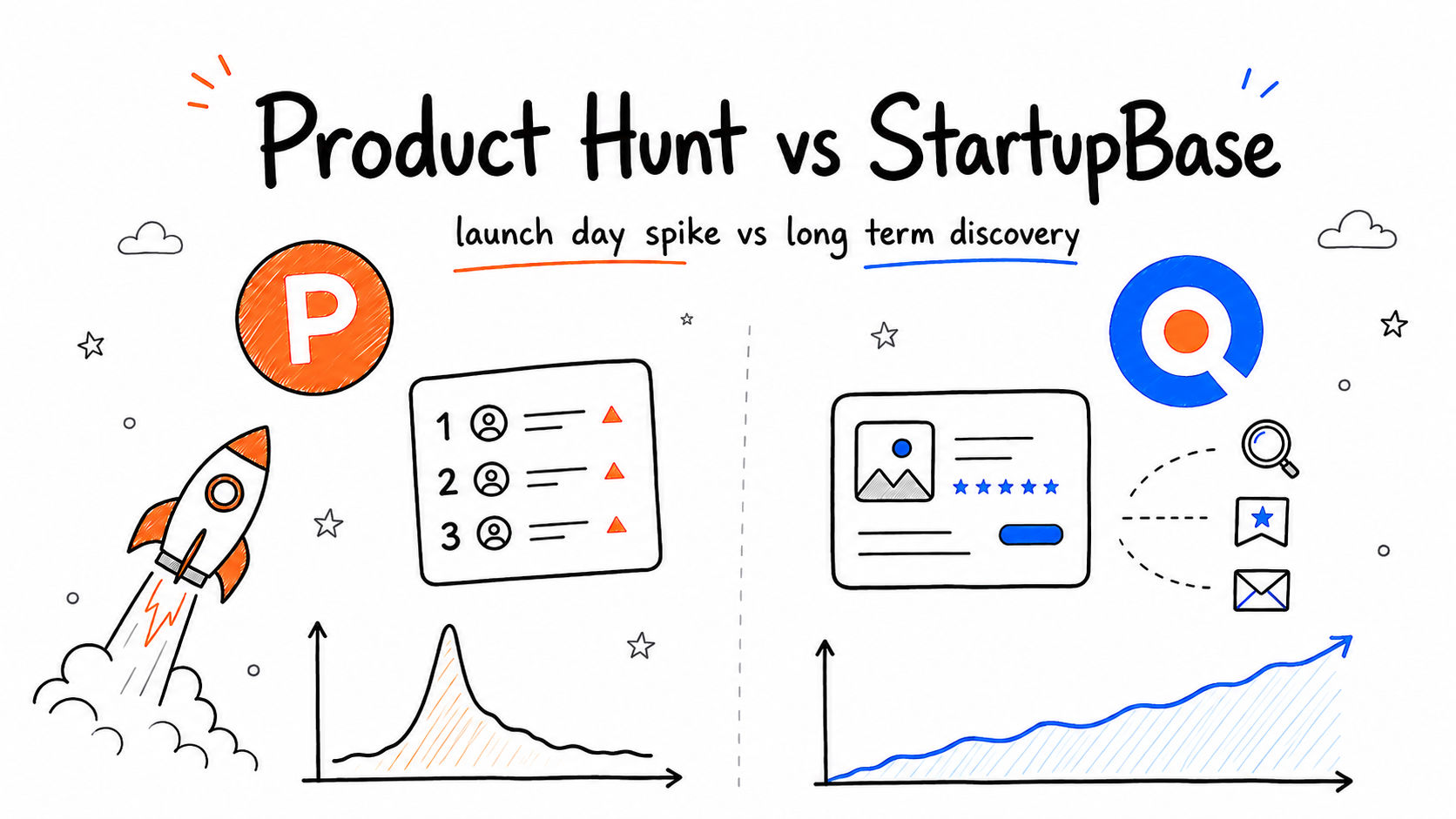
Product Hunt is still useful for creating a launch day spike, but StartupBase is better for many early stage founders because every approved product gets featured, visibility is not only reserved for insiders, and product pages keep working after launch day through rankings, collections, reviews, newsletter exposure, and long term discovery.
Quick Answer
Product Hunt is still one of the most recognized places to launch a startup, but it is no longer the only serious option for founders.
For years, Product Hunt has been the default launch platform for SaaS products, AI tools, developer tools, mobile apps, Chrome extensions, and indie projects. A strong Product Hunt launch can still bring traffic, early users, comments, social proof, and attention from other founders.
But many founders now want something more predictable, more founder friendly, and more useful after launch day.
The problem is not that Product Hunt has no value. It still has a large audience and can create a strong launch spike when everything works. The problem is that launch visibility often depends on timing, existing audience, network effects, early momentum, and whether your product gets noticed quickly enough.
For smaller teams, solo founders, bootstrapped startups, and early stage products, that can feel like a black box.
StartupBase takes a different approach. Every approved product gets a real launch spot, visibility is not only reserved for founders with big audiences, and your product page continues to support discovery after the first 24 hours.
So the real question is not only “Product Hunt or StartupBase?”
The better question is: do you only want launch day attention, or do you want a product page that keeps helping people discover what you are building?
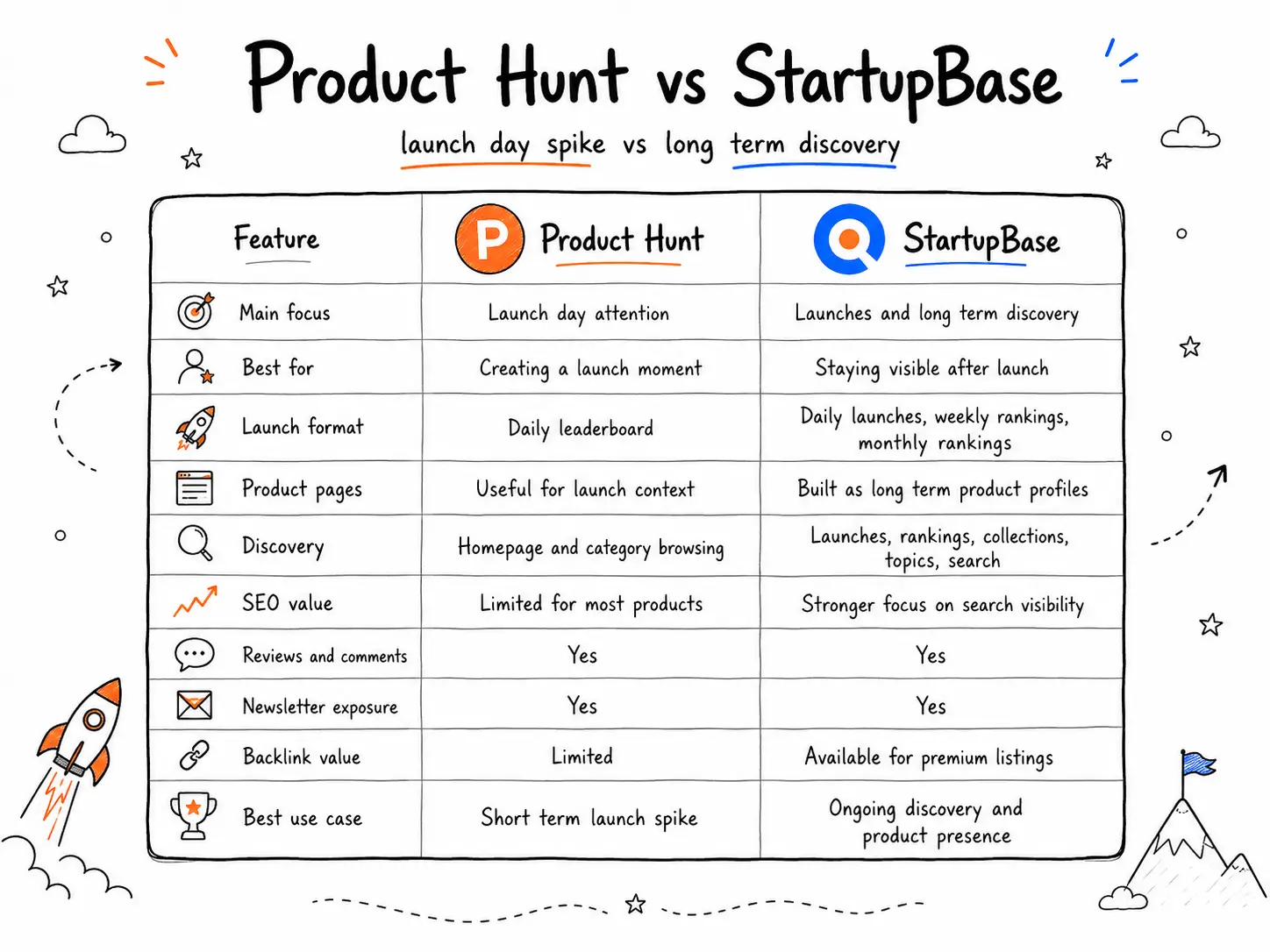
Quick overview
| Feature | Product Hunt | StartupBase |
|---|---|---|
| Main focus | Launch day attention | Launches and long term discovery |
| Best for | Creating a launch moment | Staying visible after launch |
| Launch format | Daily leaderboard | Daily launches, weekly rankings, monthly rankings |
| Product pages | Useful for launch context | Built as long term product profiles |
| Discovery | Homepage and category browsing | Launches, rankings, collections, topics, search |
| SEO value | Limited for most products | Stronger focus on search visibility |
| Reviews and comments | Yes | Yes |
| Newsletter exposure | Yes | Yes |
| Backlink value | Limited | Available for premium listings |
| Best use case | Short term launch spike | Ongoing discovery and product presence |
What Product Hunt does well
Product Hunt is popular for a reason. It has a large audience of founders, makers, investors, early adopters, and tech enthusiasts who actively look for new products.
If your product performs well on Product Hunt, it can create a strong launch moment. You may get website traffic, early signups, comments, social shares, newsletter mentions, investor interest, and useful product feedback.
This is especially valuable for products that are easy to understand quickly, such as AI tools, productivity apps, design tools, developer utilities, marketing software, and consumer apps.
Product Hunt also gives founders social proof. Being able to say your product launched on Product Hunt still carries weight, especially if you rank well or receive strong community engagement.
The problem is not that Product Hunt is bad. The problem is that many founders expect too much from one launch day.
The problem with one day launch visibility
A Product Hunt launch is usually built around a short attention window. Your product appears, competes for rankings, gets visibility, and then quickly moves out of the main feed as the next day’s launches take over.
That creates a common problem for founders.
You spend days or weeks preparing your launch assets, writing your first comment, asking your network for support, posting on social media, replying to comments, and trying to get early momentum. If the launch works, you may see a traffic spike. If it does not, your product can disappear quickly.
Even when the launch goes well, attention often drops after 24 to 48 hours.
For some products, that is enough. For many early stage startups, it is not.
Founders need discovery that compounds. They need people to find their product through Google, AI search, curated lists, category pages, rankings, newsletters, and product directories long after launch day is over.
That is the gap StartupBase is built around.
Why StartupBase is better for many founders
StartupBase is not just another place to submit a product link. It is built around a different launch philosophy.
Product Hunt is strongest when you can create fast momentum. StartupBase is stronger when you want a clearer path to visibility and a product profile that keeps working after the launch window closes.
Here are the three biggest differences.
Every approved product gets featured
On StartupBase, you are not submitting your product into a black box and hoping someone picks it.
If your product is approved, it gets a real launch spot.
That matters because founders should not have to spend weeks preparing a launch only to wonder whether their product will be seen at all. StartupBase still reviews submissions for quality, but approved products are not treated like lottery tickets.
You get a clearer path from submission to launch.
Launch visibility is not only for insiders
A launch platform should help good products get discovered, not only reward founders who already have a large audience.
On Product Hunt, momentum often comes from an existing network. Founders with bigger audiences, stronger investor circles, active communities, or launch support usually have an advantage. That does not make Product Hunt useless, but it does make it harder for smaller teams and solo founders to compete.
StartupBase is designed to give early stage products more room to be discovered.
You should not need a huge following, a VC network, or the right launch connection just to get visibility. If your product is useful and approved, it deserves a real chance to be seen.
Your product keeps working after launch day
The biggest problem with many launch platforms is that attention fades quickly.
You launch, get some traffic, collect a few comments, and then the next day your product is pushed down by the next batch of launches.
StartupBase takes a longer term approach.
Your product gets a public page that can continue to support discovery after launch day. It can appear in rankings, collections, reviews, topic pages, search results, newsletter placements, and featured areas across the platform.
That means your launch is not only a one day event.
It becomes part of a product discovery system that can keep working over time.
What StartupBase does differently
StartupBase is designed for founders who want their product to stay discoverable beyond a single launch day.
Instead of focusing only on a daily leaderboard, StartupBase gives products multiple discovery paths. A product can appear in daily launches, weekly rankings, monthly rankings, curated collections, topic pages, reviews, comments, newsletter features, and search indexed product pages.
This matters because users discover products in different ways. Some people browse new launches. Some look for the best tools in a specific category. Some search for alternatives. Some follow newsletters. Some discover products through rankings or curated collections.
A launch platform should not force every product into one short visibility window.
StartupBase gives founders a public product profile that can keep working over time. That profile can include key product details, media, team information, descriptions, links, reviews, rankings, and discovery placements.
This makes StartupBase feel less like a one day launch event and more like a long term discovery layer.
Product pages are becoming more important
Many founders underestimate the value of a strong product page.
A product page is not just a place to send traffic. It is also part of your search presence, brand presence, and discovery system.
A good product page should clearly explain what the product does, who it is for, what problem it solves, why it is different, and where users can go next. It should also include enough context for visitors, search engines, and AI discovery tools to understand the product.
This is where StartupBase has a useful advantage.
StartupBase product profiles are built to give startups more context than a simple launch listing. Founders can submit important details such as the product name, tagline, description, links, media, and team information. Once published, the product can have its own public page and can appear in rankings, curated collections, reviews, comments, newsletter distribution, and featured placements.
For founders, that means the product page is not only useful on launch day. It can support long term visibility.
SEO and AI discovery now matter in launch strategy
Startup launches are no longer only about getting traffic from one platform.
Founders also need to think about how their product appears across search engines, AI tools, comparison pages, startup directories, category pages, and recommendation systems.
This is why SEO matters more than before.
When someone searches for “best AI writing tools,” “Product Hunt alternatives,” “new SaaS tools,” “startup launch platforms,” or “best productivity apps,” your product should have more chances to appear across the web.
A listing on StartupBase can help support that broader discovery strategy. It gives your startup another indexed product page, another brand mention, and another place where users can understand what you are building. Premium listings can also include a backlink, which adds more value for founders who care about SEO.
This is especially useful for early stage startups that do not yet have strong domain authority, a large audience, or a big marketing budget.
A launch spike is good.
A product page that keeps supporting discovery for months is better.
Product Hunt is better for launch momentum
Product Hunt is still a strong choice if your goal is to create a public launch moment.
It is useful when you want fast attention, community feedback, social proof, and early visibility from a startup-focused audience. It works best when you already have a network, an existing user base, or a strong launch plan.
If your product ranks well, Product Hunt can still send meaningful traffic and create credibility.
But it should not be your entire launch strategy.
A Product Hunt launch is strongest when it is part of a larger distribution plan that includes social media, newsletters, directories, SEO pages, founder communities, and long term discovery platforms.
StartupBase is better for predictable visibility
StartupBase is a better fit if you care about what happens after launch day.
It is useful for founders who want a public product profile, a real launch spot after approval, search visibility, rankings, collections, reviews, newsletter exposure, and more chances to be discovered over time.
This makes it especially relevant for SaaS products, AI tools, indie products, developer tools, marketing tools, productivity apps, and bootstrapped startups that need steady visibility instead of only one day of attention.
StartupBase is not just about launching. It is about helping products stay visible.
That difference matters.
Should you launch on Product Hunt or StartupBase?
The smartest answer is to use both.
Product Hunt can help you create a strong launch moment. StartupBase can help your product stay discoverable after that moment ends.
A better launch sequence could look like this:
- Prepare your launch assets, screenshots, tagline, description, and product page.
- Launch on Product Hunt to create short term momentum.
- Submit your product to StartupBase for long term discovery.
- Share your launch story on X, LinkedIn, and founder communities.
- Add your product to relevant startup directories and curated lists.
- Keep updating your product profile as you ship new features.
- Relaunch or promote again when you have a major update.
This gives your product more than one chance to be discovered.
Relying on a single platform is weak distribution. Good founders build multiple discovery paths.
Product Hunt and StartupBase can work well together, but they are not the only launch channels founders should consider. For a broader list of platforms, read our guide to the best Product Hunt alternatives for launching, relaunching, and getting early users.
Final verdict
Product Hunt is still one of the best platforms for creating launch day momentum. It has a strong brand, a large startup audience, and real social proof value when your launch performs well.
But Product Hunt is not the best fit for every founder. If you are a solo founder, bootstrapped team, early stage startup, or indie maker without a large audience, launch visibility can feel too dependent on timing, network, and momentum.
StartupBase is better for founders who want a clearer path to visibility and long term product discovery. Every approved product gets a launch spot, visibility is not only for insiders, and product pages can keep working through rankings, collections, reviews, newsletter distribution, search visibility, and ongoing discovery beyond the first 24 hours.
So the choice is not really Product Hunt vs StartupBase.
Product Hunt helps you get attention.
StartupBase helps you get discovered and stay discoverable.
For serious founders, the best move is to use both.
Startup Launch
Product Discovery
StartupBase
Product Hunt Alternatives







 Continue with Google