
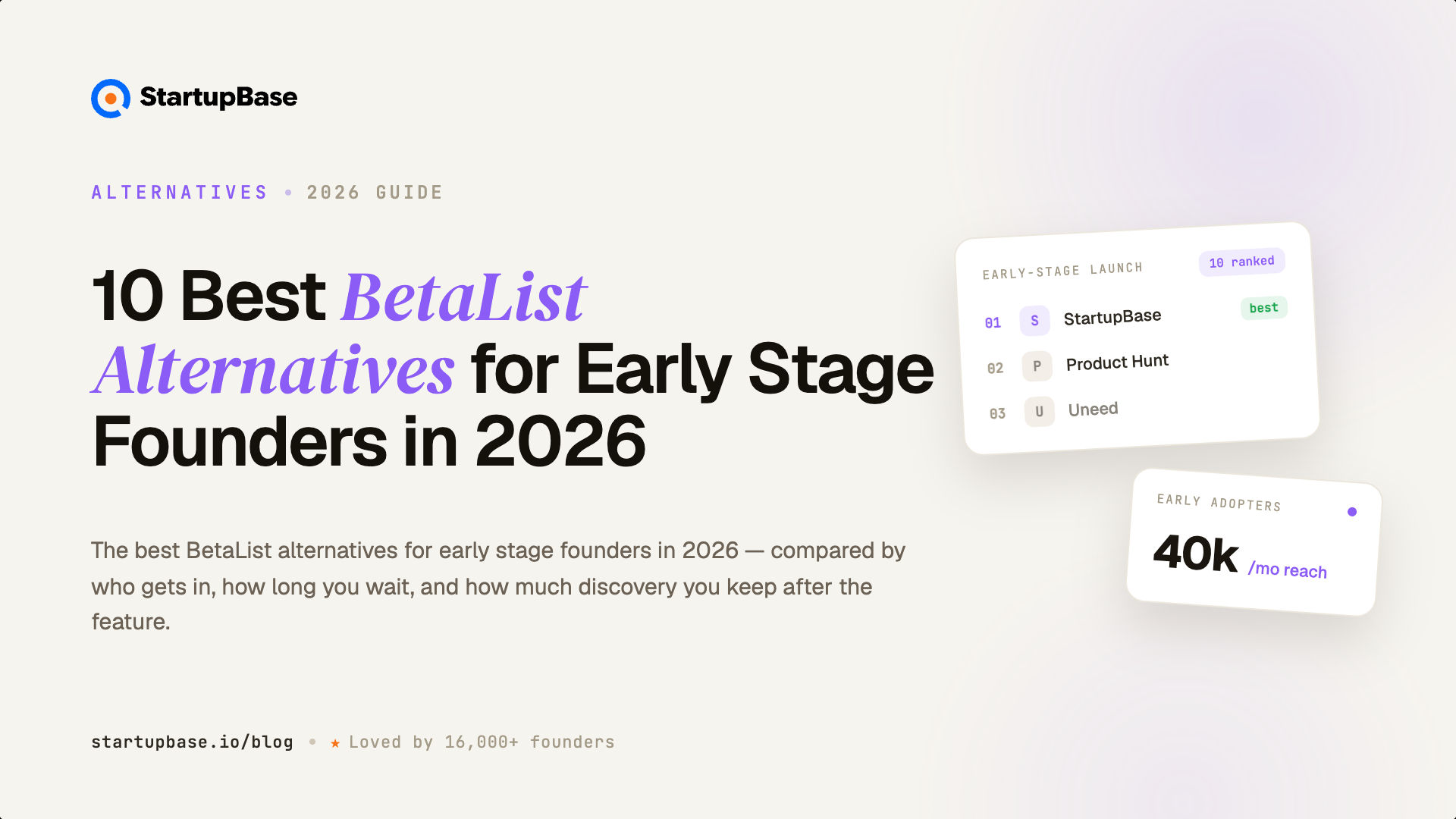
The best BetaList alternative for most founders is StartupBase, because every approved product gets a real launch spot with no two month queue, and it keeps working after launch day. Product Hunt is the biggest launch moment, Peerlist and Indie Hackers reach builders, and Reddit gives blunt early feedback. BetaList is still worth a submission if you are pre launch, but it is curated, slow, and features you only once, so it should never be your only plan.
Quick Answer
BetaList is one of the oldest names in early stage startup discovery, and it still does something few platforms do: it puts pre launch products in front of people who actively want to try unfinished things.
If you are collecting waitlist signups before a full public launch, that audience is genuinely valuable.
But BetaList has real limits. It is curated, so you might not get in at all, the queue runs long even when you do, and it features your startup once before going quiet.
This guide covers the ten best BetaList alternatives in 2026, compared by who actually gets in, how long you wait, and how much discovery you keep after the feature. It starts with StartupBase.
Where BetaList falls short
BetaList is a good platform. These are the honest limits that send founders looking for alternatives, all of them straight from BetaList's own guidelines.
- You might not get in. BetaList receives thousands of submissions a month and an editorial team picks what runs. Rejections come with no specific feedback, so you are left guessing.
- The wait is long. Even after you are accepted, it typically takes about two months to get featured. For a founder with momentum, that is a long time to sit still.
- You get featured once. BetaList generally features each startup a single time. The one exception is that a startup featured before launch can be featured again when it launches. Ship a major update after that and there is nothing to do.
- The criteria are strict. You need your own domain, a well designed landing page, and an idea they have not seen before. No free hosting subdomains, no direct app store links.
- It is built for pre launch. That focus is a strength if you are collecting early access signups, and a weakness if you are an established product that wants ongoing discovery.
To be fair to BetaList: they add UTM tracking so you can measure the traffic, and the priority listing option refunds you automatically if your startup is not selected. It is a well run platform. It is just a single, slow, one time shot.
Quick comparison
| Platform | Best for | Cost | Who gets in |
|---|---|---|---|
| StartupBase | Launching and getting discovered | Free + $39 launch | Every approved product launches |
| Product Hunt | The biggest launch day | Free | Anyone, but reach favors networks |
| Uneed | A clean maker launch | Free + paid | Open, lightly curated |
| Peerlist | Reaching builders and engineers | Free | Open |
| Fazier | An extra discovery listing | Free + paid | Open |
| Indie Hackers | Founder feedback and audience | Free | Open |
| Launching Next | A simple startup listing | Free + paid | Open |
| Blunt early feedback | Free | Open, rules apply | |
| Hacker News | Technical products | Free | Open, crowd is sharp |
| MicroLaunch | A small indie launch surface | Free + paid | Open |
Best BetaList alternatives by use case
The right BetaList alternative depends on what stage you are at and what you want back.
Best overall BetaList alternative
StartupBase. Every approved product gets a real launch spot, there is no two month queue, and the listing keeps working after launch day.
Best for a pre launch waitlist
Product Hunt's upcoming pages and Peerlist. Both let you build interest before you are fully live, which is the job BetaList does.
Best for a launch moment
Product Hunt and StartupBase. BetaList features you quietly. A launch creates a spike.
Best for honest feedback
Reddit, Indie Hackers, and Hacker News. If you want to know why people are not signing up, ask builders directly.
Best for relaunching later
StartupBase. BetaList features you once. If you ship major updates, you need somewhere you can come back to.
How we picked these BetaList alternatives
Not every launch platform suits an early stage startup. Some want polished, revenue generating products. Some are ghost towns.
We picked these ten on three things: whether you can actually get in, how fast you get visibility, and how much discovery you keep after the feature. Most of these are established platforms, so a backlink is rarely the deciding factor. Fit and timing are.
With that in mind, here are the best BetaList alternatives to consider.
1. StartupBase
We are putting StartupBase first because it fixes the two things founders complain about most with BetaList: the gatekeeping and the wait.
- Every approved product gets a real launch spot. No editorial lottery, no guessing why you were passed over. If it meets the guidelines, it launches.
- No two month queue. Free launches join a priority queue, and the $39 plan lets you launch the same day.
- Your product keeps working after launch day. It keeps surfacing through daily launches, weekly and monthly rankings, curated collections, topic pages, reviews, comments, and the newsletter. You can also relaunch when you ship something major.
- The $39 plan includes a dofollow backlink, plus a guaranteed homepage feature.
Honest comparison: BetaList has been around longer, has a stronger domain, and its audience is specifically hunting pre launch products. If you are purely collecting waitlist signups and you have two months to spare, it is worth the submission. StartupBase is stronger when you want a launch now, a guaranteed spot, and visibility that does not end after one feature.
Best for: early stage founders who want a real launch without the gatekeeping, and discovery that keeps going.
Use it when: you are launching or relaunching and you want it to keep getting found. Here is how to launch on StartupBase.
👉 Submit your product to StartupBase
2. Product Hunt
Product Hunt is the biggest launch day platform anywhere. It also runs upcoming pages, which cover the same pre launch waitlist job BetaList does, with far more reach.
Best for: the biggest one day audience, social proof, and press attention.
Reality check: the 24 hour format rewards founders who already have a network, and the spike fades fast. Pair it with something that keeps working. See Product Hunt vs StartupBase and the best Product Hunt alternatives.
3. Uneed
Uneed is a clean, maker friendly launch platform with rolling leaderboards and a newsletter. Submission is simple and the queue is nothing like two months.
Best for: a straightforward launch without a big network.
Reality check: smaller reach than Product Hunt, so treat it as one surface rather than the whole plan. If you are weighing it, see the best Uneed alternatives.
4. Peerlist
Peerlist is a professional network for builders with an active launch section. The audience is engineers, designers, and founders, which is exactly who tries early products.
Best for: technical and design led products aimed at builders.
Reality check: the audience is professional rather than mainstream consumer, so it fits developer and creator tools better than general apps.
5. Fazier
Fazier is a product discovery platform for SaaS, AI, and indie tools, with a simple submission and a listing that keeps surfacing.
Best for: an extra credible listing without a complicated process.
Reality check: smaller than the giants, so use it to widen your surface area rather than carry a launch.
6. Indie Hackers
Indie Hackers is a community, not a directory, and that is the point. BetaList shows your product to strangers. Indie Hackers lets you tell the story behind it.
Best for: feedback, early users, and building a founder audience.
Reality check: you cannot drop a link and leave. Share a lesson, a number, or a mistake, and the product follows naturally.
7. Launching Next
Launching Next is a straightforward directory of new and upcoming startups. It is not glamorous, but it is easy, it is indexed, and it takes minutes.
Best for: a simple early stage listing you can set and forget.
Reality check: low effort and low ceiling. Do not expect a traffic spike, but it is a reasonable extra listing.
8. Reddit
Reddit is where you find out whether people actually want this. Subreddits like r/SideProject, r/startups, and niche communities for your category are full of potential early users.
Best for: blunt feedback and targeted early users.
Reality check: read the rules of every subreddit first. Promotional posts get removed, and the crowd is unforgiving. Show up as a builder sharing something, not a marketer.
9. Hacker News
A Show HN post reaches a huge technical audience for free. When it works, it works better than almost anything on this list.
Best for: developer tools, open source, and technically interesting products.
Reality check: the crowd is sharp and the front page is not guaranteed. Be honest, be specific, and answer every comment.
10. MicroLaunch
MicroLaunch is a small launch platform for indie makers, with an easy submission and a maker audience.
Best for: solo founders who want another launch surface.
Reality check: small reach. Worth including in a wider stack, not on its own.
BetaList vs StartupBase
Both help an early stage startup get discovered, but they work very differently.
| Feature | BetaList | StartupBase |
|---|---|---|
| Main focus | Pre launch early access | Launches and long term discovery |
| Who gets in | Curated, editorial selection | Every approved product launches |
| Wait time | About two months after acceptance | Priority queue, or same day on the $39 plan |
| How often featured | Once, plus one relaunch if featured pre launch | Launch, plus relaunch on major updates |
| Discovery after the feature | Limited, the listing goes quiet | Rankings, collections, topic pages, search, and newsletter |
| Reviews and comments | No | Yes |
| Link to your site | Routed through a redirect | Direct dofollow link on the $39 plan |
| Best use case | Collecting waitlist signups pre launch | Launching now and staying visible |
If you are pre launch with time to spare, submit to both. BetaList reaches early adopters hunting for unreleased products, and that is a real audience. But it features you once and then goes quiet, which is exactly the gap StartupBase fills.
How to actually get accepted on BetaList
If you are going to submit to BetaList anyway, give yourself the best odds. Their team is explicit about what they look for.
- Use your own domain. Free hosting subdomains like vercel.app or netlify.app are rejected, as are direct app store links.
- Lead with a clear value proposition. They prioritize products where it is obvious what it does and who it is for, within seconds.
- Make the landing page good. Design is an explicit selection criterion, not a nice to have.
- Bring an idea they have not seen. They see thousands of submissions a month. The tenth AI writing assistant of the week is a hard sell.
- Submit while you are still pre launch. That is the audience the site is built for, and it keeps you eligible to be featured again at launch.
And do not wait on the outcome. Submit, then launch elsewhere while the queue moves.
Which BetaList alternative should you choose?
- Want a guaranteed launch spot and ongoing discovery? Start with StartupBase.
- Want the biggest launch day? Product Hunt.
- Building for developers? Peerlist and Hacker News.
- Want honest feedback before you scale? Reddit and Indie Hackers.
- Still pre launch with time to spare? Submit to BetaList too, then launch elsewhere while you wait.
The best move is not to pick one. Launch on StartupBase and Product Hunt, add Uneed and Fazier, and use the communities for feedback. For the full map, see 100+ places to launch, relaunch, and list your product and our guide to the best startup directories to submit your startup.
FAQ
What is the best BetaList alternative?
For most founders, StartupBase. Every approved product gets a real launch spot with no two month queue, and it keeps working after launch day. For the biggest launch moment, Product Hunt is the strongest.
Is BetaList still worth it in 2026?
Yes, if you are pre launch and not in a hurry. BetaList reaches early adopters who specifically want to try unreleased products, and that audience is hard to find elsewhere. Just do not rely on it alone: it is curated, takes about two months, and features you once.
How long does BetaList take?
After acceptance it typically takes about two months to be featured, though it varies with their queue. The paid priority listing gets you reviewed in a few days and featured shortly after, and refunds automatically if you are not selected.
Why was my startup rejected by BetaList?
They receive thousands of submissions a month and prioritize a clear value proposition, an original idea, and a well designed landing page. They do not give individual feedback, but you can improve on those three and resubmit.
What is the best free BetaList alternative?
StartupBase, Product Hunt, Peerlist, Indie Hackers, and Reddit all have free paths. StartupBase free launches join a priority queue, while the $39 plan skips the wait.
Where should I launch a pre launch startup?
Product Hunt's upcoming pages, BetaList, and Peerlist all reach people before you are fully live. Pair them with StartupBase so you have somewhere to launch properly when you are ready.
Final thoughts
BetaList does one job well: putting pre launch products in front of early adopters. If that is your moment, submit.
But one curated feature, two months out, with no second chance, is not a launch strategy. The founders who get traction treat discovery as a system: a real launch that keeps working, communities where they get honest feedback, and listings that keep getting found.
StartupBase is built to be the first of those, the launch that keeps getting discovered long after day one.
Launching something new?
Startup Launch
Product Discovery
Early Stage Startups
BetaList Alternatives







 Continue with Google