
Nuvoha is an AI travel discovery app that starts with your budget, style and interests rather than a destination, then presents complete trips as Trip Cards that pair flights with accommodation. It is built for leisure travellers deciding where to go, and it also works once you have picked a place and dates, packaging the available flights and hotels together. This is a first look as it launches on 29 July 2026.
Quick Answer
Most travel advice assumes you already know where you are going. Every major site opens with a search box waiting for a destination, a set of dates, and the quiet assumption that the decision is already made. For a lot of trips it is not. You know you want to go somewhere, you have a rough budget and a free week in October, and the actual hard part is choosing between a city break in Lisbon, a week in the Greek islands, or somewhere you have not thought of yet.
Nuvoha is built around that gap. Instead of asking where you want to go, it asks what you want to spend and how you like to travel, then hands back complete trip ideas that fit. It launches on 29 July 2026, and this is a first look at what it is, who it is for, and where its approach genuinely differs from the tools most people use today. We have not put the live app through a full hands-on test yet, so treat this as an assessment of the idea and the announced feature set rather than a verdict on every screen. We will come back to it once it is in our hands.
The problem Nuvoha is actually solving
The pitch is refreshingly narrow, which is a good sign. Nuvoha's own framing is that the hardest part of travel is not booking, it is deciding where to go, and everything about the product follows from taking that sentence seriously.
Booking a trip is a solved problem. There are a dozen competent sites that will sell you a flight and a room the moment you know what you want. What none of them help with is the step before that, when you have a budget and an appetite but no destination, and you end up with fifteen browser tabs open comparing places that have nothing to do with each other. Nuvoha is aimed squarely at that moment, and it is a real moment that the incumbents have mostly ignored.
How it works: budget in, Trip Cards out
The core interaction is the reverse of a search box. You tell Nuvoha your budget, your travel style, and the kind of thing you are interested in, and it recommends personalised trips built around those inputs.
Each recommendation arrives as a Trip Card, which is the concept the whole product hangs on. A Trip Card pairs flights with accommodation and destination inspiration in a single view, so instead of pricing a flight on one site and a hotel on another and doing the mental maths to see if the whole thing fits your budget, you see a complete trip as one object you can compare against another complete trip. Put two or three side by side and you are choosing between finished ideas rather than assembling each one from parts.
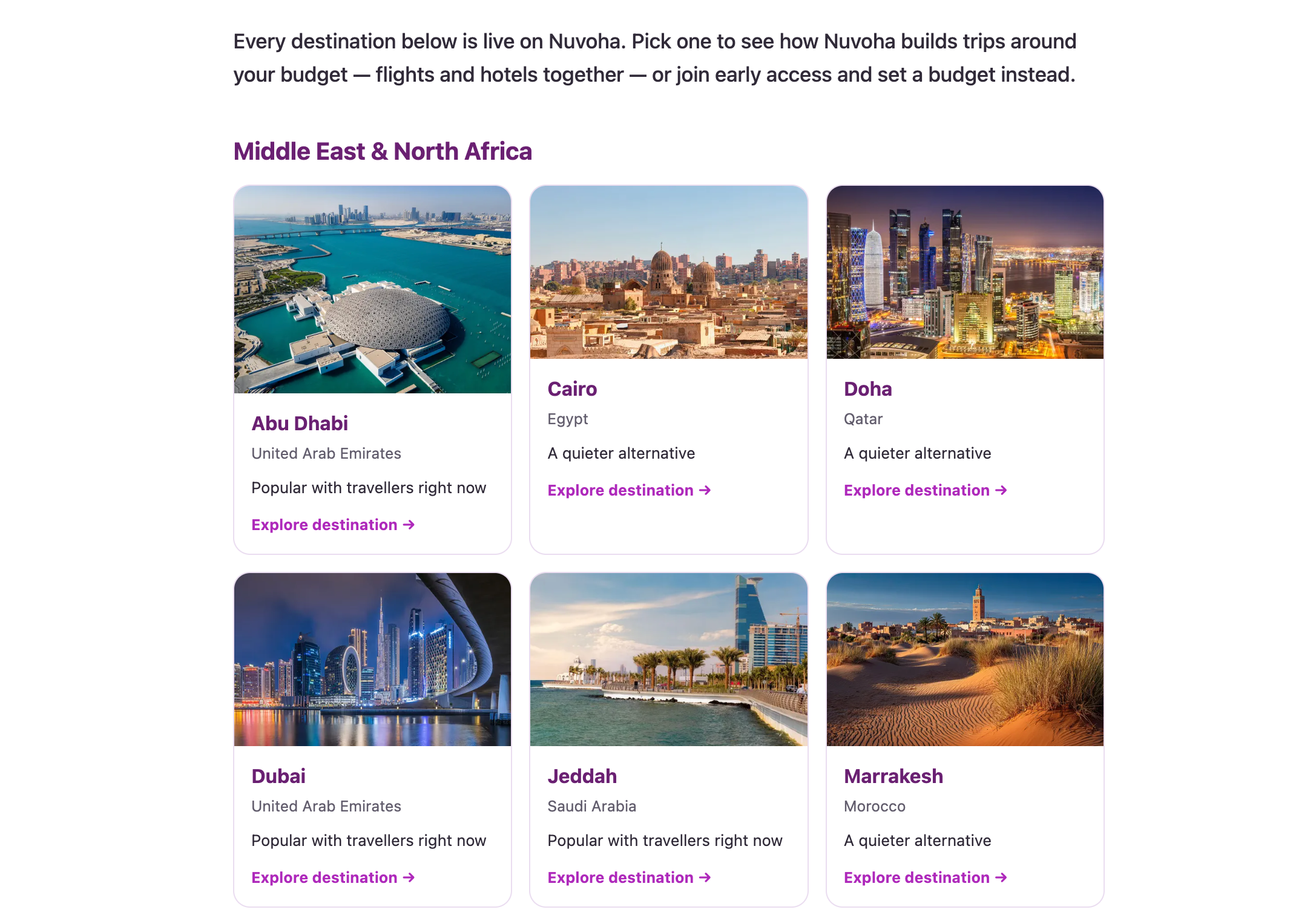
You can get a feel for this before installing anything. Nuvoha has already published destination pages for 43 places across six regions, from Lisbon and Rome to Tokyo, Zanzibar and Sydney, each one tagged by the kind of trip it suits, whether that is great for couples, strong for beach escapes, or a quieter alternative to the obvious choice. Each page shows the budget-first flight and hotel ideas for that destination, so the core concept is already something you can browse rather than only read about.
That is the part that will make or break the experience, and it is the part we most want to test at length once the app is live: a shortlist is only as good as the trips on it, and the quality of that first set of cards is where a discovery product earns or loses trust.
The AI layer
Two features carry the intelligence. The first is the discovery engine itself, which does the work of turning a budget and a travel style into destinations that actually suit you, rather than a generic list of popular places. This is the difference between a filter and a recommendation, and it is where a tool like this lives or dies.
The second is an AI Concierge that offers personalised guidance and answers as you plan, so that the questions you would normally take to a search engine or a group chat have a place inside the app. Used well, this is the piece that turns a shortlist into a decision, because most people do not stall for lack of options, they stall for lack of a confident answer to "but is this one right for me." We are keen to see how substantive the Concierge is in practice, since this is the kind of feature that is easy to announce and hard to make genuinely useful.
The parts built to keep you coming back
Nuvoha does not stop at the decision. A Digital Passport automatically collects a stamp for each country you visit and lets you attach your own photos, which over time becomes a personal record of where you have been rather than a folder of screenshots. On top of that sits a layer of levels, badges and achievements that reward exploration and mark travel milestones.
Gamification is easy to do badly, and plenty of apps bolt on points that mean nothing. The more interesting version, and the one Nuvoha appears to be reaching for, is a reason to open the app between trips, when you are not actively planning anything. Whether the Passport and the badges are substantial enough to earn that habit is an open question, but the intent, to make discovery something you do for pleasure rather than only when you have a week booked off, is the right one for a product about wanderlust.
The whole thing is mobile-first, with apps on the way to the App Store and Google Play, which fits the behaviour it is chasing. Idle travel dreaming happens on a phone on the sofa, not at a desk.
Who Nuvoha is for
Nuvoha is a good fit if you are the kind of traveller who:
- Knows you want a trip but has no fixed destination, and wants the choice made easier rather than handed a blank search box.
- Plans around a budget first, and wants to see what that budget can actually buy across several places at once.
- Travels for leisure, whether that is a weekend city break or a longer holiday, solo, as a couple, with friends, or as a family.
- Enjoys the browsing and dreaming part of travel, not just the transaction at the end.
- Already has a destination and dates in mind, and would rather see flights and accommodation packaged together than price each part on a different site.
Discovery is where Nuvoha is most distinctive, but it is not only a discovery tool. If you already know the destination and the dates, you can put those in and it will pull the available flights and hotels for that trip into the same Trip Card format, so you are still comparing complete options rather than pricing the parts separately. That is a genuinely useful second mode, and it means arriving with your mind already made up does not put you outside what the app is for.
How it differs from the booking sites
This is the comparison that matters, because Nuvoha sits in the same broad space as Booking.com, Expedia, Skyscanner, Google Travel and Kayak, and it is fair to ask what it adds.
The honest answer is that it starts from a different question. Those platforms are excellent once you have made your decision. You arrive knowing your destination and your dates, and they compete on price, inventory and convenience to get you booked. Nuvoha works one step earlier, when the destination is still undecided, and its job is to turn a budget and a travel style into a shortlist of complete trips worth considering. It is not trying to be a cheaper flight search or a bigger hotel catalogue, and comparing it on those terms misses the point. It is trying to own the decision that happens before you ever open one of those sites.
That also means the two are not really rivals for most people. You could plausibly use Nuvoha to decide where to go and still end the process with a booking. Where it adds the most is at the front of the journey, on the decision the other sites assume you have already made, and it stays useful once that decision is behind you.
Pricing
Nuvoha launches with a free tier, which is the right call for a discovery product. The behaviour it is asking for, opening the app to browse trips before you have committed to anything, only forms if there is no paywall between you and that first shortlist. The free tier is what lets the core idea prove itself.
Above that sit optional premium plans, a Lite and a Pro subscription, that unlock additional features and capabilities, and both are launching at an introductory price. Nuvoha has not published the full feature split between the tiers ahead of launch, so we are not going to guess at what lands where. Once the plans are live we will update this section with the specifics and a view on whether the paid tiers are worth it. For now, the thing to know is that you can start for free, which is exactly how you should approach a product like this.
First-look verdict
The most encouraging thing about Nuvoha is how disciplined the idea is. It is not trying to be another everything-store for travel. It has picked the one part of the journey that the big platforms genuinely neglect, the decision of where to go, and built the whole product around solving it. The budget-first Trip Card is a clean expression of that, and the supporting pieces, the AI Concierge, the Digital Passport, the levels, all point at the same goal of making discovery something you enjoy rather than endure.
The open questions are the ones you can only answer with the live app in hand. A discovery product is only as good as the quality of that first shortlist, and how well the AI Concierge turns options into a confident decision. Those are exactly the things we could not test on a pre-launch page, and exactly what we will look at when we revisit this after 29 July.
If the premise resonates, that the hard part of travel is deciding where to go, not booking it, then Nuvoha is worth a look from day one. It is free to start, and the concept is different enough from everything else in the category to be worth trying for yourself.
Want a review like this for your own product? Order a StartupBase review.
Personalised Travel
Travel Discovery Platform
AI Travel Planner
Trip Planning App








 Continue with Google