
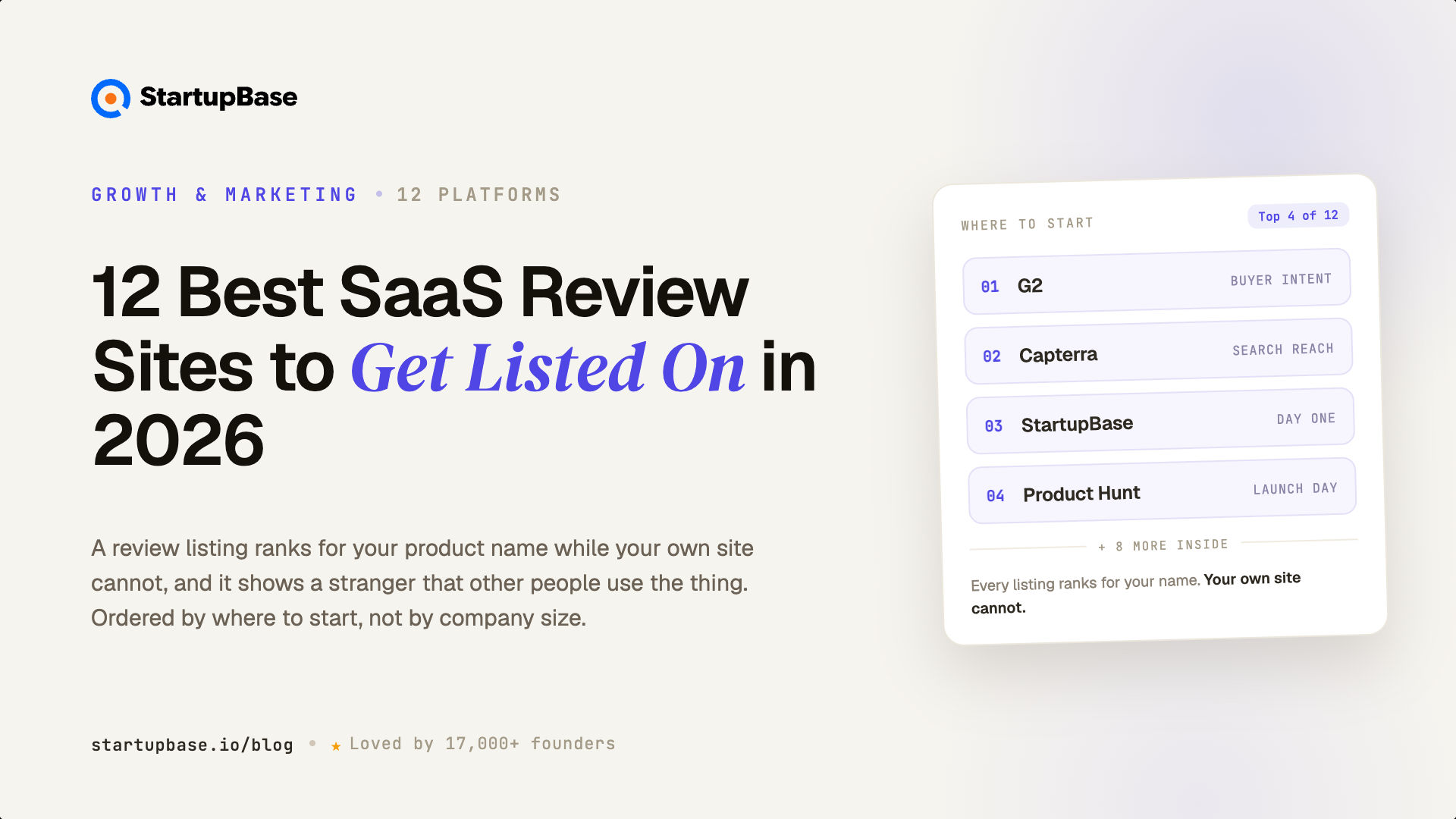
The twelve software review sites worth listing on in 2026, ordered by where a founder should actually start rather than by company size. Covers what each platform is good for and who reads it, what a free profile includes versus what paid placement costs, why AI assistants now read these pages, and a stage by stage order of operations. Starts with G2 and includes Product Hunt and StartupBase.
Quick Answer
There are two reasons to put your product on a review site, and they are different enough that most founders only ever get value from one of them.
The first is trust. A stranger who has never heard of you wants evidence that other people use the thing and did not regret it. Your own website cannot provide that, because you wrote it.
The second is search, and it matters most exactly when you are least able to do anything about it. A new domain has no authority. For the first several months after launch, the pages that rank for your own product name will mostly belong to somebody else, and your only real choice is whether those pages say something accurate.
A good listing does both jobs at once. Below are the twelve platforms worth the time, with what each one is actually for, who reads it, and what it costs.
One note on the order. These are sorted by where a founder should start rather than by how big the company is. A pre revenue startup cannot do anything useful with an enterprise procurement platform, but it can be live on a launch platform tomorrow. That is why the order looks different from most lists.
| # | Platform | Who it reaches | Where it fits |
|---|---|---|---|
| 1 | G2 | Business software buyers | The default. Claim it whatever stage you are |
| 2 | Capterra | Small business buyers | Free listing syndicates to two more sites |
| 3 | Product Hunt | Early adopters, makers | Launch day, permanent page afterwards |
| 4 | StartupBase | Founders, early adopters | Reviews and collections that keep working after launch |
| 5 | TrustRadius | Enterprise buyers who read | Once you have customers worth quoting |
| 6 | SourceForge | Developers, open source adjacent | Free, ranks well, awards are earned not sold |
| 7 | AlternativeTo | People already leaving a competitor | Highest intent placement on the list |
| 8 | Trustpilot | Consumers and small teams | Self serve products, strong on brand searches |
| 9 | Software Advice | Buyers who want to be matched | Mostly syndicated from Capterra |
| 10 | GetApp | Comparison and feature shoppers | Mostly syndicated from Capterra |
| 11 | Gartner Peer Insights | Enterprise procurement | Only if your deals involve formal evaluation |
| 12 | PeerSpot | Systems administrators | Infrastructure and security products |
1. G2
G2 is the largest software review platform and the default answer for most business software. If your buyer researches purchases at all, they have seen a G2 category page.
Claiming a profile is free and gets you a description, screenshots, feature list, pricing and the ability to collect reviews. The paid tiers buy placement, competitor intelligence and lead generation. Published pricing at the time of writing puts the entry package at $2,999 for the first year rising to $5,999, with enterprise packages reported in the $21,300 to $28,300 range and higher with add ons.
Worth knowing: G2 acquired Capterra, Software Advice and GetApp from Gartner in a deal that closed in February 2026. The four still run separately with separate review pools, but they share an owner now, so listing on G2 and Capterra is less of a hedge than it used to be.
Start here if: you sell business software to companies with a buying process.
2. Capterra
Capterra is the other name everyone knows, stronger with small business buyers than G2 and often the first place a non technical buyer lands.
Free listings are genuinely useful and syndicate across to GetApp and Software Advice, which is three surfaces for one piece of work. Paid placement runs as a pay per click auction rather than a subscription, with a $2 minimum bid and a monthly budget floor around $500, which makes it easier to test with a small budget than G2.
Start here if: your customers are small businesses, agencies or solo operators rather than procurement committees.
3. Product Hunt
Product Hunt is not a review site in the traditional sense, and it is more useful than most of them for an early product.
A launch produces a page with real comments from people who tried the thing on day one, and that page stays indexed and keeps ranking for your product name for years afterwards. Founders treat the launch as the event and the page as a by product, which is the wrong way round. The event lasts a day. The page is the asset.
It is free, and the comments are the closest thing to reviews most products have in their first year.
Start here if: you have not launched yet, or you have shipped something significant enough to launch again.
4. StartupBase
Every approved product gets a page that stays indexed and keeps working after launch day, collecting reviews and comments, appearing in daily, weekly and monthly rankings, and sitting in curated collections and topic pages. The reviews and the collections are what matter for this list, because a page carrying real reviews reads differently to a buyer than a bare directory entry. Alongside those we publish our own editorial reviews of products we have spent time with, which is a slower and more detailed thing than a user rating.
We have watched our own product pages come up first on searches for a maker's brand name, ahead of the product's own website. That is not a claim about us being better than their site. It is what happens when a domain with some authority publishes a page about a domain with none, and it is the single clearest argument for making sure any listing you have says something accurate and current.
Free launches join the queue. Launch Now is $39, skips the queue, guarantees a homepage feature and includes a dofollow backlink from a domain currently rated DR 72.
Start here if: you want a page collecting reviews and staying discoverable rather than a single launch day spike.
5. TrustRadius
TrustRadius carries long form reviews written by people who use software at work, aimed at buyers who read before they buy.
Lower volume than G2 and more weight per review, because the reviews are detailed enough to be worth reading rather than a star rating and a sentence. Reviewers are verified, which is the point.
Worth knowing: it is independently owned, which matters more than it did a year ago, and it is one of the few places a considered negative review will survive.
Start here if: you already have customers with job titles that will impress your next customer. There is little point before that.
6. SourceForge
SourceForge is older than most of this list and still a large discovery surface, especially for developer facing products and anything open source adjacent.
Its category pages rank well, listings are free to claim, and its awards are calculated on percentile performance rather than sold, which makes them mean slightly more than most badges.
Start here if: your users are developers, or your product sits close to infrastructure.
7. AlternativeTo
AlternativeTo is not a review site so much as the place people go once they have decided against something else.
Being listed as an alternative to an incumbent is one of the highest intent placements anywhere on the internet, because the person reading has already decided to switch and is only choosing where to. It is free, community edited, and consistently undervalued.
Start here if: there is an obvious tool you replace. Get listed under it.
8. Trustpilot
Trustpilot is broad consumer trust rather than software evaluation. Ranks very strongly on brand name searches, which is its main value here.
Enterprise buyers largely ignore it. Individuals and small businesses do not, and for products sold self serve it often carries more weight than a software specific platform.
Start here if: you sell to individuals or small teams with a credit card rather than a purchase order.
9. Software Advice
Software Advice is now owned by G2 following the February acquisition, having previously been part of Gartner Digital Markets.
Its distinguishing feature is advisor led matching, where buyers describe a need and get a shortlist. That means presence here can put you in front of someone who never searched for you by name.
Start here if: you already claimed Capterra. Your listing likely syndicates here anyway, so this is mostly a matter of checking it is accurate.
10. GetApp
GetApp is the third of the platforms G2 acquired in February, and the most consumer facing of them.
Strong on comparison pages and feature filters, which suits products that win on a specific capability rather than on brand.
Start here if: same as Software Advice. Check what syndicated across from Capterra and fix anything wrong.
11. Gartner Peer Insights
Gartner Peer Insights is the one that appears in enterprise procurement shortlists, with a slow, formal review process to match.
Largely irrelevant unless you sell to IT departments that run structured evaluations. If you do sell to them, it stops being optional, because it is where the shortlist gets built.
Start here if: your deals involve security questionnaires and legal review.
12. PeerSpot
PeerSpot is enterprise focused and community led, strongest in infrastructure, security and networking.
Narrow, but if your buyer is a systems administrator comparing tools with colleagues, this is where that conversation happens.
Start here if: you sell technical infrastructure to large companies.
What free gets you, and what paid costs
Every platform here lets you claim a profile without paying, and for most readers of this article that is the correct place to stop.
| Free profile includes | Paid buys | |
|---|---|---|
| G2 | Profile, screenshots, pricing, collect reviews | Placement, competitor data, leads. From $2,999 a year |
| Capterra | Profile, collect reviews, syndication to GetApp and Software Advice | Pay per click placement. $2 minimum bid, around $500 a month floor |
| Product Hunt | Launch, comments, permanent page | Nothing required |
| StartupBase | Product page, reviews, collections, rankings | $39 launch, skips queue, dofollow link |
| TrustRadius | Profile, collect reviews | Intent data and lead products |
| SourceForge | Listing, category pages, awards | Promoted placement |
| AlternativeTo | Listing under incumbents | Nothing required |
Pricing in this category moves, so check before you commit to anything.
The pattern worth noticing is that the free tier does the two jobs from the top of this article. It ranks for your name and it holds your reviews. Paid tiers buy distribution, which is a different thing and only worth money once you can see the free version working.
The newer reason to be listed
There is an argument for review sites that did not exist two years ago and has nothing to do with buyers reading them.
When we ran five buyer questions through ChatGPT and logged every source it consulted, the shape of the question changed the sources. Ask for the best tool in a category and vendor documentation dominates. Ask about alternatives to a specific tool and the review platforms appear: G2, Capterra, TrustRadius, sitting alongside the vendor domains.
So a product with no presence on any of them has no route into that answer. It is not that a buyer reads your G2 page. It is that an assistant answering somebody else's question reads it first.
Being read is not the same as being recommended, and we were fairly blunt about that gap when we published our own results. But you cannot be chosen from a set you were never in.
The order to work through them
Doing all twelve in one week produces very little. Doing them in this order produces something at each step.
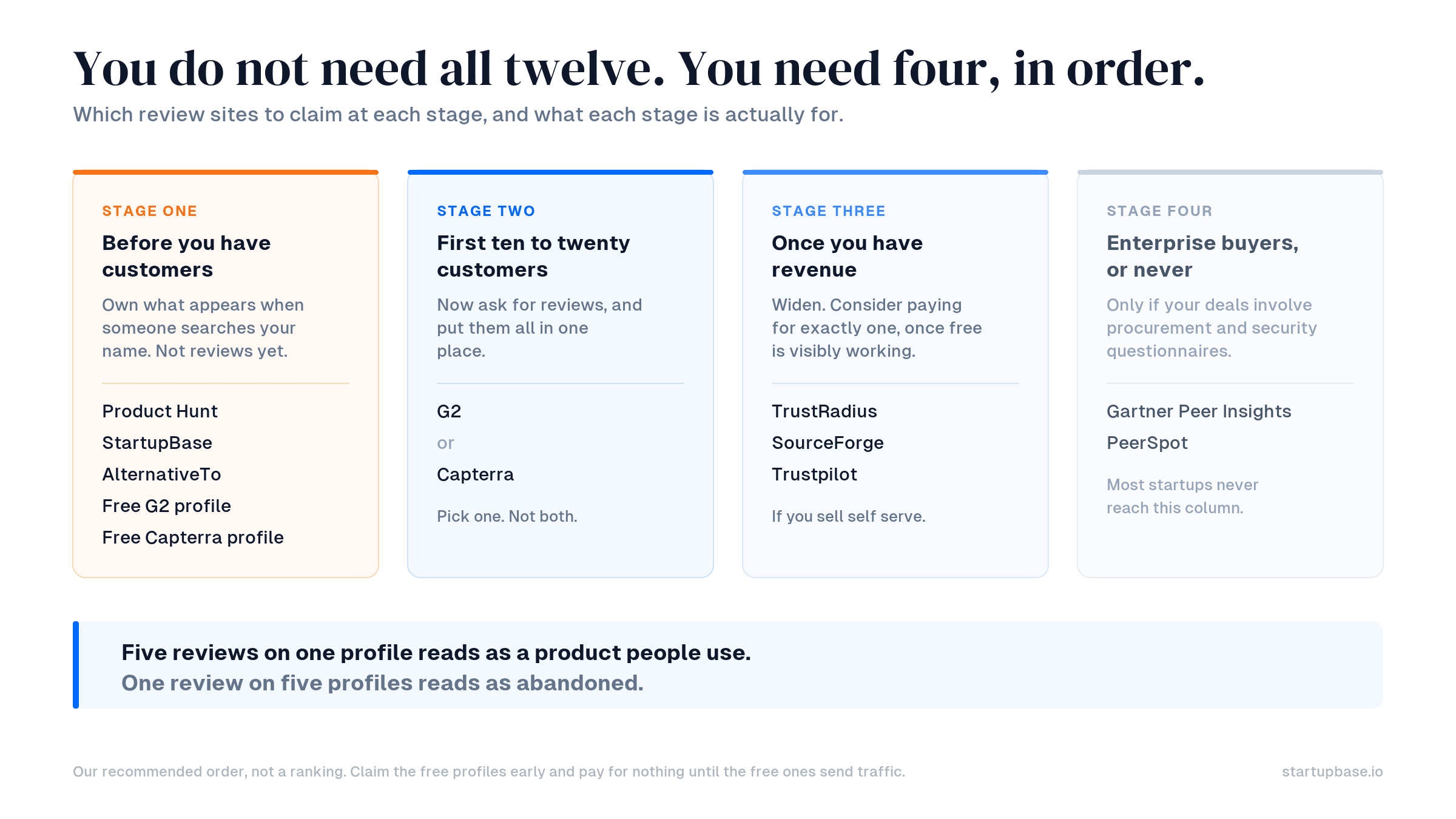
Before you have customers. Claim what is free and make it accurate. Product Hunt when you launch, StartupBase, AlternativeTo under whatever you replace, and free profiles on G2 and Capterra. You are not collecting reviews yet. You are making sure the pages that rank for your name say the right thing.
First ten to twenty customers. Now ask for reviews, and concentrate them. Five reviews on one profile reads as a product people use. One review on five profiles reads as abandoned. Pick G2 or Capterra depending on who your buyer is.
Once you have revenue. Add TrustRadius, and SourceForge if you are developer facing. Consider paying for exactly one platform, and only after you can point to traffic the free listings already send.
Enterprise buyers, or never. Gartner Peer Insights and PeerSpot.
For the wider set of places to be listed rather than reviewed, we covered those in the best startup directories to submit your startup and, for link value specifically, in launch platforms with dofollow backlinks.
How to actually ask, without getting your reviews deleted
Every guide tells you to ask customers for reviews and then stops, which leaves out the part where founders get themselves in trouble.
Ask at the moment something went right. Not on a schedule. After a support ticket you solved well, after they hit a milestone in the product, after they say something nice in an email. The request costs you nothing at that moment and almost everything at a random Tuesday.
Ask one person at a time, from a person. A bulk campaign to your whole list converts badly and looks like what it is. A short note from the founder referencing what they actually use converts well.
Send them to one platform. Give each customer a single link. If you let people choose, most choose nothing.
On incentives, know the rules, because they are specific. G2 permits incentives up to $100, and most campaigns run at around $10 in gift cards. Capterra caps the value at $25, including physical items like swag. Both require you to use the incentive link from the vendor portal rather than arranging it yourself, and reviews collected that way get labelled as incentivised when they publish.
The line you cannot cross is sentiment. You may reward the act of writing a review. You may not reward a positive one, or offer anything conditional on the rating. That is against platform rules, it is a problem with the FTC in the United States, and it is the fastest way to have a batch of reviews removed after you spent a month collecting them.
Do not buy them. Services promising volumes of reviews get detected, and the penalty lands on your profile rather than theirs.
Frequently asked questions
Are SaaS review site listings free?
Claiming a profile is free on every platform in this list, and a free profile can collect reviews and rank for your product name. Paid tiers buy placement and leads rather than the listing itself. Published pricing puts G2's entry package at $2,999 for the first year, while Capterra runs a pay per click auction with a monthly budget floor.
Which review site should a startup start with?
Whichever one your buyers already use. That is usually Capterra for small business software and G2 for business software. If you have not launched yet, Product Hunt and StartupBase come first, because they are the only places a review of a brand new product can realistically exist.
Does G2 own Capterra?
Yes. G2 acquired Capterra, Software Advice and GetApp from Gartner in a deal that closed in February 2026. They still operate as separate sites with separate reviews, but they share an owner, so listing on both is less of a hedge than it looks.
Do review sites help SEO?
Mostly by ranking for your product name during the period when your own domain has no authority to do it, which is the first several months after launch. That is a real benefit and it is the one founders underuse. We went into how this works for listings generally in do startup directories help SEO.
How many reviews do I need?
Enough that the page does not look abandoned, which in practice is about ten. Badge thresholds vary by platform and category, which is also why a badge in a category with four products in it means very little.
Should I pay for a listing?
Not until the free version is working. If your free profile is already sending traffic and closing deals, paid placement multiplies something real. If it is not, paying moves you up a page nobody is converting from.
Final thoughts
The reason to do this is not the badge. It is that for the first year of a product's life, other people's pages rank for your name, and a listing is how you get a say in what those pages contain.
Claim the free profiles early and keep them accurate. Concentrate your first reviews in one place rather than spreading them thin. Pay for nothing until you can see the free version sending you customers.
And remember there are now two readers. One is a person deciding whether you are real. The other is an assistant deciding whether to mention you at all.
SaaS Marketing
Startup SEO
Software Reviews
Customer Trust







 Continue with Google