
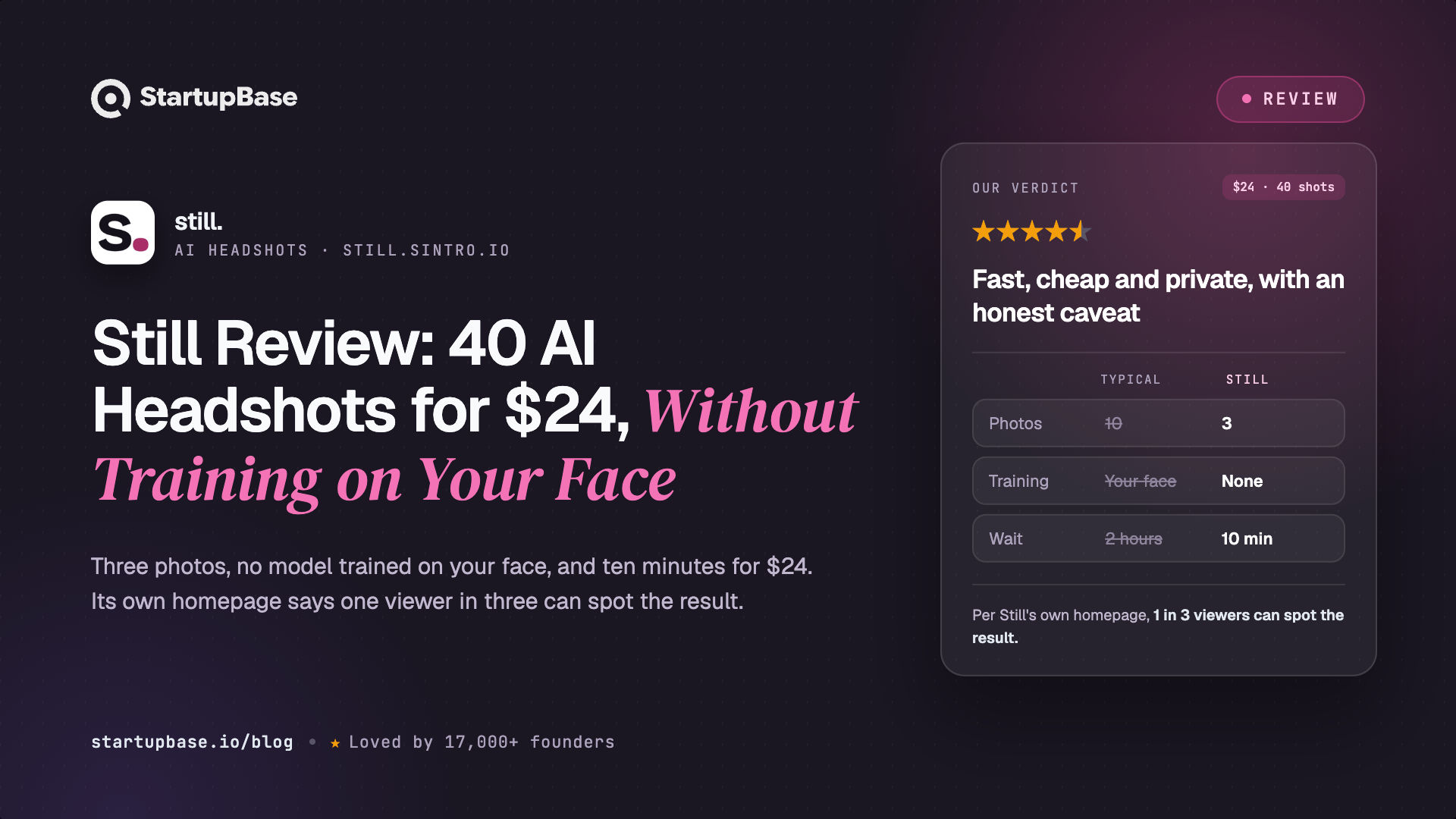
Still is an AI headshot service that turns three photos into forty portraits in about ten minutes for $24. This review covers what the portraits are for, why it is faster and cheaper than Aragon, BetterPic and HeadshotPro, how close AI headshots get to looking like you in 2026, what the refund actually protects, and when to book a photographer instead.
Quick Answer
A proper headshot costs a few hundred dollars and half a day. You book a studio, take the time off, put on the shirt, and try to look approachable while a stranger tells you to relax.
Most people never get round to it. They crop themselves out of a wedding photo, or keep using the one decent picture somebody took at a conference in 2019, and that image follows them across LinkedIn, Slack, a speaker bio and three client decks for the next six years.
Still is one of a dozen or so services now offering to end that for the price of a takeaway. You send three photos from your phone, and about ten minutes later you have forty portraits for $24.
The question is not whether that is convenient. It obviously is. The question is whether the results look enough like you to put your name under.
This review is based on the live site and material the company provided. We did not buy a pack, so nothing here is a verdict on how a particular face comes out.
What you actually get
Forty portraits, in one or two categories you choose after paying.
The categories cover more ground than the word headshot suggests: professional and executive, but also editorial, public speaking, social, dating, acting, yearbook and Christmas. Each portrait comes with a 16:9 crop for banners and email signatures, which is the sort of thing you only notice is missing after you have paid somebody else.
You upload three photos already on your phone, taken from different angles in reasonable light. Results land in a private gallery reached from your order link, and they expire after thirty days, so download them.
Why it takes ten minutes instead of two hours
This is the part that separates it from most of the category, and it explains everything else about how the product behaves.
Almost every AI headshot service trains a small model on your face. That is why they ask for eight or twelve photos, and why you wait an hour or two while it happens. The training is most of what you are paying for and most of what you are waiting on.
Still skips it. Your face is read from the three reference photos at the moment each portrait is generated, so nothing is built and nothing has to finish before you see results.
Against the three services Still names most often as alternatives, using each company's own pricing page in September 2026:
| Still | Aragon AI | BetterPic | HeadshotPro | |
|---|---|---|---|---|
| Price | $24 for 40, rising to $35 on 21 December | $35 for 40, though a $44 price renders on the same page | From $35 for 20 | $29 for 30 |
| Photos you upload | 3 | Not stated | 8 to 12 | "A few selfies" |
| Wait | About 10 minutes | About 45 minutes | About 2 hours | About 2 hours |
| Trains a model on you | No | Not stated | Yes | Not stated |
Two of those pages show more than one price at once and two say nothing about training, so the blanks are blanks rather than noes. Check the numbers yourself before buying.
What the table does show is that the photo count and the wait move together, because they have the same cause. Fewer photos, no training, faster results.
There is a second consequence that matters more than speed. Because no model of your face is ever built, there is no model of your face sitting on a server afterwards. For a product whose raw material is your face, that is a meaningfully different position from the tools that keep one.
Will it look like you
This is the only question that decides whether $24 was well spent, so it deserves a straight answer rather than a reassuring one.
Start with what the whole category can do in 2026, because this is not specific to Still. Generated portraits are now good enough that most people cannot reliably pick them out. Still puts a number on it in its own FAQ, citing blind tests where AI portraits pass as photographs about 62 percent of the time. Read that the useful way round: roughly one viewer in three can still tell.
What gives it away is consistent and worth knowing before you look at your own results. Skin that has been smoothed past the point of being skin. A smile that stops at the mouth and never reaches the eyes. Lighting that is technically perfect and slightly wrong, because no room actually looks like that.
Then there is the question specific to this approach. Training on a dozen photos is, in general, the more dependable way to reproduce one particular face. Reading a likeness from three photographs at generation time is faster, and it is the method more likely to drift towards a handsome, plausible, slightly generic version of you. Whether current models have closed that gap is the bet the whole product rests on.
You cannot settle that from the website, and this is the one real gap in what Still shows you. Every example on the site is generated from a reference image of a person who does not exist. They say so plainly, which is more than most of the category manages, and the examples do prove something worth proving: forty portraits of one face across six setups, consistent throughout. But they cannot show how close the output sits to a real input, because there is no real input.
So you find out in the gallery, on your own face, which makes the refund terms part of the product rather than fine print.
What it costs, and what the refund protects
$24 for forty portraits until 21 December 2026, then $35.
The refund is seven days, no reason required, and it runs from when your portraits are ready rather than from when you paid. Opening the gallery and looking costs you nothing. Downloading one full-resolution file ends it.
That structure is fair, and it tells you exactly how to buy this. Look first, decide while everything is still in the gallery, and only download once you are sure the face is yours. If you save your favourite and then have second thoughts, you have spent the $24.
Missing portraits are retried free and faulty ones replaced regardless of what you have downloaded, which is a different and more reasonable policy.
A separate service rewrites a CV against a specific job advert. We have not seen its output and this review does not cover it. If the CV is the real project, our review of Nainly looks at a service built around that end of it.
Things to weigh
One viewer in three can tell. For a dating profile or a social post, irrelevant. For a CV going to a recruiter who looks at faces all day, think about it properly.
You cannot judge the likeness before paying. Plan to decide in the gallery, inside seven days, before you download.
Thirty days and the files are gone. Download everything you might want.
It is a new service from a small company. Still is young, and your protection on a $24 purchase is the refund window and your card, not a long track record. Both are adequate here, but treat it as the small purchase it is.
Who it suits
If your current profile picture is a cropped wedding photo, this is an easy $24 and you can act on it tonight.
If you are freelancing or consulting and maintaining several profiles, forty images is close to a year of posting. If those profiles all point at one page, our review of Liinks covers that page.
If you are updating a headshot rather than a face, the approach suits you, because nothing is being trained to average you towards anything.
If you are a team who want one consistent look without getting everybody into a room on the same day, this is the clearest use of the whole category, and the person who joins in March gets the same backdrop as the January intake.
It suits you less when the photograph is the product. Actors, models and anyone whose headshot is judged as photography by people who commission photography should book a photographer. It also suits you less if your picture will sit on a team page next to colleagues who were photographed properly, because that is the comparison that exposes it.
Questions people ask
How does Still work?
Upload three photos taken from different angles, pay, then pick one or two categories. Forty portraits arrive in about ten minutes in a private gallery you reach from your order link.
Why does it not need twelve photos or two hours?
It does not train a model on your face. Most services in this category build a small per-customer model, which is what the extra photos and the wait are for. Still reads your face from the three references at generation time.
What does Still cost?
$24 for forty portraits until 21 December 2026, then $35.
How does it compare to Aragon or BetterPic?
Cheaper than both at the time of writing, and considerably faster. BetterPic wants eight to twelve photos and about two hours, because it trains a model on you. Check current prices yourself, since two of those pages render more than one number.
Can I get a refund?
Within seven days of your portraits being ready, with no reason required, as long as you have not downloaded a full-resolution file. The first download ends it. Missing or faulty portraits are fixed regardless.
Will people know it is AI?
Sometimes. Still cites blind tests where AI portraits pass as photographs about 62 percent of the time, so roughly one viewer in three can tell. Smoothed skin and a fixed smile are the usual tells.
Verdict
For most people the honest comparison is not Still against a photographer. It is Still against doing nothing for another two years, which is what the cropped wedding photo represents.
Judged that way it is a good deal. Forty usable images across several settings, for $24, delivered before you have finished your coffee, from three photos you already have. The speed is not a gimmick either. It falls out of a real architectural choice, and the same choice means nobody ends up holding a trained model of your face.
The limit is the one the whole category shares and this one cannot prove in advance. It has to look like you, and a portrait that is flattering but not quite yours is worth less than the photo you already have. One viewer in three will clock it regardless, which is fine on a dating app and worth a moment's thought on a CV.
So buy it the way it is built to be bought. Open the gallery, look hard at your own face before you download anything, and use the seven days if what looks back is a handsome stranger. If it is you, this is the cheapest good headshot available in 2026, and it is not close.
👉 See the examples and the price
Browse more of our product reviews.
Want a review like this for your own product? Order a StartupBase review.
AI Tools
Design
Career Tools







 Continue with Google