
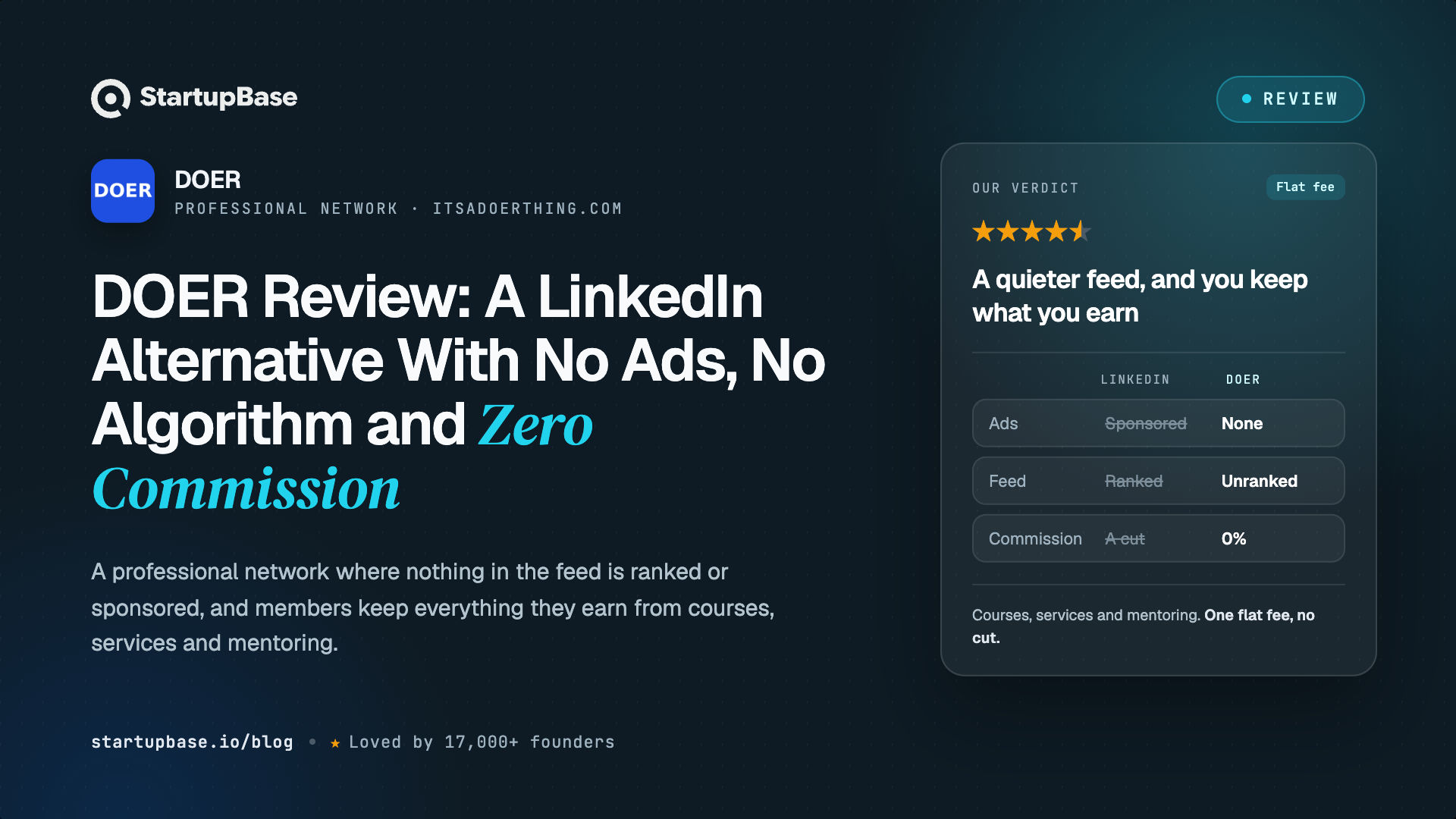
DOER is a professional network built around four parts: connecting, learning, earning and building. There are no ads, the feed is not ranked, and the platform takes no commission on member sales. This review covers the feed, how selling works, what running a paid mentor room involves, how the pricing compares to Skool and Gumroad, and who it suits.
Quick Answer
Open LinkedIn on a Monday morning and count how much of the feed you actually asked to see. A promoted post from a company you do not follow. A stranger's thread about what a hiking trip taught him about leadership. And somewhere underneath, the one useful thing a person you know posted, pushed down because the ranking decided something else would hold your attention longer.
Most people who use LinkedIn for work have stopped enjoying it without being able to stop needing it. It is where the jobs are posted, where clients check you out, and where your network lives, so you keep scrolling past the noise to find it.
DOER is built for that gap. It describes itself as the next generation of professional network: no ads, no algorithm deciding what you see, and no commission on anything you sell through it. It opened to the public in June 2026 and is aimed at freelancers, coaches, course creators and founders.
This review is based on the live site and material the company provided. We have not used it day to day, so nothing here is a verdict on how the community feels from the inside.
What DOER is
Four parts, built to work together rather than as separate apps bolted to a feed.
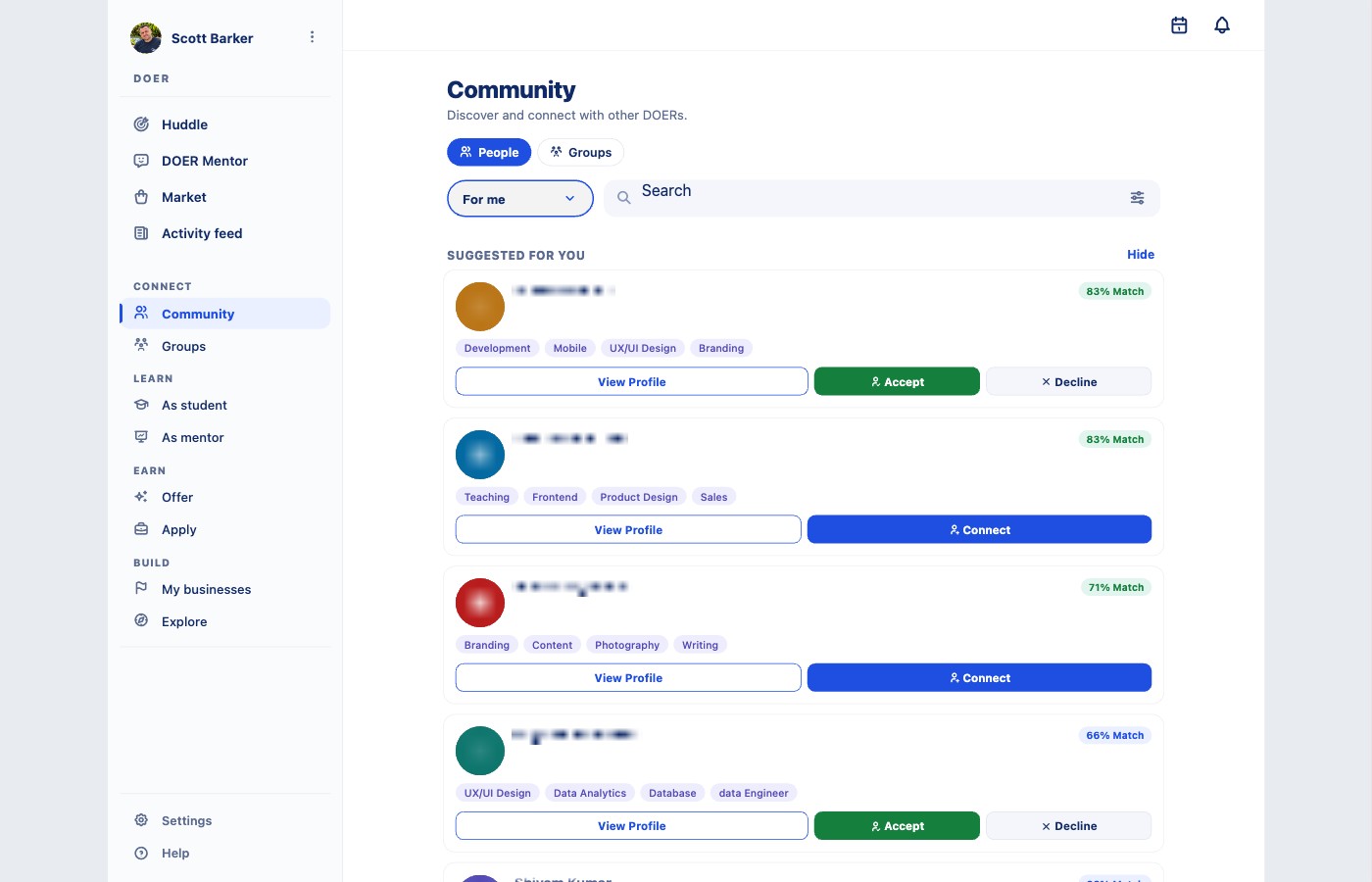
Connect is the networking layer: profiles, messaging, a feed, and groups DOER calls rooms. Members declare what they are looking for, whether that is testers, investors, fractional help, marketing support or simply other founders to talk to. You then sort people by who is useful to you right now, rather than by who is loudest.
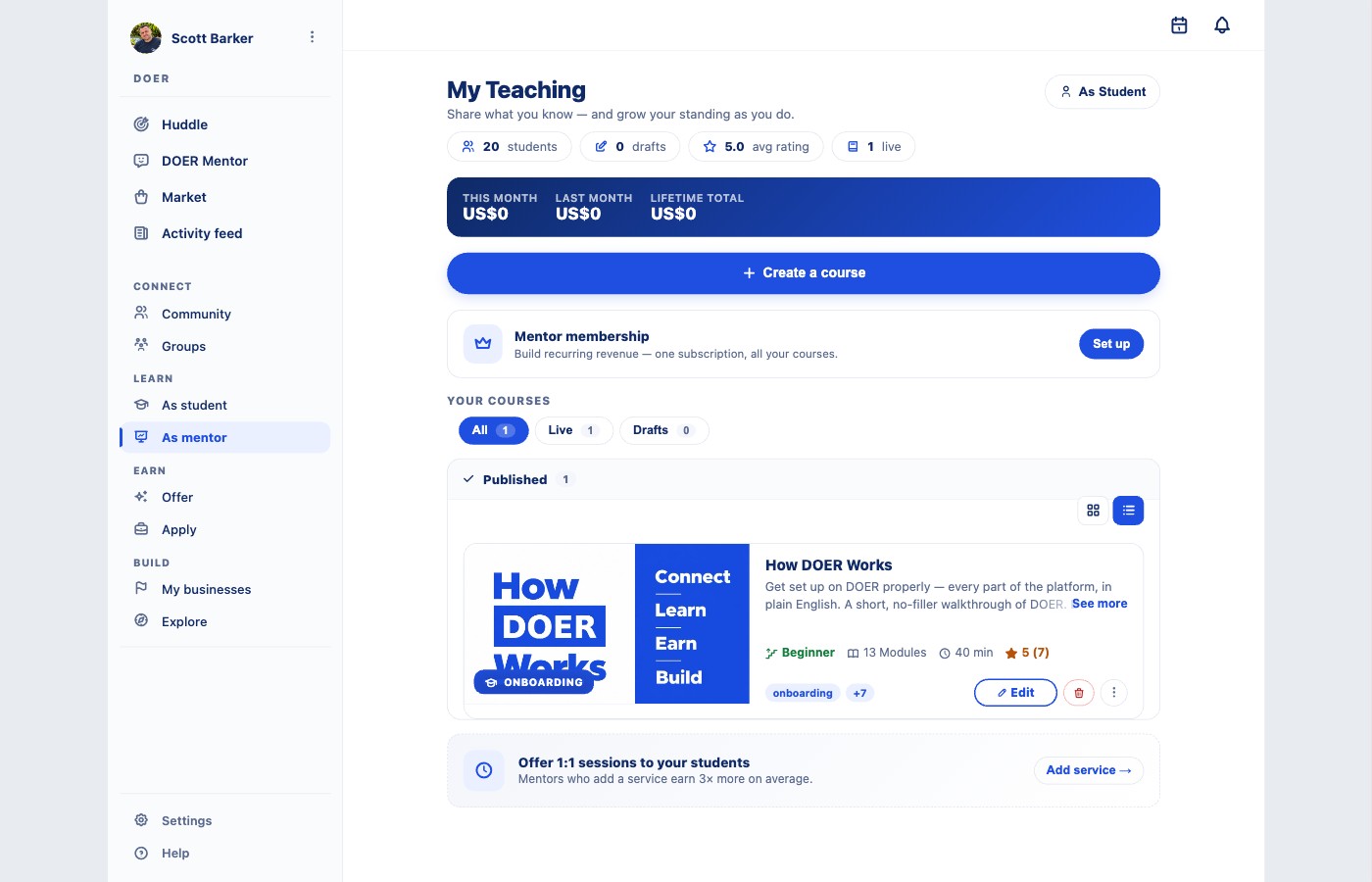
Learn is where members teach. Anyone can publish courses, and experienced members can run their own rooms as mentors, with a paid membership if they choose.
Earn is a marketplace for services, courses and physical products, plus a board of paid work members can apply for.
Build is for turning an idea into a business: a business profile with milestones and goals, a place to link your team and collaborators, and a job board for recruiting.
There is also an AI Mentor, a built-in assistant for drafting and improving posts, courses and listings, with a monthly message allowance that rises with your plan.
A feed with no ads and no algorithm
Nothing in the DOER feed is sponsored, and nothing is boosted. The feed is not ranked by engagement, so a post does not travel further because it provoked more comments, and you are not shown things because a system predicted they would keep you scrolling. What you follow is what you see.
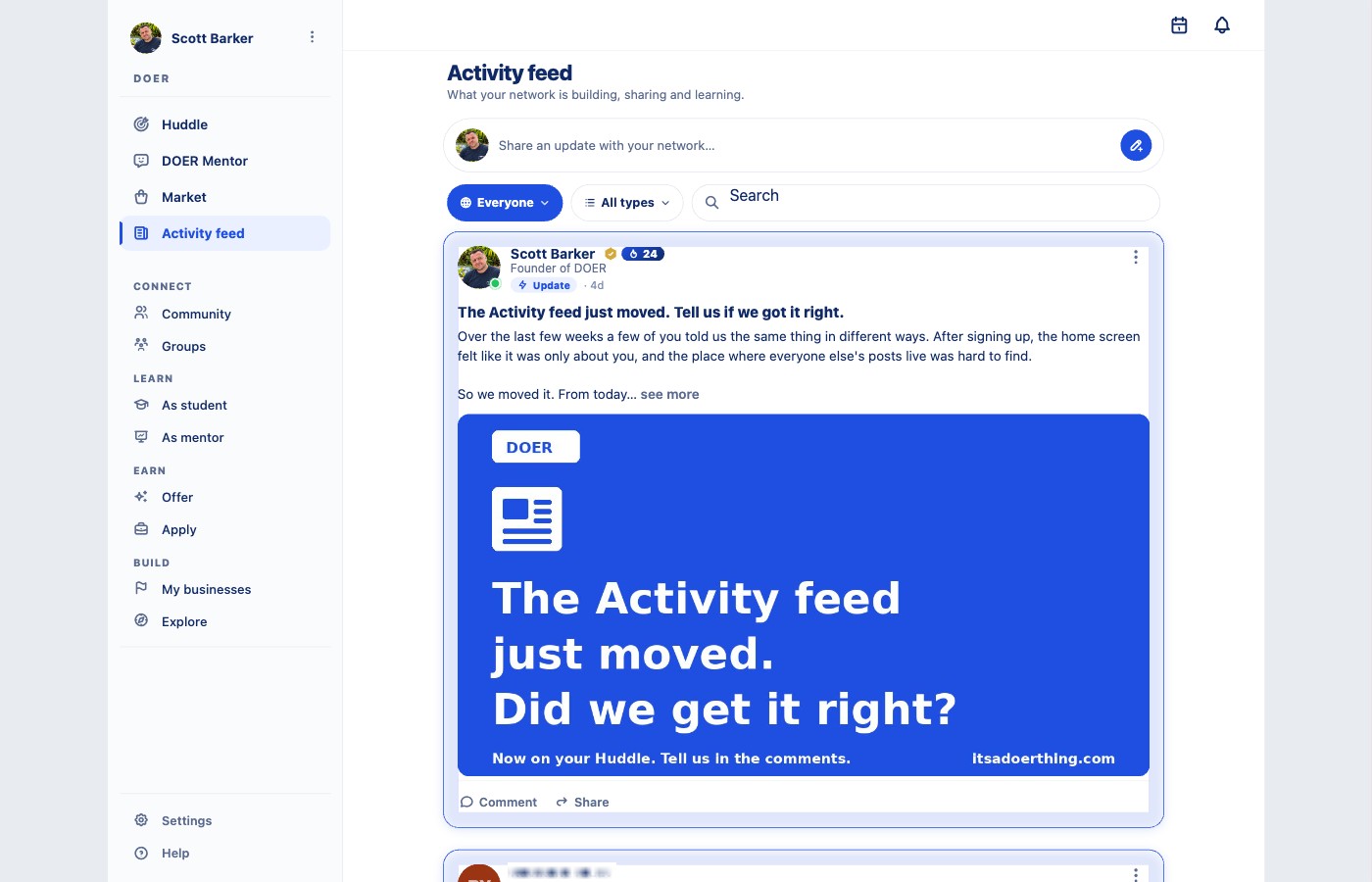
DOER goes further than most platforms in writing this down. Its pricing page states that there are no ads on the free tier, none on the paid tiers, and none planned as a future revenue option. It also says it does not rank people by followers, likes or engagement counts, and does not sell or enrich member data.
Without ranking, nobody can game their way to reach, so the incentive to post bait disappears. The flip side is that nothing lifts a quiet, useful post into view either. On DOER you are found by being in the right rooms and declaring the right intent, not by going viral. That suits people who want to be found for what they do. If your business runs on reach, expect to work differently.
Selling with zero commission, and what it actually costs
DOER takes no cut of what members sell. Payments go through Stripe Connect straight into your own Stripe account, so a $100 course earns you $100 before Stripe's standard card fee, which DOER lists at around 2.9 percent plus 30 cents. DOER itself takes nothing on top.
The platform earns from subscriptions instead, and the plans decide what you can sell:
- Free, $0. Join, connect, post, and publish one free course, one free service and one free product. No paid selling.
- Pro, $30 a month. Up to five paid courses and five paid services, each priced at up to $10. You can also create your own groups.
- Premium, $100 a month. Unlimited paid offerings at any price, and the ability to run your own paid mentor membership.
The $10 cap matters. It makes Pro a plan for testing whether anybody will pay, not for selling a full course. Most people selling a real course or a service at a real price will need Premium.
In practice, zero commission means a flat monthly fee instead of a percentage. Here is how that lands against two platforms creators often weigh it against, using each company's own pricing page in September 2026.
| DOER Premium | Skool Pro | Skool Hobby | Gumroad | |
|---|---|---|---|---|
| Monthly price | $100 | $99, as listed | $9, as listed | $0 |
| Platform fee on each sale | 0% | 2.9% | 10% | 10% + $0.50 |
| Card processing | Stripe, charged separately | Not stated | Not stated | Not stated on the pricing page |
Against a 10 percent platform like Gumroad, DOER Premium becomes the cheaper option once you sell more than roughly $1,000 a month. Below that, a percentage costs you less than a flat $100. Against Skool Pro the two come out close to level. Skool Pro is $99 a month with 2.9 percent per sale, and DOER sellers pay Stripe's card fee of about the same, so pick between them on the product rather than the price.
So DOER is not cheaper for a small seller. It beats a 10 percent platform the more you earn, and it wraps the selling inside a professional network rather than a standalone community.
The trial is well designed for sellers. On a paid plan your card is charged at whichever comes first: thirty days, or the point where your sales on DOER reach twice the plan price. If you start selling quickly, you pay once the platform has already covered itself twice over. If you do not, you are charged at day thirty either way. The trial is one per member and does not apply to paid mentor memberships.
Running your own paid room as a mentor
A mentor on DOER sets a monthly price, chooses which of their courses come with it, and gets a members-only room. Members who subscribe are enrolled in the included courses automatically. DOER takes no commission on the membership, the same as everything else.
Two conditions apply. Offering your own paid membership requires Premium, and it is charged immediately when you switch it on, with no trial. That is reasonable for a feature designed around recurring income, but it means you are paying $100 a month before your first member joins, so it suits people who already have an audience to bring with them rather than people hoping to find one.
Things to weigh
A network is only as good as who is on it. DOER opened in June 2026 and does not publish a member count. The rooms, the mentors and the paid work are only as valuable as the people in them, and that takes time to build. Join free and look at the rooms in your field before paying for anything.
Pro's $10 cap makes Premium the real selling plan. If you want to sell anything at a normal course or service price, budget for $100 a month.
A flat fee costs more than a commission at low volume. Below roughly $1,000 a month in sales, a percentage-based platform leaves you with more. Above it, DOER does.
Paid mentor rooms start billing straight away. Premium plus an immediate charge, with no trial. Best for people bringing an existing audience.
In DOER's favour, it states that you own your content, audience and earnings and can export anything at any time. On a new platform, that matters.
Who it suits
If you are a freelancer or consultant tired of performing for a feed, and you would rather be found by people who have said they need what you do, DOER's intent-based connecting is the most interesting thing here.
If you are a coach or course creator already earning well on a percentage-based platform, run your own numbers. Once your monthly sales pass roughly $1,000, a flat $100 with no commission starts to save you money every month.
If you are a founder looking for testers, early users or collaborators, the Build and Connect parts are built for that, and they are free. For a wider list of places to find other founders, our guide to the best communities for founders covers the established options alongside newer ones.
It suits you less if you depend on reach, if you sell only occasionally and in small amounts, or if you need a large, established audience on day one. For those, LinkedIn's size or a percentage platform's zero monthly cost still wins.
Questions people ask
Is DOER a good LinkedIn alternative?
For people who want professional connections without ads or a ranked feed, yes, and it adds tools for selling and teaching that LinkedIn does not have. It does not yet have LinkedIn's size, so it works best alongside it for now rather than as a replacement.
Does DOER have an algorithm?
No. The feed is not ranked, and nothing is boosted or sponsored. You see what you choose to follow.
Does DOER take a commission?
No, on any plan. Payments go straight to your own Stripe account. Stripe's standard card fee still applies, as it would anywhere.
How can I sell a course with no commission?
On DOER, publish it as a paid course. Pro allows up to five paid courses at up to $10 each. Premium, at $100 a month, removes both the limit and the price cap. DOER takes nothing from the sale.
Is DOER a Skool alternative?
Yes, and the prices are close. DOER Premium is $100 a month with no platform fee. Skool Pro is listed at $99 a month with a 2.9 percent transaction fee. The larger difference is that DOER sits inside a wider professional network rather than being a standalone community.
Is DOER free?
Yes. Joining, connecting, posting, messaging and publishing free courses and services costs nothing. Paid plans are only needed to sell.
Verdict
DOER is built on one bet: that enough professionals are tired of being the product on someone else's platform that they will choose a network with no ads, no ranking and no cut of their income.
The product matches it. The feed is not ranked. Nothing is sponsored. Members keep what they sell. And the way people connect, by declaring what they need rather than competing for attention, is a different idea about what a professional network is for. The mentor rooms give experienced members a reason to be there beyond networking, which a young network needs.
The limit is the one every new network faces. The value lives in who shows up, DOER is months old, and no pricing model can shortcut that. On price, zero commission is real, but it is a flat fee in place of a percentage. It pays off for people who sell every month and costs more for people who sell now and then.
If you sell or teach enough for a monthly fee to beat a commission, or if you simply want a place to talk shop without a ranking system in the room, join free and see who is already there.
Browse more of our product reviews.
Want a review like this for your own product? Order a StartupBase review.
Community
Creator Tools
Founder Tools







 Continue with Google