
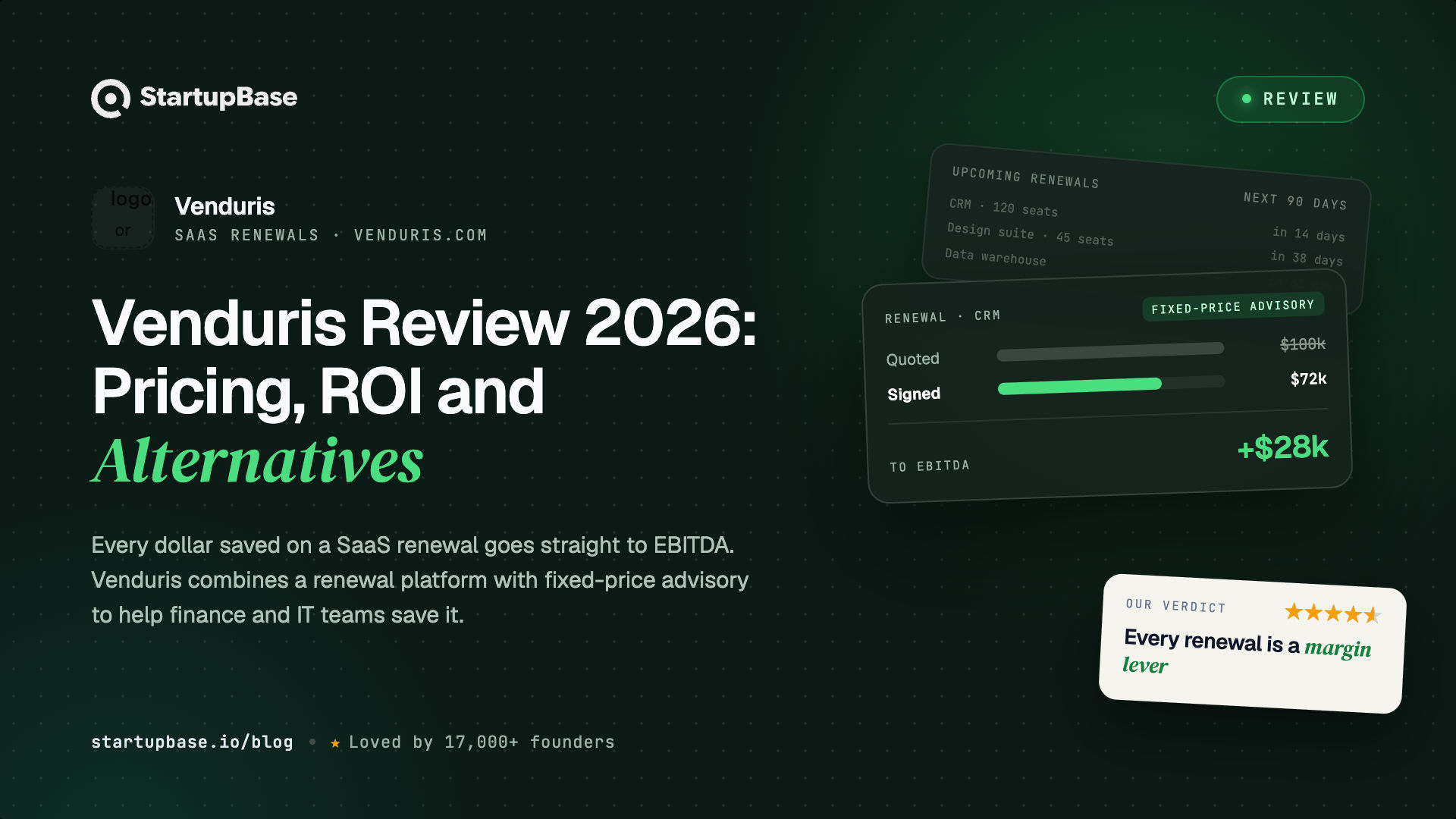
Venduris is a SaaS and AI renewal platform with fixed-price advisory services for mid-market companies and teams inside large enterprises. This review covers the EBITDA math behind renewal savings, pricing, the five advisory services, AI contracts, when to start a renewal, and how Venduris compares to Vertice, Zylo, Sastrify, Tropic and savings-share firms.
Quick Answer
Many SaaS renewals are decided before anyone negotiates them. The notice window closes 30 to 90 days before the renewal date, the contract rolls over, and the vendor's quote becomes the price. Venduris says it typically sees price increases of around 10% at renewal, often on seats nobody uses.
For a finance leader, that is not just a software problem. Money saved on a renewal does not need to be sold, delivered or supported. It goes straight to the bottom line, every year the lower price holds.
Venduris is built around that idea. It is a SaaS and AI renewal platform with fixed-price advisory on top, made for mid-market companies and for individual teams inside large enterprises that have no procurement team of their own.
This Venduris review covers pricing, the return on renewal savings, and the main alternatives. It is based on the Venduris website, its service and pricing pages, and its published guides. We have not used the platform or bought a service.
Venduris ROI: what SaaS savings do to EBITDA
The case for Venduris is a financial one, so here is the math.
Savings drop straight to EBITDA. If you cut $150,000 from your software bill, EBITDA rises by $150,000. There is no cost of sale and no extra work to deliver it.
Revenue does not. At a 20% operating margin, $1 of new revenue adds only $0.20 to EBITDA. To add the same $150,000, you would need to sell $750,000 of new business.
Recurring savings carry the multiple. If the lower price holds every year, buyers and investors value it like any other recurring profit. At a 10x EBITDA multiple, $150,000 a year of savings adds about $1.5 million of enterprise value.
The same math at different levels of savings:
| Annual SaaS savings | Added to EBITDA | New revenue needed at a 20% margin | Enterprise value at a 10x multiple |
|---|---|---|---|
| $25,000 | $25,000 | $125,000 | $250,000 |
| $50,000 | $50,000 | $250,000 | $500,000 |
| $150,000 | $150,000 | $750,000 | $1,500,000 |
| $300,000 | $300,000 | $1,500,000 | $3,000,000 |
To use your own numbers, divide the savings by your operating margin to get the revenue equivalent, and multiply the savings by your EBITDA multiple to get the enterprise value.
Venduris shows the same logic on a smaller scale with an illustrative example on its site. A collaboration suite quotes $134,400 for renewal, up 12%. A $2,500 Pre-Renewal Strategy Brief leads to a negotiated position that removes 30 unused seats, caps the price rise, shortens the term and resizes the AI credits. The result is $47,300 a year in hard savings against the quote, about 19 times the fee in year one, and roughly $473,000 of enterprise value at a 10x multiple.
The break-even point is low. On a $134,400 renewal, a $2,500 brief pays for itself if it saves just under 2%. The platform at the top of its published range, $299 a month, costs $3,588 a year, which one modest renewal win would cover.
That example is illustrative, and real outcomes depend on the contract, the vendor and how much leverage you have. Your margin and your multiple will also differ. Venduris has a free EBITDA calculator for running your own numbers.
What is Venduris?
Venduris has two parts, and you can use either one on its own.
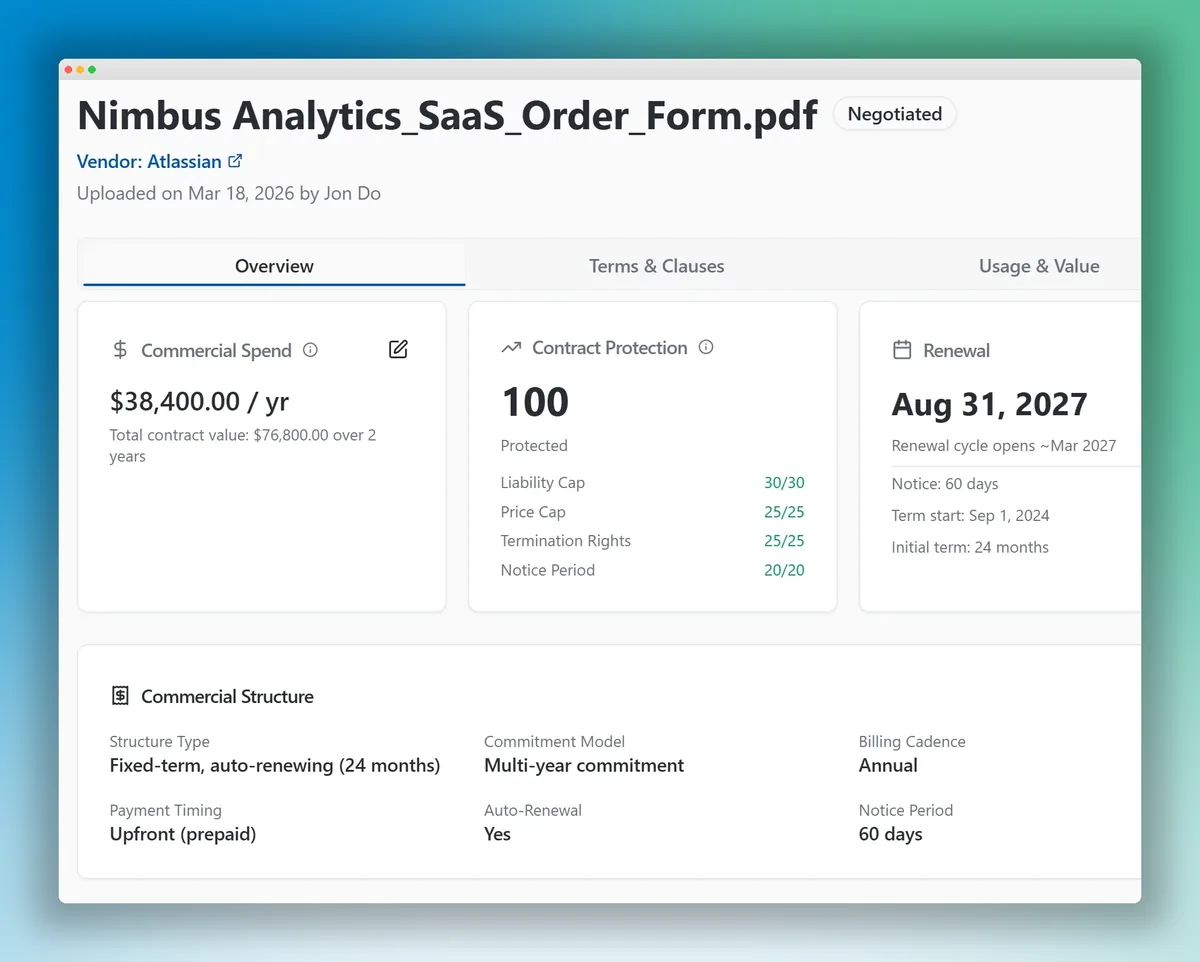
The platform is a system of record for SaaS and AI contracts. You upload contracts or connect your email, and it extracts the key terms: renewal dates, notice periods, pricing and clauses. From there it gives you:
- Notice-deadline alerts, so a renewal is never decided by default
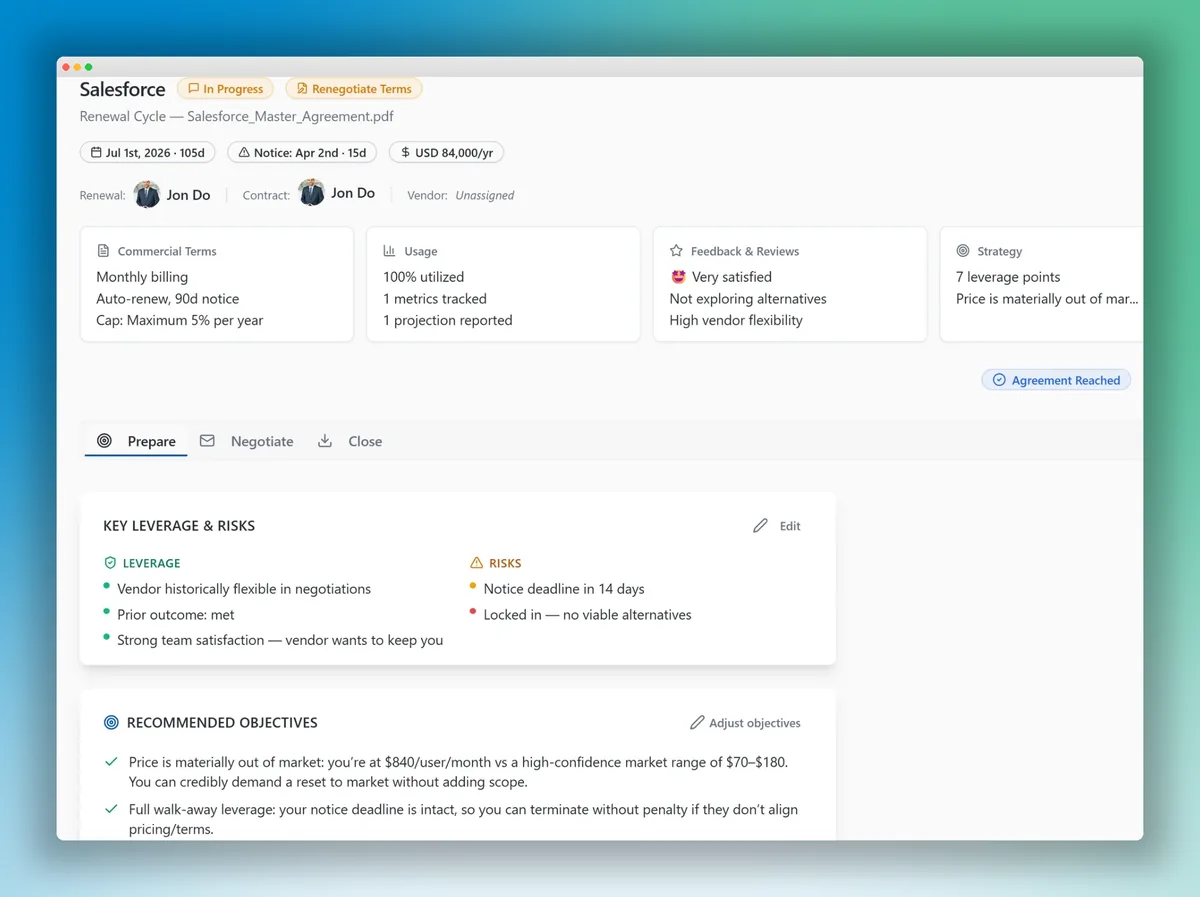
- A negotiation workspace, with a brief and benchmark context for each renewal
- Usage and entitlement tracking, so you can see seats paid against seats used
- Renewal exposure reporting across the whole portfolio
- One renewal calendar shared by finance, IT and operations
The services are fixed-price advisory engagements, delivered by a person rather than software. Boris, the founder, spent twenty years in software: ten selling it and ten buying it. Venduris says the person you speak to on the first call is the person who reads your contracts and writes your brief.
Venduris pricing
The platform is priced by how many vendors you manage, and the price is agreed on the first call and held for as long as you stay.
| Vendors managed | Price |
|---|---|
| Fewer than 25 | From $79 a month |
| 25 to 75 | From $149 a month |
| 75 to 200 | From $249 a month |
| 200 or more | Scoped to your portfolio |
It is monthly, with no minimum term, and your data can be exported at any time, including when you leave. Onboarding is done with you at no extra cost: the Venduris team loads your contracts, maps your renewal calendar and prepares your first negotiation brief.
Venduris services and fixed prices
This is the part that sets Venduris apart. Every engagement has a fixed price agreed in writing before work starts, and you keep 100% of the savings.
| Service | What it is for | Price |
|---|---|---|
| Renewal Readiness Audit | Every contract read and ranked by exposure, delivered in 5 business days | From $3,500 for up to 20 vendors |
| Pre-Renewal Strategy Brief | One important renewal, 90 to 120 days before the deadline | $2,500 per vendor |
| Negotiation Support | An advisor alongside your team from first quote to signature | From $4,000 |
| M&A Contract Exposure Review | Change-of-control and renewal risk in a target's contracts | From $10,000 |
| Renewal Desk | An ongoing retainer that owns your renewal calendar | From $2,500 a month |
The full scope of each one is on the SaaS renewal management services page, including a redacted sample page from a real brief.
Two more details. Negotiation Support is done with you, not for you: your team stays in the room and Venduris prepares positions, counter-language and debriefs between rounds. And none of the services require the platform. The brief is a PDF you own, readable without a login.
AI contracts: where renewals are hardest to price
AI tools are now part of most software budgets, and they are harder to renew than seat-based SaaS. Instead of a simple price per user, AI contracts are built from credits, tokens, add-ons and minimum commitments. That makes them hard to forecast and easy to overbuy.
Venduris covers AI contracts alongside SaaS. Its services page shows an illustrative AI deal:
| Vendor's renewal quote | Negotiated position | |
|---|---|---|
| Commitment | $60,000 of prepaid credits | $30,000 commitment that grows each quarter |
| Unused credits | About $20,000 expire unused | Credits roll over |
| Overage | Charged at list rate | Charged at the committed rate |
| Paid in the year | $60,000 | About $40,000 |
Two other AI traps the Venduris guides point out:
- Commitment checkpoints. Committed-spend contracts, common for cloud and AI platforms, have a date when unused commitment is lost or billed. That date is not the renewal date, so it needs tracking on its own.
- Pilots that convert. Proof-of-concept agreements for AI tools often include a conversion clause and a committed spend for year one. Add them to your tracker on day one.
Free tools
Venduris also publishes free tools:
- A renewal tracker that calculates every notice deadline and exports them to your calendar
- A notice letter builder for sending a notice of non-renewal
- An EBITDA calculator for working out what your savings are worth
- A renewal assessment that scores your renewal process in about two minutes
The free SaaS renewal tracker is a good place to start. Your data stays in your browser, and it comes with an Excel template and the notice deadline formula if you prefer a spreadsheet.
Venduris alternatives: Vertice, Vendr, Zylo, Sastrify and Tropic
Venduris sits between two kinds of competitor: software platforms that manage SaaS spend, and negotiation firms that take a share of what they save you.
| Model | Published pricing | Best for | |
|---|---|---|---|
| Venduris | Renewal platform plus fixed-price advisory | Yes: $79 to $299 a month, services from $2,500 | Mid-market teams without procurement |
| Vertice (now incl. Vendr) | Purchasing platform with in-house negotiators | Starting prices on AWS Marketplace, from $30,000 a year for $250K to $1M of SaaS spend | Larger companies that want negotiation handled for them |
| Zylo | SaaS management platform: discovery, usage and licence optimisation | No, quote only | Large enterprises with sprawling SaaS estates |
| Sastrify (now part of Deel) | Procurement platform with pricing benchmarks | No, quote only | Teams that want pricing benchmarks |
| Tropic | Procurement platform with intake workflows and negotiation support | No, quote only | Teams that want a full procurement process |
| Savings-share firms | Negotiators paid a percentage of the savings | Varies by firm | One-off large renewals |
A few things stand out.
The market is consolidating. Vertice acquired Vendr in June 2026, and Deel acquired Sastrify, with the deal closing in April 2026. Both moves point towards larger, bundled platforms. Venduris is going the other way, with a small, founder-led service and a low monthly price.
The price gap is real. Vertice's published starting price is $30,000 a year for companies spending $250,000 to $1 million on SaaS. The Venduris platform costs $79 to $299 a month for most teams, and a full Renewal Readiness Audit starts at $3,500. For a mid-market company, that is a different order of cost.
Fixed fees change the incentive. With a savings-share model, the fee grows with the savings figure, so the baseline used to measure savings matters a great deal. With a fixed fee, you know the cost before work starts, and every dollar saved stays with you.
Platforms and advisory are not the same thing. Zylo and similar tools are strong at finding every app in use and tracking licences. Venduris focuses on the renewal decision itself: reading the contract, finding the leverage and writing a position.
When to start a SaaS renewal
The most useful habit is simple: track the notice deadline, not the renewal date. The notice deadline is the renewal date minus the notice period, usually 30 to 90 days earlier. Miss it, and most auto-renewing contracts roll over for another full term at the price the contract allows.
Venduris suggests starting earlier the bigger the contract:
| Contract | First reminder | Decision made by |
|---|---|---|
| Small or monthly | 30 days before the notice deadline | 7 days before |
| Mid-size annual | 90 days before the notice deadline | 30 days before |
| Large, multi-year or strategic | 180 days before the notice deadline | 60 days before |
For a large renewal, that leaves time to check usage against what you pay for, look at alternatives and build a position. It is also why the Pre-Renewal Strategy Brief is meant to be used 90 to 120 days before the deadline. Inside the notice window, most of the leverage is gone.
Before you buy
There is no self-serve trial. Setup starts with a 30-minute renewal review call. Venduris says most teams are live with their own contracts loaded within a day of that call.
SOC 2 is in progress, not done. Contract data is encrypted, hosted in the EU and covered by GDPR. Venduris says it is building towards SOC 2 and will tell you where that stands if you ask. If your security team requires the report today, check first.
It is a small team. The founder reads your contracts and writes your brief. That is a strength for quality and accountability, and something to plan for if you need a large team on call.
You still run the negotiation. Venduris prepares and supports you. If you want someone to negotiate entirely on your behalf, a platform with in-house negotiators may suit you better.
Who it suits
If you are a CFO or finance lead at a mid-market company and renewals keep arriving with price rises nobody planned for, Venduris gives you a calendar, the deadlines and a position for each negotiation.
If you lead IT or operations inside a large enterprise and your team manages its own software budget, the platform and a few fixed-price briefs give you procurement-level preparation without waiting for central procurement.
If you are preparing an acquisition, the M&A Contract Exposure Review covers change-of-control clauses, integration blockers and escalators before close.
If you have one big renewal coming up and do not want to give away a share of the savings, the $2,500 Strategy Brief is the lowest-cost way to find out where your leverage is.
Questions people ask
What is Venduris?
Venduris is a SaaS and AI renewal platform with fixed-price advisory services. It helps mid-market companies and teams inside large enterprises cut software spend at renewal.
How much does Venduris cost?
For most teams the platform costs $79 to $299 a month, depending on how many vendors you manage. Services are fixed price: $2,500 for a Strategy Brief, from $3,500 for a Renewal Readiness Audit, from $4,000 for Negotiation Support, from $10,000 for an M&A review and from $2,500 a month for the Renewal Desk.
Does Venduris take a percentage of savings?
No. Every service has a fixed price agreed before work starts, and you keep 100% of the savings.
How do SaaS savings affect EBITDA?
Savings go straight to EBITDA because there is no cost of sale. At a 20% margin, $150,000 of savings equals $750,000 of new revenue, and at a 10x multiple it adds about $1.5 million of enterprise value.
How is Venduris different from Vertice or Vendr?
Vertice, which acquired Vendr in 2026, is a larger platform with in-house negotiators and starting prices from $30,000 a year. Venduris is a lower-cost platform with fixed-price advisory, where your team stays in charge of the negotiation.
Is Venduris worth it?
For a mid-market company with a large renewal coming up, the numbers work in its favour. A $2,500 brief pays for itself if it saves under 2% on a $134,400 renewal, and the platform costs $79 to $299 a month for most teams. Whether you get the savings depends on your contracts and your leverage, so start with the free tools.
What are the best Venduris alternatives?
Vertice, which now includes Vendr, if you want negotiators to handle deals for you. Zylo if you need to discover and manage a very large SaaS estate. Sastrify, now part of Deel, and Tropic if you want a full procurement platform. Savings-share firms for a one-off negotiation where you prefer to pay only on results.
What happened to Vendr?
Vertice acquired Vendr in June 2026. Vendr's pricing data and US negotiators are now part of Vertice.
When should you start a SaaS renewal negotiation?
Count back from the notice deadline, not the renewal date. For a large or strategic contract, start about 180 days before the notice deadline. For a mid-size annual contract, start about 90 days before it.
Is there a free version?
The platform has no free plan, but the renewal tracker, notice letter builder, EBITDA calculator and renewal assessment are free.
Verdict
Venduris is built on a simple financial argument: renewal savings are some of the highest-value money a company can find, because every dollar goes straight to EBITDA and keeps going every year. At a 20% margin, $150,000 saved is worth the same as $750,000 of new revenue.
What makes Venduris different is how it charges for that. The platform has a low, published monthly price, and the advisory work is priced up front, so the savings stay with you. Against larger platforms and savings-share firms, that is a clear and easy-to-measure trade.
It is a young, founder-led company, so check the security documents you need and expect a call rather than a free trial. If you have a renewal in the next 90 to 120 days, start with the free tracker, run your numbers through the EBITDA calculator, and then decide whether a $2,500 brief is worth it on your biggest contract.
Browse more of our product reviews.
Want a review like this for your own product? Order a StartupBase review.
Finance
Procurement


 Continue with Google