
StonkJournal is a trading journal for active retail traders, covering stocks, options, futures, forex and crypto. The free plan has no cap on trades or accounts and includes analytics, risk rules, custom sessions and journaling. Pro at $10 a month adds broker file import and an AI coach that reads only the user's own trading history. This review covers the rules system, the free and paid split, how it compares to TradeZella, TraderSync and Tradervue, and what a journal can and cannot do.
Quick Answer
Almost everything sold to a retail trader is a claim about the market. The signals service knows where oil is going. The course knows the setup that works. The indicator knows what price is about to do. The business model of most of that industry is confidence, sold by the month.
StonkJournal sells the opposite, and it is unusually blunt about it. The product does not predict anything, does not tell you what to buy, and has nothing at all to say about whether NVDA is a good idea. What it has is a complete record of every trade you have taken and a set of tools for finding the patterns in it, most of which you would rather not know about.
Their own site puts it better than we could: they do not have opinions about AAPL, they have opinions about you.
It is not new, which matters more here than it would for most products. The company says it has been running since 2021, with more than 200,000 traders and over ten million trades logged. Anyone about to hand over their entire trading history has a reasonable interest in whether the thing will still exist next year.
This review is based on the public site and a product overview from the founder. We did not create an account or import a broker file, so nothing here is a judgement about how well the import parsers cope with a messy export, which is the thing we would most want to test.
The rules are the interesting part
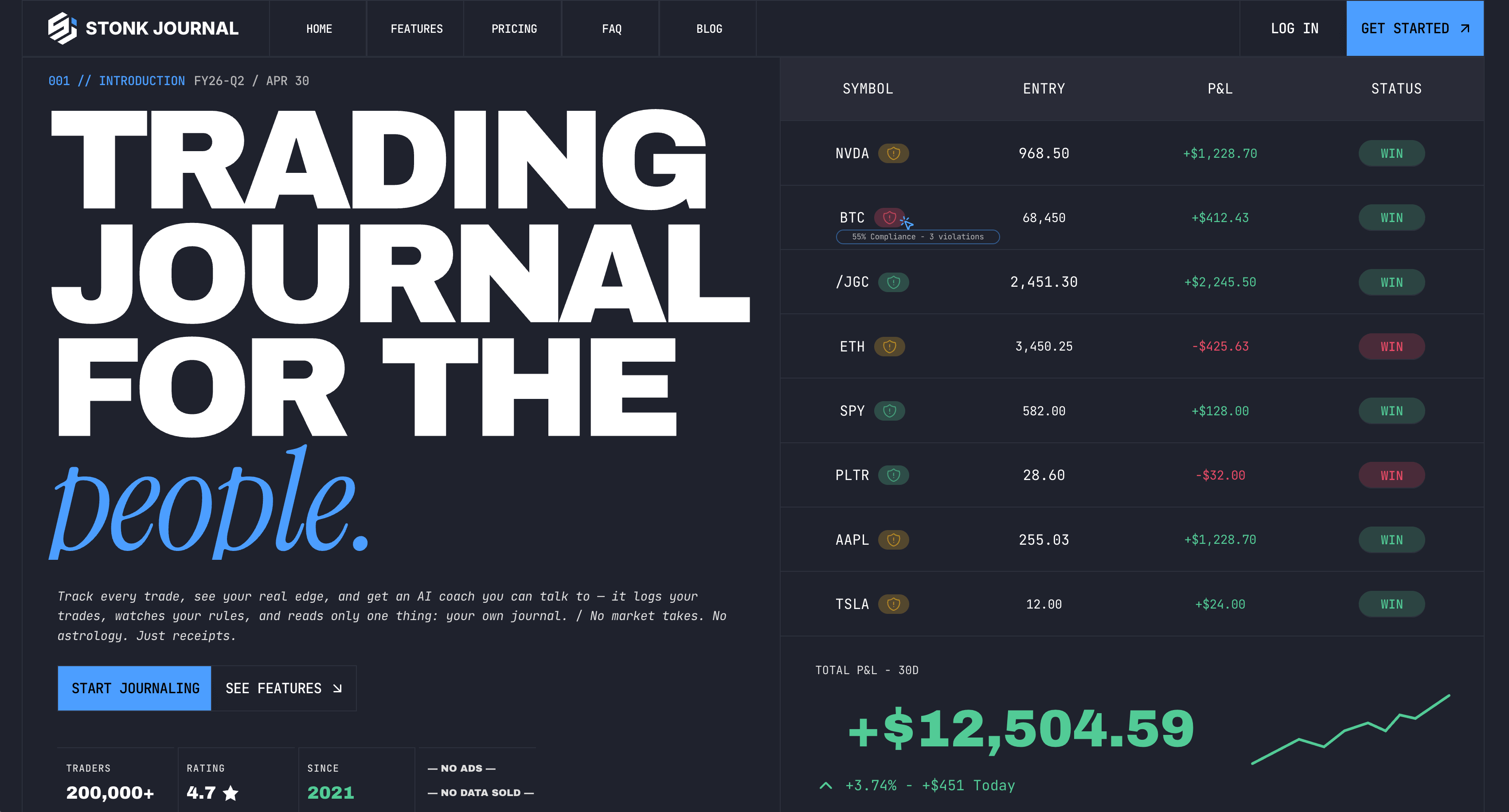
Most trading journals are a database with charts on top. The feature that makes this one worth writing about is the rules system, because it is aimed at behaviour rather than at analysis.
You define your own constraints in the rules section. Maximum risk per trade, maximum position size, a daily loss limit, a minimum reward to risk ratio, a cap on trades per session, or a requirement that you write a plan before entering. Sixteen rule types in total, spread across risk, discipline and behaviour.
Then the useful part: every trade gets scored against those rules, and you end up with an adherence percentage over time, with sparklines per rule so you can see which one you keep abandoning.
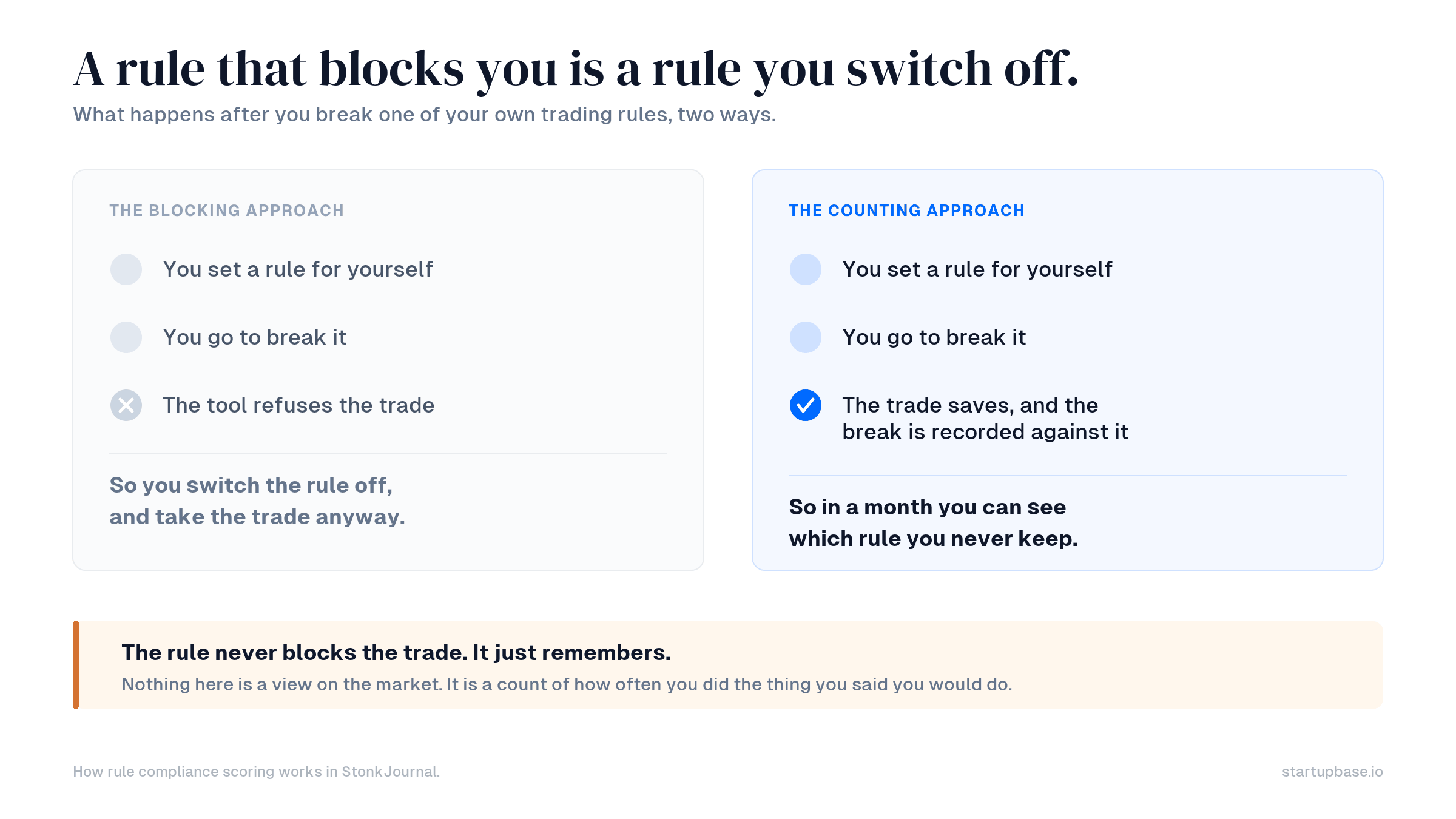
What it does not do is stop you. The rules never block a trade from being saved, and that is the correct decision. A journal that refused to record your worst trade would be worse than useless, because the worst trades are the entire point of keeping one. The premise is that most traders already know the rules they should follow, and the open question is whether they actually follow them. Counting is the whole intervention.
That is a genuinely different idea from what the category usually offers, and it is the reason we would point a serious trader here rather than at a prettier dashboard.
Custom sessions, and the specificity problem
The second feature worth calling out is custom trading sessions. Rather than choosing from fixed presets like the open or the London session, you define your own windows down to the minute, and each one reports trade count, win rate, expectancy, average win and average loss.
The reason this matters is that useful patterns tend to be narrower than the presets allow. A trader might find that the first fifteen minutes after the open behaves nothing like the rest of the morning, or that a particular half hour is where most of the damage happens. Fixed sessions average that away.
The honest caveat, which applies to every tool of this kind and is worth holding onto: the narrower the window, the fewer trades sit inside it, and the easier it is to find a pattern that is noise. Twelve trades in a nine minute window is a story, not evidence. To their credit the AI side of the product appears to know this, and the site says it will tell you when there are too few closed trades in a window to call something a pattern rather than inventing one to fill the space. That is a small piece of restraint that a lot of products skip.
The spreadsheet you outgrew
Almost nobody starts with a trading journal. They start with a spreadsheet, because a spreadsheet is free, familiar, and perfectly adequate for the first hundred trades.
It stops being adequate in a predictable way. Options break it first, because a multi-leg position is four rows that need to behave as one trade and your formulas were not built for that. Futures break it next, because every contract has its own tick value and you either look them up each time or quietly get the maths wrong. Then you add a second account and have to decide whether to duplicate the sheet or add a column, and either answer makes the analysis harder. By the time you want win rate by day of week, filtered to one setup, excluding the trades where you broke your own rules, you are building a small piece of software rather than keeping a record.
The other failure is quieter and worse. Manual entry decays. You fall a week behind during a busy stretch, the gap becomes a month, and the sheet stops being a record of your trading and becomes a record of the trades you felt like typing up. That is the version that actively misleads, because the ones you skipped are rarely the ones you are proud of.
This is the moment a journal earns its place, and it is worth being honest that a spreadsheet is fine until it is not. If you take twenty trades a year, keep the sheet.
How it compares, and why the free plan is the story
This is where StonkJournal does something structurally unusual, and it is the thing a prospective user should understand first.
The free plan is not a trial and does not cap your trades or your accounts. It includes the journal, the analytics, the risk rules, custom sessions, the calendar, setups, tags, screenshots, R-multiple analysis and the filtering. Pro, at $10 a month, adds broker file importing and the AI coach, with automatic broker sync listed as in development.
Set that against the rest of the category, using published pricing at the time of writing.
| Free plan | Cheapest paid | |
|---|---|---|
| StonkJournal | Unlimited trades and accounts, full analytics | $10 a month |
| TradeZella | None | $35 a month |
| TraderSync | None published | About $30 a month |
| Tradervue | Capped, roughly 30 to 100 trades a month, basic analytics | About $30 a month |
Prices in this category move, so check before you buy. The shape, though, is clear enough. The usual pattern is either no free plan at all or a free plan capped tightly enough that an active trader clears the limit in a fortnight. StonkJournal has put the whole journal on the free side and charged for the two things that genuinely cost it money to run: parsing broker files and running a model over your history.
There is a reasonable question about whether that is sustainable, and it is the one we would ask the founder. A free product with no ads and no data sales has to be paid for by the Pro conversions, and $10 is a low price to carry that. It is good for the user today and worth understanding as a bet rather than a permanent state.
The AI coach, and what it refuses to do
The coach is the other paid feature, and the boundary around it is drawn more carefully than is normal.
It reads your journal and nothing else, a boundary the company also spells out in its own FAQ. It does not forecast, does not issue signals, and does not have a view on any stock or contract. What it does is surface behavioural patterns from your own history: cutting winners short while holding losers, sizing up after a loss, a win rate that sags after a run of three wins, rule violations clustered on particular days.
Two details suggest someone thought about this properly. Findings are sorted by how much money the pattern has cost you rather than by date, which is the right priority order. And each one is tied to specific trades you can open and check, rather than being an assertion you have to take on faith.
There is also a chat that queries the journal directly, so you can ask for your Tuesday losses or your worst five trades and get actual rows back with symbols, dates and figures attached, rather than a summary you cannot verify.
We have not used it, so we cannot tell you how good the pattern detection actually is, and that is the part where these products usually disappoint. What we can say is that the design constraint is the right one. An assistant that only reads your own data cannot hallucinate a market view, because it was never given one.
Importing is the real barrier, and it is the paid feature
Anyone who has tried to keep a trading journal knows how it usually falls apart. You keep it for three weeks, fall behind during a busy stretch, and never catch up, because manually entering a month of fills is nobody's evening.
StonkJournal has dedicated parsers for twenty five brokers and platforms, including MetaTrader 4 and 5, Schwab and thinkorswim, Interactive Brokers, Webull, Tradovate and NinjaTrader, with a column mapper for anything else. The importer also handles duplicate detection, open position reconciliation and stock splits, which are the three things that quietly corrupt an imported journal and are tedious to fix by hand.
Putting import behind the paywall is defensible, since it is the part with real engineering cost and ongoing maintenance as brokers change their formats. It does mean the free plan asks for manual entry, and manual entry is where journaling habits go to die. If you are serious about keeping this up, the $10 is probably the difference between a journal you maintain and one you abandon.
Sharing, and prop firm use
Whole accounts can be published through a revocable link that carries the statistics, the trades and the journal notes, and individual performance cards can be shared on their own. Nothing is public unless you choose it, and regenerating the link kills the old one.
The obvious use is prop firm applications and working with a mentor, where the thing being asked for is a verifiable record rather than a screenshot of a good week. Multiple accounts are supported separately, so a prop challenge, a live account and a paper account keep their own trades, rules and statistics rather than blending into one flattering average.
Who it is for, and what it cannot do
The clear fit is a trader who has outgrown a spreadsheet and has started asking process questions rather than market questions. Which setups actually make money. What time of day suits me. Which of my own rules do I keep breaking. If those are the questions, this is built for exactly them, and the free plan means the cost of finding out is your time rather than your money.
Prop firm traders are a strong second, given the rule tracking and separate accounts.
It suits you less if you trade rarely. A journal is only as useful as the sample inside it, and thirty trades a year will not tell you much about anything. It is also not for anyone looking for something to tell them what to trade, and the product will be a disappointment if that is the hope.
One thing should be said plainly, because it is true of every product in this category and it is not in anyone's marketing. A journal cannot make you profitable. Active trading is difficult, most people who attempt it do not make money at it, and no amount of record keeping changes the odds of any individual trade. What a journal does is show you what is actually happening, in your own numbers, sooner than you would otherwise notice. Sometimes what it shows you is that a strategy is working. Often what it shows you is that it is not, and that the honest answer is to trade smaller or to stop.
That is not a criticism of StonkJournal. It is the strongest argument for using something like it, and the product is unusually comfortable with saying so, right down to the line in their own footer about being built by traders who lost money first.
Questions people ask
Is StonkJournal actually free?
Yes, and it is not a trial. The free plan has no cap on trades or accounts and includes the journal, analytics, risk rules, custom sessions, calendar, setups, tags and journaling. Pro at $10 a month adds broker file import and the AI coach.
Which markets does it cover?
Stocks, options, futures, forex and crypto in the same journal. Multi-leg option strategies are recorded as a single trade, and futures use actual contract tick values rather than a generic multiplier.
Can I import from my broker?
On Pro. There are dedicated parsers for twenty five brokers and platforms including MetaTrader 4 and 5, Schwab and thinkorswim, Interactive Brokers, Webull, Tradovate and NinjaTrader, with a column mapper for anything not on the list. Automatic broker sync is listed as in development.
Does the AI tell me what to trade?
No. It reads your own trading history and reports patterns in your behaviour and results. It does not forecast markets, issue signals or tell you what to buy or sell, and the company states this directly.
How does it compare to TradeZella or Tradervue?
The main difference is the free tier and the price. TradeZella starts around $35 a month with no free plan, and Tradervue's free tier is capped at a small number of trades a month. StonkJournal leaves the whole journal free and charges $10 for import and the coach. Feature depth differs in other ways, so compare against how you actually trade rather than on price alone.
Should I just use a spreadsheet instead?
For a small number of trades a year, yes, and a spreadsheet costs nothing. It tends to break once you trade options or futures, run more than one account, or want to filter results several ways at once. The other problem is that manual entry decays, and a journal with gaps in it is worse than no journal, because the missing trades are rarely the good ones.
Is my data private?
The company states that it does not sell data or run ads, and that shared links are opt-in and revocable. It runs as a web app and installs as an offline first progressive web app.
Verdict
There is a version of this product that would have been easier to sell. Add a market feed, bolt on some predictions, charge $40 a month, and let people believe the tool knows something they do not.
StonkJournal has done the harder and more useful thing. It has built a careful record keeping tool, put the whole of it on the free side, priced the paid half at $10, and pointed its only AI feature inward at the user rather than outward at the market. The rules system in particular treats trading as a discipline problem rather than an information problem, which matches what most traders who have been at it a while would tell you.
We have not run a broker export through it, and that is where we would look hardest before committing. But the thinking behind it is sound, the boundaries are drawn honestly, and the free plan means you can find out for yourself without spending anything.
Nothing here is financial advice, and a trading journal is a record keeping tool rather than a way to improve returns.
Want a review like this for your own product? Order a StartupBase review.
Trading Journal
Trading Tools
Product Review









 Continue with Google