

IndepAI is a financial independence planning app for people who work from anywhere. It scores how close you are to living off your investments, then ranks cities by how many years each one takes off your FI date. This review covers the core idea, how the city and tax data is sourced, the free calculator suite, pricing, how it compares to other geo-arbitrage and FIRE tools, and an honest assessment of where the headline numbers need reading carefully.
Quick Answer
Almost every retirement calculator ever built contains a hidden assumption, and it is such a quiet one that most people never notice it is there. The assumption is that you will retire in the same place you are sitting when you fill the form in. Your income goes in, your spending goes in, a number comes out, and the entire calculation treats the cost of your life as a fixed fact about you rather than a fact about where you happen to be standing.
For anyone whose work is not attached to a building, that assumption is the largest variable in the whole equation, and it is the one nobody lets them change.
IndepAI is built on removing it. You give it your income, your spending and your savings, and instead of returning a single number, it returns that number across cities, ranked by how much each one moves your date forward. It is live now, with a free tier substantial enough to form an opinion before you pay anything. This review is based on the public product, the free calculators and the city and tax data, all of which are open to anyone. The logged-in features sit behind an account we did not create, so the AI coach, the portfolio tracker and the trip planner are described here from what the product documents rather than from use.
The idea: your FI date is partly a geography question
The core concept is geo-arbitrage, which is the unglamorous name for earning in one economy and spending in another. It is not a new idea. What is new is measuring it properly and reporting the result in the only unit that actually persuades anyone.
Consider the difference between these two sentences. The first is that Da Nang is cheaper than where you live now. The second is that living in Da Nang puts your financial independence date thirteen years closer. Both may describe the same fact, but only one of them makes anybody do anything. IndepAI reports in years, and that decision does more work than any feature on the page.
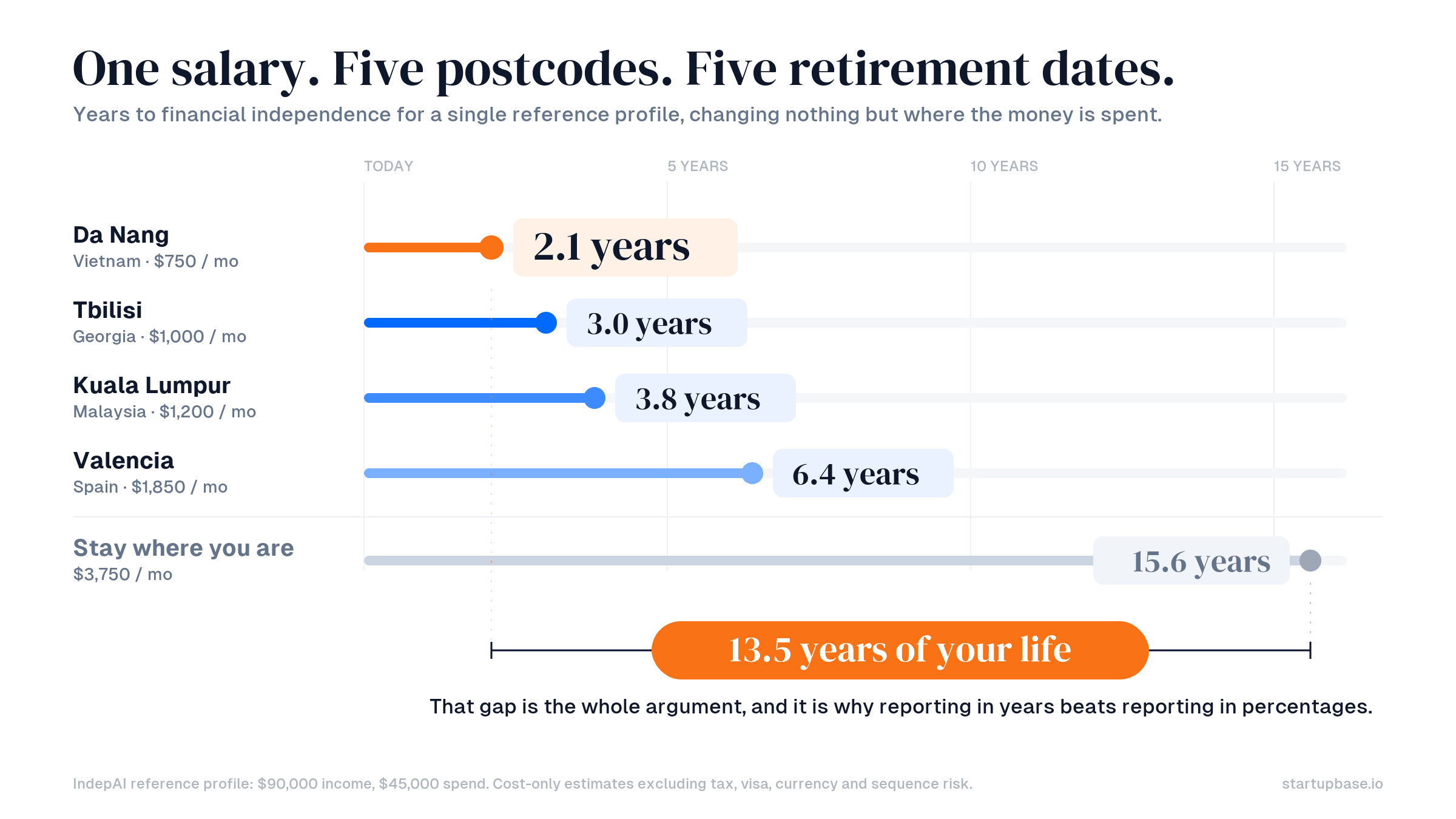
This is also why the product is narrower than it first appears, in a good way. It is not trying to be a budgeting app, and it does not want to categorise your grocery spending. It is answering one question, which is where you should be in order to stop working sooner, and most of what it offers is in service of that question.
What is underneath the numbers
The fastest way to judge a tool like this is to look at whether it tells you where its data came from, because the ones that do not are usually guessing.
IndepAI does. Cost of living figures on the city pages cite Numbeo and Eurostat and carry a last-reviewed date. Tax figures cite PwC's tax summaries with an as-of date and a direct link to the source. The cost breakdown itself is itemised rather than presented as one number, so a $750 a month figure for Da Nang resolves into rent, food, transport, coworking and entertainment, which means you can immediately see whether the assumptions behind it resemble your life or somebody else's.
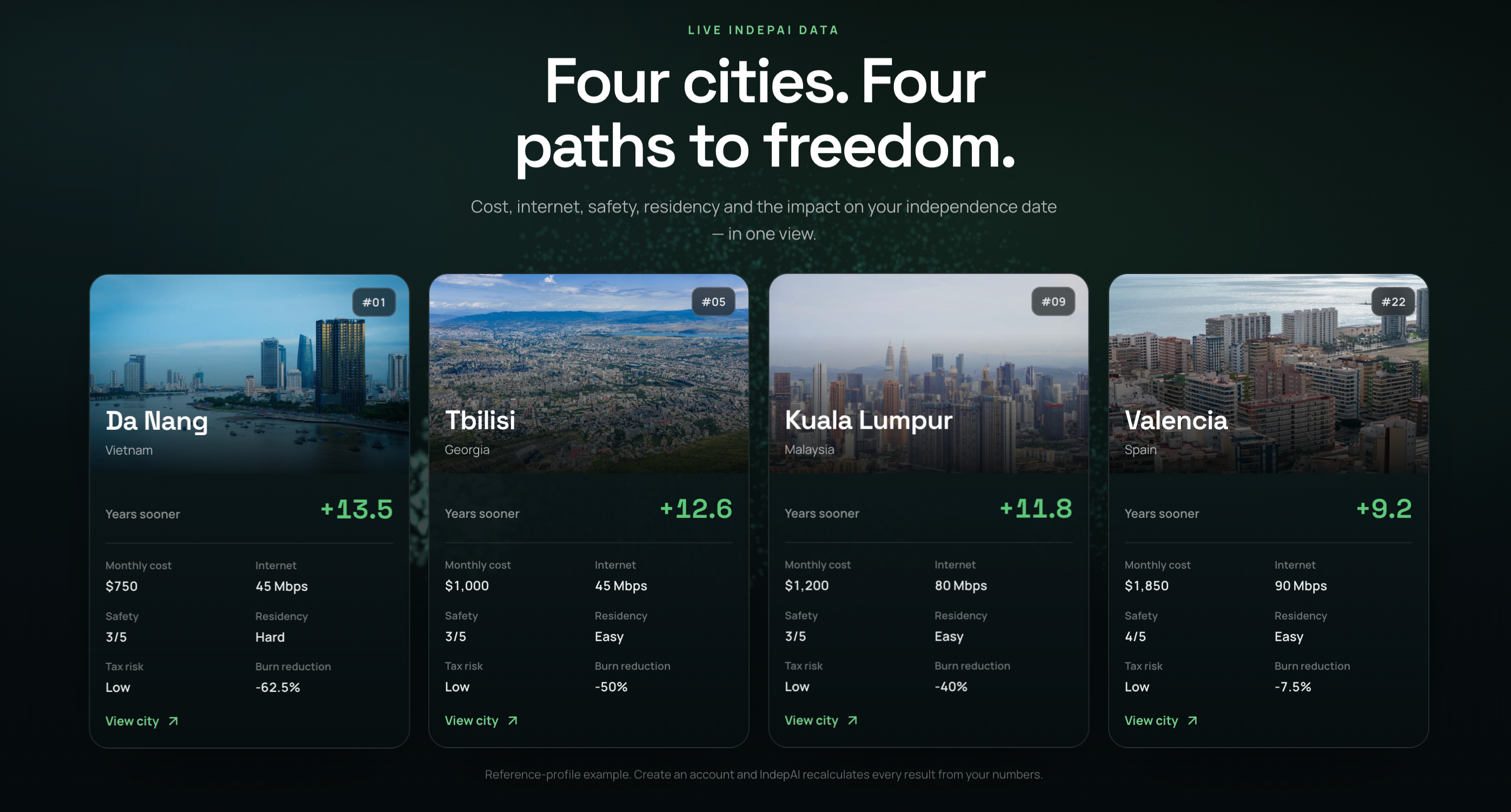
More impressive is what the product refuses to claim. The headline timeline on each city page is explicitly labelled a cost-only estimate, and directly beneath it sits a list of everything the figure excludes: taxes and treaties, visa eligibility and costs, currency movement, local inflation, and sequence-of-returns risk. The tax section carries its own warning that rules change and depend on residency. The financial disclaimer goes further than most and names the risk that the AI features may produce confident, fabricated answers, which is an unusually candid thing for a company to write about its own headline technology.
None of that is glamorous, and none of it will appear in a launch tweet. It is also the difference between a tool you can reason with and a tool that is quietly making things up, and it is the main reason we would point a cautious person here rather than at most of what comes up when you go looking.
How to read the headline number
That candour matters, because the numbers are dramatic and it is worth understanding what they are and are not saying.
Take the Da Nang page as the example. Against the reference profile the site uses, a $90,000 income with $45,000 of spending, it reports financial independence in about 2.1 years. That is a startling figure, and it is arrived at honestly: the FI number is calculated as twenty-five times annual spending at Da Nang prices, which is roughly $225,000 rather than the far larger number your current cost base would produce.
What the figure assumes is that you continue earning at your current level while living on the destination cost base. For a remote worker on a Western salary this is the whole premise and it is perfectly reasonable. It is worth noticing how much that one assumption is carrying, and that the other half of the question is legal rather than financial. The same Da Nang page notes that Vietnam has no nomad visa available, and a plan you cannot get a visa for is a spreadsheet rather than a plan.
To be fair to IndepAI, it says all of this itself, in writing, on the same page. We are underlining it because a number that good deserves a reader who understands where it comes from, and because the temptation with any tool like this is to screenshot the exciting figure and skip the paragraph underneath.
The one thing we would treat with more caution is the headline count of cities. Eleven thousand four hundred is a lot of places, and the coverage is genuinely wide, but the count includes districts and suburbs as well as cities, so several neighbouring entries can turn out to be parts of the same city carrying the same figures. The practical depth sits in the hub cities that people planning this kind of move actually shortlist, and there the data is detailed and current. Breadth is the marketing number. Depth is the one that will matter to you.
The free tools are genuinely free
There are fourteen calculators available without paying, and several of them are useful on their own terms even if you never go further: an FI calculator, Coast FIRE and Barista FIRE, Lean and Fat FIRE, savings rate, investment growth, currency risk, portfolio health, a tax calculator and a withdrawal simulator.
This is a sensible way to run an early product. The calculators are the reason to arrive, they answer a real question on their own, and they give a stranger a way to test whether the maths behaves sensibly before deciding whether to trust anything larger. There is a cost to that, in that entering your numbers and then being asked to register in order to see the full result appears several times across a single page, and on the city pages it appears more often than it needs to. It is a fair trade, and it is disclosed rather than sprung on you, but a lighter touch would probably convert better than a heavier one.
How it compares
IndepAI is not alone in noticing that geography belongs in a FIRE calculation, and it is worth knowing what else exists before deciding.
The closest comparisons are Freedom Clock, which models time to financial independence across more than forty countries with visa and tax context, and Nomad Runway, which is free and runs a geo-arbitrage simulation across a hundred and twenty cities while tracking assets in multiple currencies. Both are narrower than IndepAI and both are worth a look, particularly Nomad Runway if you want the core comparison and nothing else.
The other comparison is with the established FIRE planning tools, ProjectionLab being the best known. Those go considerably deeper on portfolio modelling, scenario planning and drawdown, and if your question is how a particular run of investment decisions plays out over thirty years, they are the better tool. What they do not do is treat where you live as something you can change, which is the whole idea here.
So IndepAI sits between the two, and it is worth being clear about that. It is broader than the single-purpose geo-arbitrage calculators, because it carries tax data, visa context, a portfolio tracker and a trip planner alongside the city comparison. It is shallower than a dedicated planning tool on the pure investment mathematics. If your hard question is where to live, this is the more useful product. If your hard question is what to hold and when to sell it, it is not.
Pricing
The free plan is permanent and covers the FI calculator without limits, a basic portfolio health score, three CSV imports a month, five AI coach questions a month, and ten cities with two compared side by side.
Pro is $9.99 a month or $99 a year, which removes those limits: unlimited imports, unlimited coach questions, unlimited city comparisons with five side by side, multi-portfolio management, unlimited nomad trips and full historical data. There is a fourteen day money-back guarantee, payment runs through Stripe, and there is a launch code offering half off the first month.
For context, that is cheap for this kind of tool, and the annual price is roughly what a single hour with an adviser costs in most markets. The free tier is substantial enough that you can decide with your own numbers rather than on trust.
Who it is for
The clearest fit is someone with location-independent income who has started to suspect that where they live is a financial decision rather than only a personal one. Remote employees, contractors, founders of small internet businesses, and anyone already moving between countries who wants the moves to add up to something.
It is also a reasonable fit for someone earlier in the process who simply wants their FI number and has never seen it written down. The free calculators do that in a few minutes without a bank connection.
It is a weaker fit if you are tied to a place by family, a mortgage or a job that expects you in a room, because the one thing the product asks you to change is the thing you cannot change. It is also not a budgeting app, not a brokerage, and not a substitute for professional advice, which the company states plainly and we will repeat: these are educational projections, and any actual relocation involves tax and immigration questions that need a qualified person in the relevant jurisdiction.
The newest part, a community section for meeting people in a city before you arrive, is in beta and too young for us to judge fairly. The privacy design behind it looks considered, with opt-in visibility and broad date ranges rather than live location, and we will come back to it once there are enough people in it to say something useful.
Questions people ask
Is IndepAI free?
There is a permanent free plan that covers the FI calculator without limits, a basic portfolio health score, five AI coach questions a month, three CSV imports and ten cities with two compared side by side. Fourteen calculators are usable before you create an account, though the complete results are revealed once you register. Pro is $9.99 a month or $99 a year and removes the limits.
What is geo-arbitrage?
Earning in a strong currency while living somewhere with a lower cost base. The gap between the two becomes savings, which shortens the time until your investments can cover your expenses. It is the idea the whole product is built around, and it is why the same salary produces very different retirement dates in different places.
How accurate are the city figures?
Cost of living data is credited to Numbeo and Eurostat and carries a last-reviewed date, and tax figures cite PwC's tax summaries with an as-of date. The timelines are labelled cost-only estimates and exclude tax, visa eligibility, currency movement and sequence-of-returns risk, which the product states on each city page. Treat them as a starting point for a shortlist rather than a plan you act on without checking.
Does IndepAI give financial advice?
No, and the company says so plainly. It is an educational planning tool, it is not a registered adviser or broker, and its own disclaimer notes that the AI features can produce inaccurate or fabricated answers. Any actual relocation involves tax and immigration questions that need a qualified professional in the relevant jurisdiction.
Is it worth paying for?
That depends on whether you are comparing more than ten cities. The free tier is genuinely enough to get your FI number and test whether the maths behaves sensibly with your own figures, so you can answer this without spending anything. At $99 a year the paid tier is cheap for what it is.
Verdict
IndepAI is doing something specific and doing it with more care than most of its rivals. The insight is real, the presentation in years rather than percentages is the right call, the sourcing is cited and dated, and the caveats are printed next to the claims instead of buried in a footer. The headline city count flatters the coverage and the registration prompts are more frequent than they need to be, but neither of those is the substance of the product, and the substance is sound.
If you work from anywhere and have never seen your financial independence date written down next to a list of places that would bring it closer, it costs nothing to find out.
Want a review like this for your own product? Order a StartupBase review.
FIRE Planning
Digital Nomads
Geo Arbitrage










 Continue with Google