
Graded Prompts is an AI prompt marketplace where every prompt, free or paid, is reviewed by a person and run on the model it targets before it can be listed. Prompts cost between $2.99 and $9.99 and include credits so buyers can run them in the platform. Creators keep 85 percent. This review covers what grading involves, why the included credits matter more than the badge, how it compares to PromptBase, and where the model has limits.
Quick Answer
Buying a prompt is an odd transaction. You are paying for a paragraph of text on the strength of four images somebody else generated, with no way to know whether those images came out of the prompt as written, out of the prompt plus ten attempts, or out of the prompt plus Photoshop.
The marketplaces know this, which is why they lean on ratings. You buy, you find out, you leave a star rating, and the next person is slightly better informed than you were. It works, eventually, at the cost of the people who went first.
Graded Prompts is built on the opposite instinct. Launched in June 2026, it is a prompt marketplace where nothing goes on sale until a person has run it on the model it was written for and compared the result to what the seller claimed. The catalogue is smaller because of that, deliberately.
This review is based on their site and on material provided by the company, including screenshots of an actual review in progress. We did not buy a prompt or sell one, so nothing here is a verdict on how good the prompts themselves are.
What grading actually involves
The word could mean very little. In this case it means five checks, and the fifth is the one that matters.
A reviewer confirms the listing is accurate, so title, description, category and tags all match what the prompt does. They confirm the instructions are complete, with every variable labelled. Then the prompt is filled with sample values and run live on its target model, and the output is set beside the seller's examples.
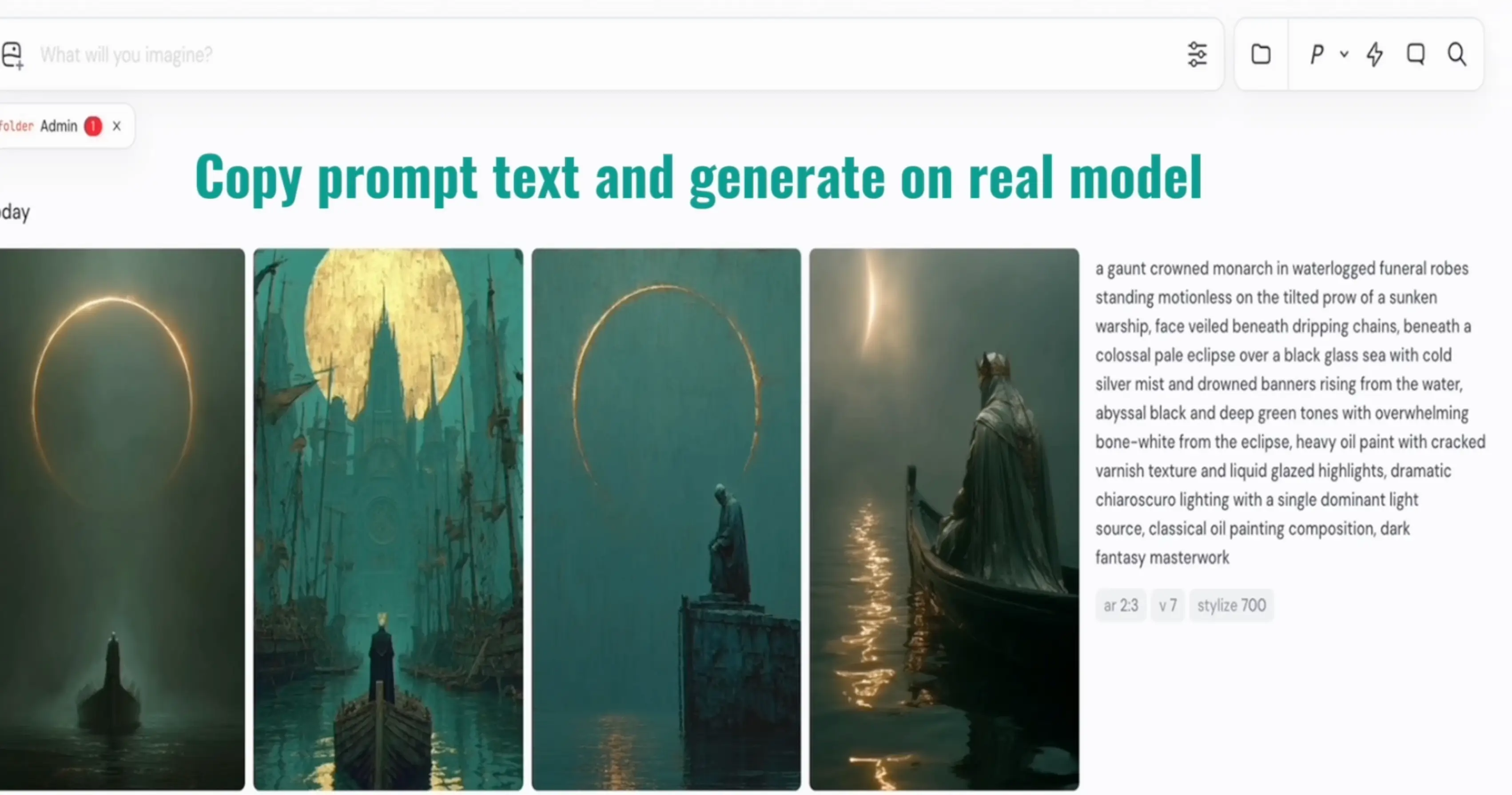
That last step is what a cherry-picked preview cannot survive. If a seller generated forty images and posted the best four, the reviewer's run will not match, and the submission goes back with notes rather than going live. Prompts that pass carry a Graded badge, and the criteria are published in their grading guide rather than described vaguely.

It is a real process rather than a marketing word, and the screenshots make that checkable, which is more than most quality claims in this category offer.
The credits are the stronger guarantee
Here is the thing they are underselling.
A badge asks you to trust their reviewer. That is an improvement on trusting the seller, but it is still trust. What actually settles the question is that every paid prompt comes with credits, at least 100 and more on higher-priced listings, and those credits let you run the prompt yourself.
Open a purchased prompt and its variables appear as a labelled form. Fill in your own values, press run, and the image or video is generated on the real model, without you needing a Midjourney subscription or API access. The output appears in a gallery alongside the exact text that produced it.
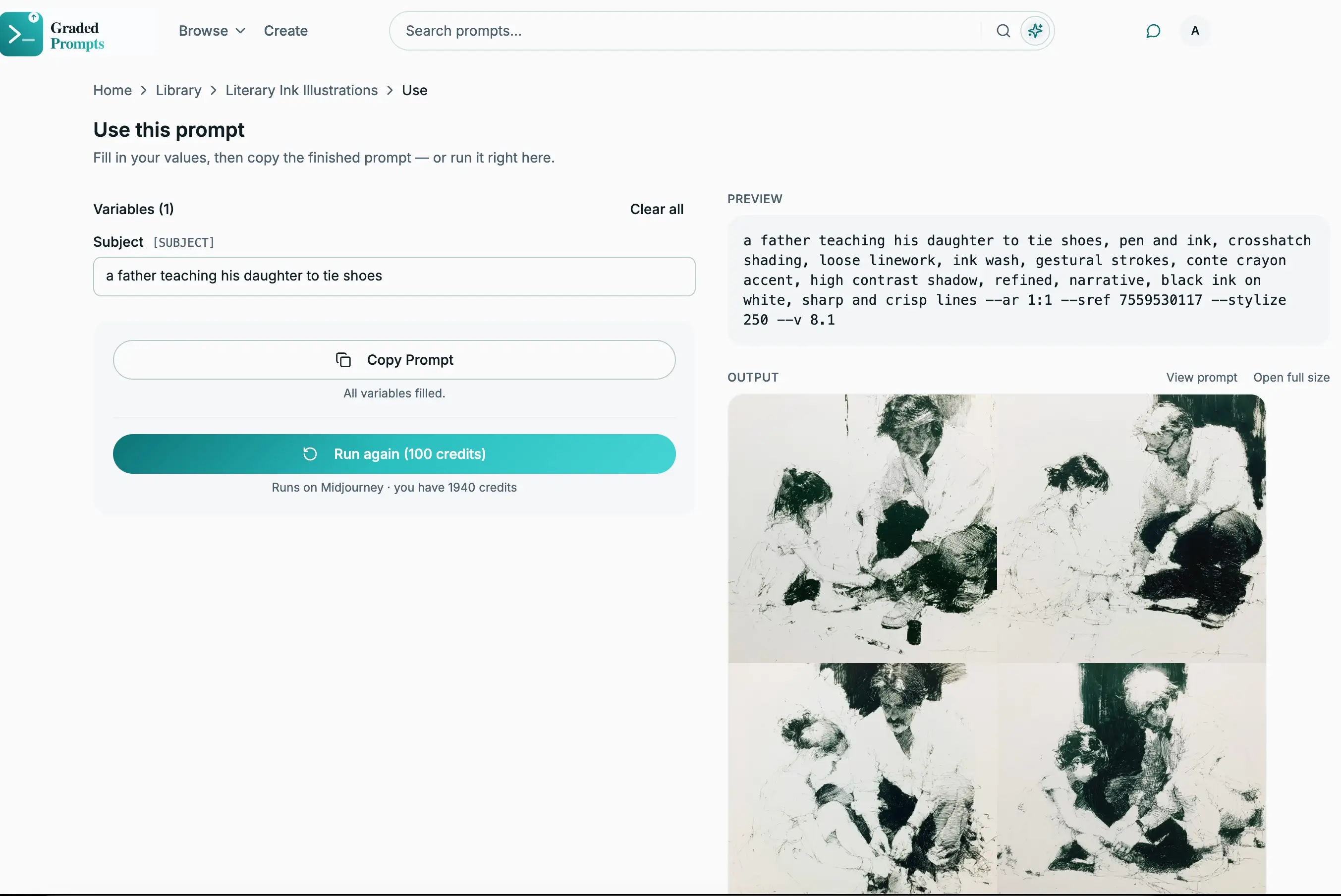
That is a different kind of promise. The badge says somebody checked. The credits say check it yourself, on your own subject, before you build anything on it. For a buyer, the second is worth considerably more, and if we were writing their homepage it would be above the fold.
A run that fails refunds its credits automatically, which is the correct behaviour and not universal.
Finding something
The catalogue covers image, text and video prompts across more than 26 models, including Midjourney, ChatGPT, Claude, Gemini, FLUX, Veo and Kling.
Ordinary filters exist, but the better entry point is the AI search. Rather than guessing keywords, you describe what you are trying to make in plain language, and it returns prompts that produce it. You can then refine conversationally, narrowing an infographic search to football, for instance, and it re-runs on the new intent. No account needed to try it.
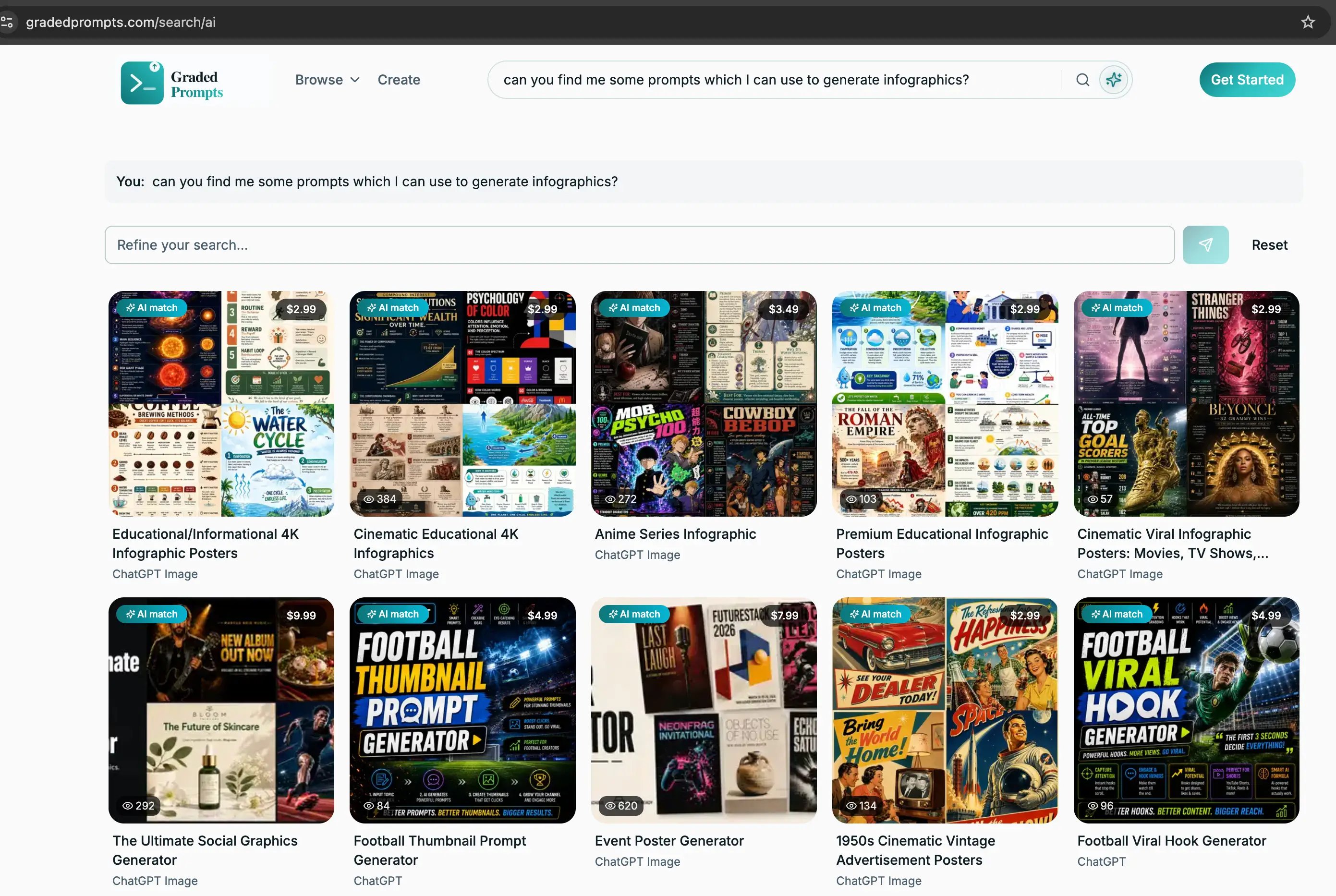
This is a genuinely better fit for the problem than keyword search, because almost nobody buying a prompt knows the vocabulary the seller used.
How it compares to PromptBase
PromptBase is the biggest name here and the obvious comparison, so it is worth being precise about what is actually being compared. Figures are from each company's own site in August 2026.
These two are not competing for the same purchase. PromptBase is a catalogue, and its advantage is size. Graded Prompts is a filter, and its advantage is that somebody has already done the checking you would otherwise do after paying.
| Graded Prompts | PromptBase | |
|---|---|---|
| Every listing run on the model before sale | Yes | No, quality is judged by ratings after purchase |
| Credits to run the prompt yourself | Included, 100 or more | Not included |
| If a prompt underdelivers | Raise it within three days and the platform reviews it | Down to the seller |
| Seller keeps on a marketplace sale | 85 percent | 80 percent |
| Catalogue | Small and hand-checked | 310,000, published on upload |
Which one you want comes down to a single question: do you want more options, or fewer bad ones?
If you enjoy browsing and are content sorting the good from the bad yourself, a large catalogue has its uses. If you want to buy one prompt and have it work, every untested listing is noise, and paying somebody to have already run it is the entire point.
On the seller side, Graded Prompts pays 85 percent against 80. PromptBase also charges nothing on sales you drive through your own link, which sounds better than it is, because it only applies to buyers you found yourself, and anyone with an audience that size can sell from their own site more cheaply than either. What you actually pay a marketplace for is the buyers it brings you, and on those Graded Prompts pays more and puts your work in a much shorter queue.
The seller side
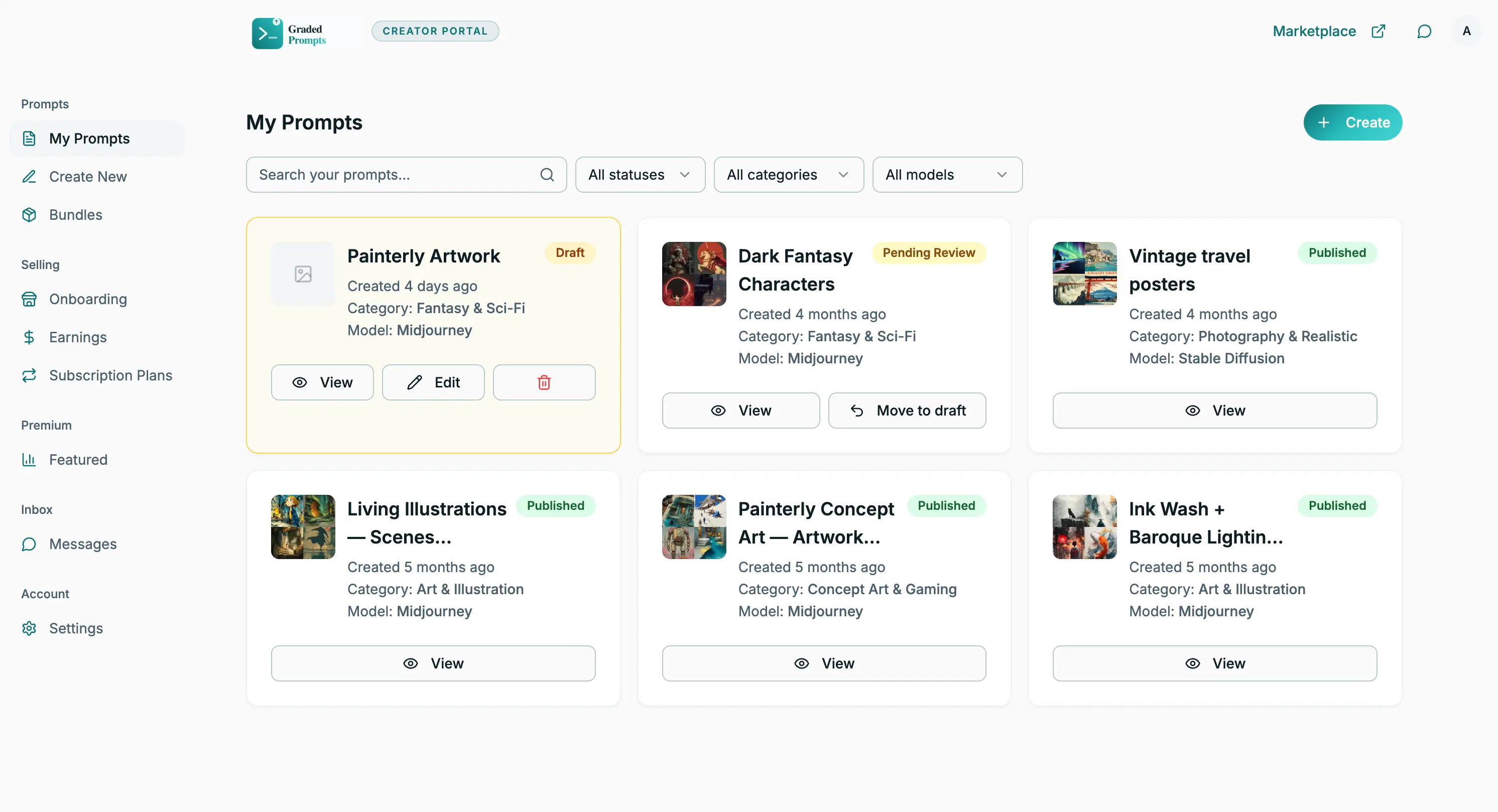
Selling runs through a creator portal on the same account as the marketplace. A wizard walks through writing the template, labelling variables, attaching genuine examples and setting a price between free and $9.99.
There are no listing fees and no tiers, and the same 85 percent applies to subscription renewals. Payouts go through Stripe from a $30 balance, or in USDC to a wallet the seller controls, which is unusual and will matter to people outside easy Stripe coverage.
Graded Prompts is the merchant of record, so refunds and buyer support are the platform's problem rather than a seller's inbox. Sellers can also run their own monthly subscription, letting subscribers claim a set number of prompts each month, and anything claimed stays in the buyer's library for good.
What it costs
There is no platform subscription. Free prompts are free, and paid prompts are $2.99 to $9.99 as a one-time purchase, which includes a perpetual licence for personal and commercial use, client work included, plus the credits.
If a prompt does not do what its listing says, you raise it with the platform within three days and they review it. That means one company to deal with, rather than an argument with a stranger who sold you a paragraph.
When we checked in August 2026 there was also a launch offer running, buy two and get one free on selected prompts, applied at checkout without a code. Worth looking for, and worth assuming it has ended if you are reading this much later.
Things to weigh
The catalogue is small and will stay smaller. Reviewing everything by hand is the product, and the cost of the product is that it cannot grow at the speed of a marketplace that publishes on upload. If your search is niche, you may simply not find anything. Sellers should also expect a wait that auto-publish platforms do not have.
Video eats credits. A video run costs far more than an image run, sometimes more than the credits included with a single purchase, so watching a video prompt perform may take credits pooled from more than one. Longer video prompts offer a cheaper five-second preview cut, which softens it, and the cost is always shown before you confirm. Worth knowing before you buy a video prompt expecting the included credits to cover a full run.
Text prompts do not run in the platform. They are copy and paste by design, on the reasonable grounds that a text prompt is the start of a conversation rather than a single fixed output. It does mean the credits argument above applies to image and video buyers only, which is not obvious from the pricing.
Nothing says what happens when the model changes. This is the question we would most want answered, and it is the one place the whole idea could quietly come apart. Image models get new versions, and a prompt tuned for one can behave differently on the next. A prompt graded in June and bought in December was tested against a model that may have moved since. It is a hard problem and not unique to Graded Prompts, but a marketplace whose entire promise is testing needs a public answer on re-grading or expiry, and there is not one yet.
It is new. June 2026 is very recent for a marketplace, and a marketplace is only as good as the people selling on it. The grading process is a strong idea, but it will be judged on whether enough good creators show up to grade.
Who it suits
If you buy prompts occasionally and want the one you buy to work, this is built for you, and the included credits mean the risk of a bad purchase is close to zero for image prompts.
If you are a creator whose work is good and who is tired of competing on volume with untested uploads, the review process is doing something for you that a bigger marketplace does not, and 85 percent through the marketplace is a better deal than 80.
It suits you less if you buy in bulk, or if what you want most is the widest possible choice and you do not mind doing the filtering yourself.
Questions people ask
What does graded mean on Graded Prompts?
That a person checked the listing, the instructions and the variables, then ran the prompt on its target model with sample values and compared the result to the seller's examples. Prompts that fail go back with feedback rather than being listed.
How much do prompts cost?
Between $2.99 and $9.99 one time, with free prompts also available. Each paid prompt includes at least 100 credits and a perpetual licence covering personal and commercial use.
What are the credits for?
Running a purchased prompt inside the platform on the real model, without your own subscription or API key. Image and video models are supported. Text prompts are copy and paste by design.
How much do sellers keep?
85 percent of every sale, including subscription renewals, with no listing fees. Payouts run through Stripe from a $30 balance or in USDC.
How does it compare to PromptBase?
PromptBase is far larger and judges quality by ratings after purchase. Graded Prompts tests every listing on the real model before it goes on sale and includes credits so you can run it yourself. The choice is between more options and fewer bad ones. On seller terms, Graded Prompts pays 85 percent on marketplace sales against PromptBase's 80.
Verdict
The prompt marketplace problem has always been that the product is unverifiable at the point of sale, and the industry's answer has been to let early buyers find out the hard way and write it up in a review.
Graded Prompts has picked the more expensive answer. Checking every submission by hand does not scale, will keep the catalogue small, and is the entire reason to use the site. Whether that trade works depends on something outside their control, which is whether enough good creators decide a smaller shopfront with a higher split is worth the wait.
The part we would push them on is the pitch. The badge is what they lead with, and the badge asks for trust. The credits are what actually settle it, because they let you run the thing yourself on your own subject before you rely on it. That is the stronger argument and it is currently the third thing you learn about the product rather than the first.
👉 Browse Graded Prompts, or read how the grading works first.
Want a review like this for your own product? Order a StartupBase review.
AI Tools
Marketplaces







 Continue with Google